When Consumers Say They Love a Brand But Don’t Buy It
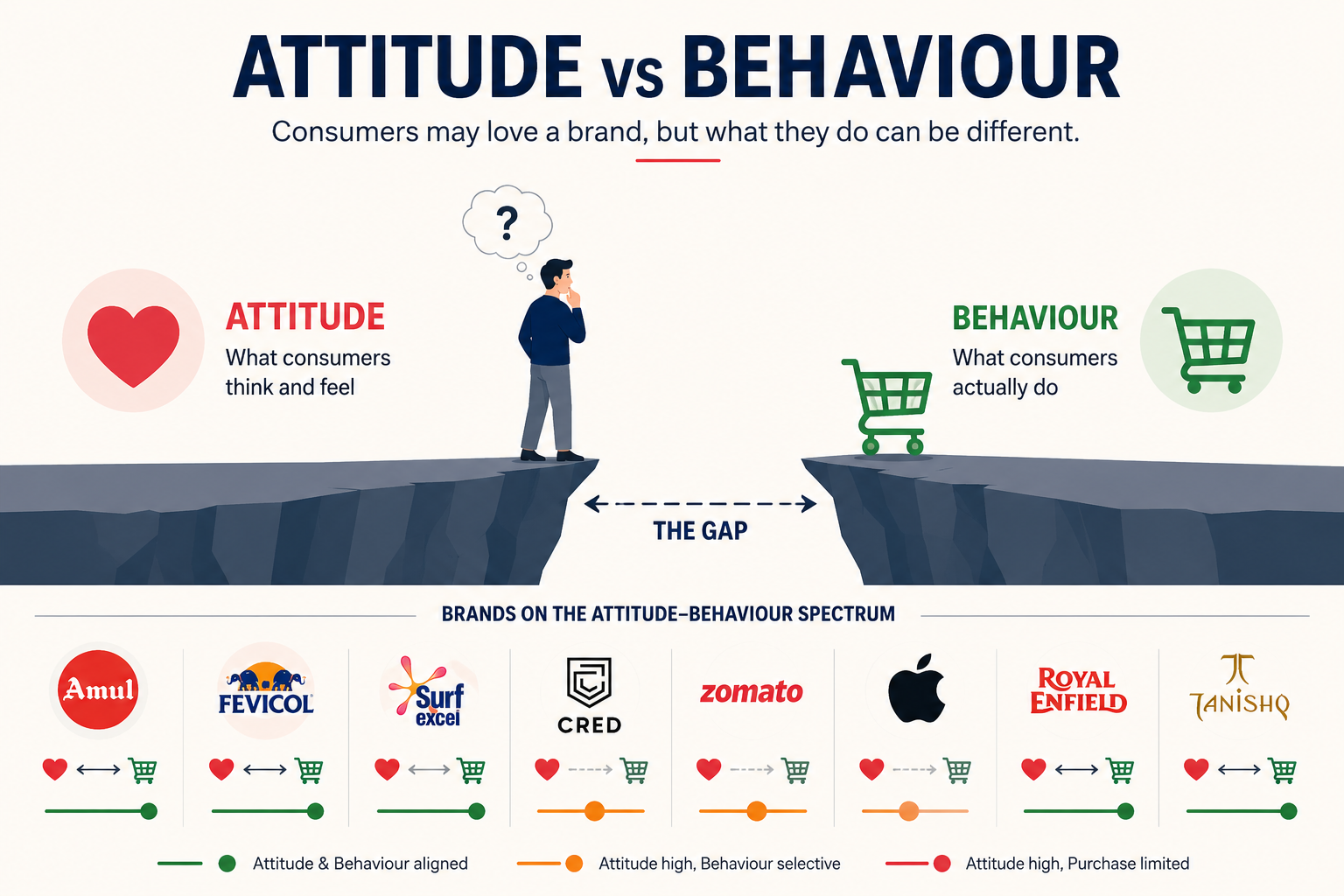
Consumers may say they love a brand but still buy another. Explore the gap between brand attitude and consumer behaviour through some of India’s most iconic brands.
The Curious Gap Between Attitude and Behaviour
A fascinating contradiction lies at the heart of marketing. Consumers can say they love a brand and still buy something else. They can admire an advertisement without ever purchasing the product. They can repeatedly buy a brand without feeling particularly attached to it.
This is the gap between attitude and behaviour.
Attitude is what consumers think and feel about a brand. Behaviour is what they actually do. Ideally, the two should move together, but often they don’t.
A consumer may describe a brand as innovative, trustworthy or aspirational, yet choose a competitor at the point of purchase. Another may buy a brand every month simply because it is familiar or easily available, without having any strong preference for it.
For marketers, this difference is critical. What consumers say can reveal potential. What they do reveals what is actually happening.
When Liking Doesn’t Lead to Buying
Consider Apple. – For millions of Indian consumers, Apple represents design, innovation, status and premium technology. Many consumers admire the brand long before they own one of its products.
A consumer may say:
- “I really want an iPhone.”
- “Apple products are better designed.”
- “I would love to own a MacBook.”
But the purchase may still not happen.
Price, family priorities, existing device ecosystems or the perceived value of competing smartphones can prevent that positive attitude from becoming behaviour.
This creates an important marketing opportunity.
The problem isn’t necessarily that the consumer needs to like Apple more. They already do.
The question is: What is stopping admiration from becoming action?
When Attitude and Behaviour Work Together
At the other end of the spectrum are brands where what consumers think and what they do reinforce each other.
Amul: Familiarity, Trust and Everyday Behaviour
Amul is a good example of how a brand can become embedded in everyday life.
Over decades, the brand has built associations with trust, familiarity, Indian identity and value. Its distinctive topical advertising has also kept the brand culturally visible.
For many consumers, there is little distance between their perception of Amul and their behaviour towards it.
They trust the brand.
They recognise the brand.
And they buy the brand.
That combination is extremely powerful.
However, even a high-frequency purchase should not automatically be labelled emotional loyalty. Some consumers may choose Amul because it is available, familiar and reasonably priced.
The marketer’s job is to understand what is actually driving the purchase.
Fevicol: From Functional Benefit to Cultural Meaning
Fevicol demonstrates another route to building a strong relationship between attitude and behaviour.
At its simplest, the product is an adhesive. But the brand has turned the functional proposition of “strength” into a memorable cultural idea.
Its advertising has repeatedly used humour and exaggerated situations to dramatise the idea that things simply refuse to come apart.
Over time, “Fevicol” has become much bigger than a product name.
The brand has created:
- Strong memory structures
- A distinctive advertising property
- Cultural familiarity
- A clear functional association
- A personality that competitors find difficult to replicate
When a brand becomes mentally available at the moment of purchase, attitude has a much better chance of influencing behaviour.
Surf Excel: When a Product Becomes a Point of View
Surf Excel provides another example of how communication can change the way consumers perceive a category.
The “Daag Achhe Hain” platform reframed stains. Instead of presenting every stain simply as a problem, the brand associated them with childhood, play, learning and experiences.
The communication created an emotional reason to think differently about the brand.
But advertising alone cannot sustain the relationship.
Parents may appreciate the campaign, but the detergent still has to clean clothes effectively.
This is an important principle of brand building:
Communication creates meaning. Experience validates it.
A strong attitude can encourage trial and preference. A strong product experience gives consumers a reason to continue choosing the brand.
CRED: When Attitude Can Run Ahead of Behaviour
CRED illustrates a more contemporary version of the attitude-behaviour gap.
Its advertising has consistently used humour, celebrities and unexpected creative executions to make a relatively functional financial service culturally interesting.
People may remember the advertisements.
They may share them.
They may discuss them.
They may even like the brand’s personality.
But liking CRED’s communication is not the same as becoming a regular CRED user.
This distinction is increasingly important in the digital age.
A brand can generate enormous:
- Awareness
- Social conversation
- Advertising recall
- Engagement
- Cultural relevance
without generating an equivalent level of purchase or usage.
Attention is an ingredient of brand building, not proof of brand success.
Zomato: The Consumer Who Switches With the Situation
Food delivery provides an interesting contrast.
A consumer may say that Zomato is their preferred platform. But when they are hungry and ready to order, behaviour can be influenced by the immediate situation.
The consumer may choose another platform because:
- The restaurant is offering a better deal.
- Delivery is faster.
- A coupon is available.
- The preferred restaurant isn’t listed.
- The total bill is lower.
- The app experience is more convenient.
The consumer hasn’t necessarily changed their attitude towards Zomato.
They have simply changed their behaviour because the circumstances changed.
This is situational loyalty.
It is particularly common in categories where switching costs are low, and alternatives are only a tap away.
Royal Enfield: When the Brand Becomes Part of Identity
Royal Enfield represents a very different kind of relationship.
For many riders, the motorcycle is not merely a means of transportation. It can represent individuality, adventure, heritage and belonging to a particular community.
This gives the brand an important advantage.
A consumer may know that another motorcycle offers better mileage, lower maintenance costs or greater practicality.
Yet the consumer may still choose Royal Enfield.
Why?
Because the decision is not entirely functional.
The consumer may be buying:
- A sense of identity
- A lifestyle
- A feeling of freedom
- Heritage
- Community
- Status within a particular social group
Here, attitude becomes powerful enough to influence behaviour.
The product is being chosen not only for what it does, but for what it means.
Tanishq: When Trust Converts Aspiration Into Purchase
Jewellery is a category where attitude can remain dormant for a long time before becoming behaviour.
Tanishq has built strong associations around trust, design and contemporary Indian jewellery.
A consumer may admire the brand for years without buying anything.
Then an occasion arrives.
A wedding.
An anniversary.
A festival.
A significant family milestone.
Suddenly, an existing positive attitude becomes a purchase.
This shows that consumer behaviour is often context-dependent.
The brand may have already won the consumer’s mind. The purchase happens when need, occasion, affordability, and opportunity come together.
Four Types of Consumer Relationships
Looking only at sales or brand preference can hide these differences. A simple attitude-behaviour framework helps reveal them.
1. High Attitude + High Behaviour
The consumer likes the brand and buys it.
This is the strongest position. Preference, experience and purchase reinforce one another.
2. High Attitude + Low Behaviour
The consumer likes the brand but doesn’t buy it.
This represents potential.
The marketer needs to identify the barrier:
- Price
- Availability
- Lack of trial
- Habit
- Product fit
- Lack of urgency
3. Low Attitude + High Behaviour
The consumer buys the brand but doesn’t feel particularly strongly about it.
This is a vulnerable position.
The behaviour may be driven by:
- Convenience
- Habit
- Distribution
- Price
- Lack of alternatives
A competitor can potentially disrupt the relationship quite easily.
4. Low Attitude + Low Behaviour
The consumer neither feels strongly about the brand nor buys it.
This is usually the least attractive relationship and requires the brand to establish awareness, relevance and differentiation.
The Danger of Confusing Advertising Success With Brand Success
Modern marketing has created another problem.
A campaign goes viral.
The celebrity becomes a talking point.
Millions of people watch the film.
Social media is full of comments.
The brand trends.
Everyone celebrates.
But what happened to the brand?
Did consideration increase?
Did trial increase?
Did sales increase?
Did repeat purchase increase?
Did consumers become more willing to choose the brand?
These are harder questions.
A campaign can be creatively successful and commercially unsuccessful. It can also be culturally successful while having little effect on purchase behaviour.
That does not make advertising irrelevant.
It simply means advertising effectiveness and brand effectiveness are not always the same.
Discounts Can Create Behaviour Without Creating Loyalty
The opposite problem occurs when marketers look only at sales.
A consumer buys a product because it is heavily discounted.
Sales increase.
The brand reports more buyers.
But what happens when the promotion disappears?
If the consumer continues buying, the promotion may have helped establish trial and habit.
If the consumer immediately moves to another brand, the promotion may have simply purchased a transaction.
This distinction is particularly relevant in India’s highly promotional retail environment.
Discounts can be excellent tools for:
- Trial
- Customer acquisition
- Inventory movement
- Short-term volume
- Switching consumers from competitors
But they do not automatically create loyalty.
A sale is behaviour. It is not necessarily preference.
Habit Is Not Always Loyalty
Repeat purchase is another metric that can mislead marketers.
Imagine a household buying the same detergent for ten years.
Is the family loyal?
Perhaps.
But perhaps the product is simply what they have always bought.
Nobody has actively evaluated alternatives. The neighbourhood store stocks it. The family knows the price. There has never been a compelling reason to change.
That is habit.
Habit can be extremely valuable to a brand, but it is different from active preference.
A competitor can break the habit through:
- A better product
- A compelling promotion
- Greater convenience
- Better availability
- A strong recommendation
- A new product format
- An attractive trial proposition
The moment consumers reconsider the category, the strength of the existing relationship becomes visible.
What Should Marketers Measure?
If brands want to understand the relationship between attitude and behaviour, they need to measure both.
Useful indicators include:
- Awareness
- Consideration
- Preference
- Purchase intention
- Trial
- Actual purchase
- Purchase frequency
- Repurchase
- Switching
- Recommendation
- Satisfaction
- Price sensitivity
- Perceived differentiation
- Willingness to pay a premium
The most interesting insight often comes from the contradictions.
High preference + low purchase
There is desire, but something is blocking conversion.
Low preference + high purchase
The brand has behavioural momentum but may be vulnerable.
High preference + high purchase
Attitude and behaviour are reinforcing each other.
Low preference + low purchase
There is little meaningful relationship with the brand.
India’s Consumer Is Becoming Harder to Hold
The Indian consumer has more choice than ever.
A person can discover a brand on Instagram, watch a YouTube review, compare prices on an e-commerce platform, read customer reviews, check availability on quick commerce and complete the purchase within minutes.
This has compressed the consumer journey.
The distance between awareness and trial has become shorter.
But the distance between trial and switching has also become shorter.
A consumer who once stayed with a brand because there were few alternatives can now switch with almost no effort.
That makes genuine preference increasingly valuable.
The Question Is Not “Do Consumers Love Us?”
Perhaps the most useful question a marketer can ask is not:
“Do consumers love our brand?”
It is:
“What does that love make them do?”
Do they choose the brand when alternatives are available?
Do they pay a premium?
Do they recommend it?
Do they search for it?
Do they forgive an occasional mistake?
Do they buy it again?
Do they actively reject competing brands?
These behaviours provide stronger evidence of brand strength than a simple statement of liking.
The same principle applies in reverse.
If consumers repeatedly buy a brand but cannot explain why they prefer it, marketers should investigate what is actually holding the relationship together.
It could be genuine preference.
It could be habit.
It could be convenience.
Or it could simply be the absence of a better alternative.
From Attitude to Action
The strongest brands connect what consumers think, feel, choose and experience.
Amul has built familiarity and trust into everyday consumption. Fevicol has turned a functional benefit into cultural memory. Surf Excel has connected a product category with an emotional point of view. CRED demonstrates the power of attention and brand personality. Zomato shows how behaviour can shift with context and convenience. Apple demonstrates how aspiration can exist before ownership. Royal Enfield shows how identity can influence purchase. Tanishq illustrates how trust and occasion can turn a long-held attitude into action.
They are very different brands.
But they all demonstrate the same fundamental truth.
A brand does not live in a consumer’s mind alone. It eventually has to show up in the consumer’s behaviour.
A consumer may admire your brand.
They may remember your advertising.
They may follow you online.
They may even say they love you.
But the real test comes when they have to choose.
Because ultimately, the strongest brands don’t merely win hearts or wallets. They connect the two.




1 Comment