When Customers Feel More Than a Transaction: 9 Signs of a Healthy Brand-Customer Relationship
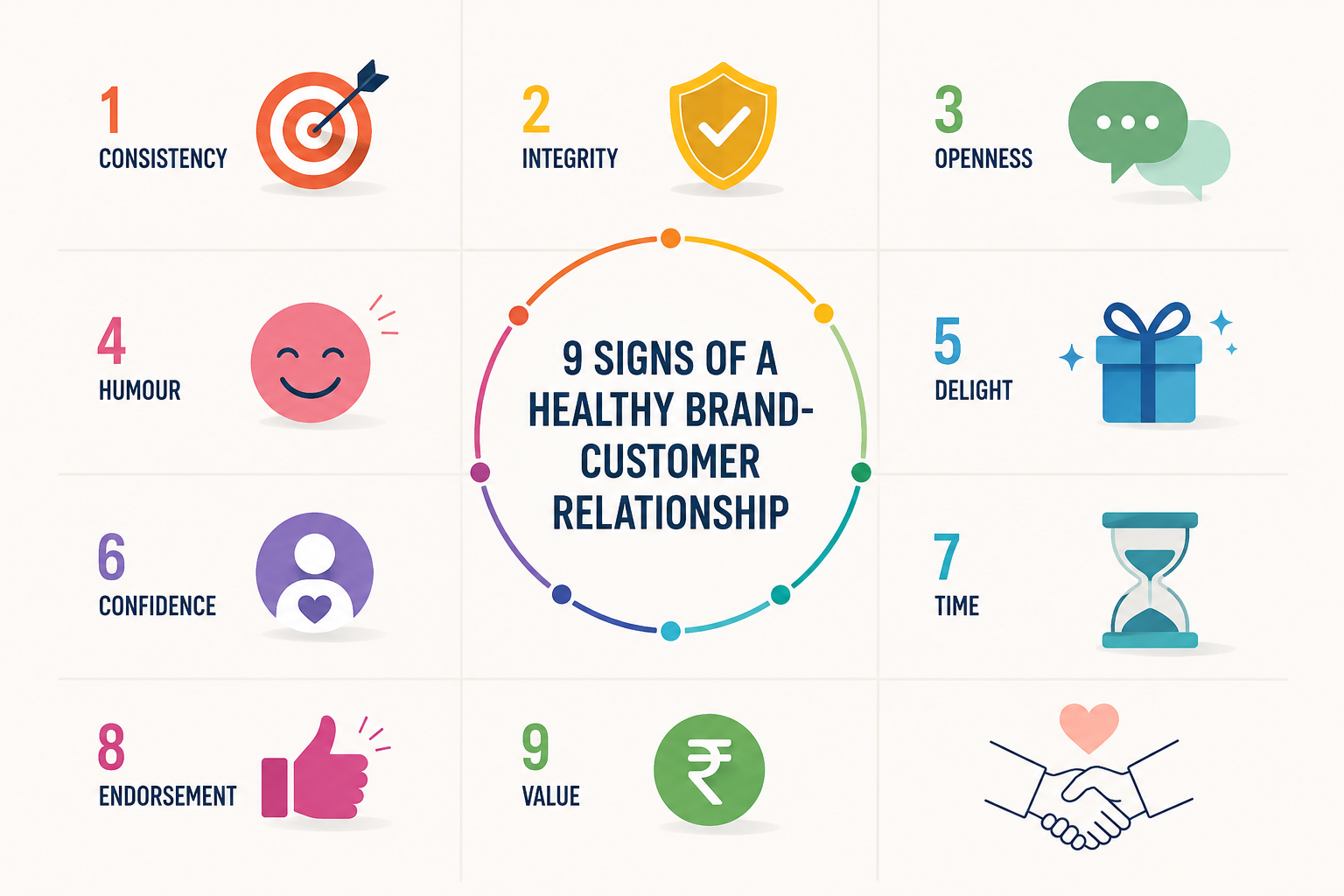
A strong brand customer relationship goes beyond transactions. Here are nine signs of a healthy relationship, with lessons from some of India’s most successful brands.
A customer buys a product. They use it. They pay for it. And then they move on.
That is the basic transaction.
But some brands manage to become much more than transactions. They become part of people’s routines, conversations, memories and even identities.
We don’t simply buy Amul. We grew up with its humour, topical advertising, and familiar voice. We don’t merely see Fevicol as an adhesive. Its advertising has made “strong bonding” almost synonymous with the brand. And when someone talks about Royal Enfield, the conversation is rarely limited to the specifications of a motorcycle.
This is where the difference between a customer and a relationship becomes important.
A customer can buy from you once. A relationship develops when the customer begins to understand what the brand stands for, trusts what it will deliver and feels that the interaction gives them something beyond the product itself.
The original Branding Strategy Insider article identifies nine characteristics that can indicate a healthy relationship between a brand and its customers. This article builds on those ideas and examines them through the lens of Indian consumers and brands.
1. Consistency: Customers Know What to Expect
Relationships become comfortable when there is predictability.
That does not mean a brand should never change. It means that while the product, advertising or technology may evolve, the underlying experience remains recognisable.
Think about Amul.


Amul’s advertising has changed with the times, but the basic personality has remained remarkably consistent: topical, witty, Indian and culturally aware. The Amul Girl has commented on everything from politics and sport to films and social trends. Amul itself traces the topical campaign back to the 1960s, when the advertising moved towards commenting on current events.
That consistency gives the brand a distinctive voice.
The same principle applies to brands such as Fevicol. The situations in its advertisements change, but the fundamental idea remains the same: a bond so strong that it becomes almost impossible to break. Pidilite continues to showcase decades of Fevicol advertising on its own website.
Consistency creates reassurance.
For brands, this means:
- Keep the core brand promise stable.
- Make sure advertising and actual experience do not contradict each other.
- Maintain consistency across stores, websites, apps and social media.
- Allow the brand personality to evolve without abandoning its recognisable character.
- Build distinctive assets that people can recognise quickly.
A customer should not have to rediscover the brand every time they interact with it.
2. Integrity: Say What You Mean and Do What You Say
Trust is difficult to build and remarkably easy to lose.
A brand demonstrates integrity when there is a reasonable match between its communication and its behaviour.
Consider Tanishq.


Over the years, Tanishq has tried to position itself around craftsmanship, trust and a contemporary interpretation of Indian jewellery. Its communication has often tried to reflect changing Indian attitudes towards marriage, family, relationships, and identity.
The larger lesson is that communication becomes more credible when it feels connected to what the brand actually represents.
The opposite is equally true.
If a brand talks endlessly about customer care but makes customers spend hours resolving a simple complaint, the advertising eventually becomes irrelevant.
Customers increasingly ask a simple question:
“Does this brand actually behave the way it says it does?”
Integrity means making sure the answer is yes.
3. Openness: Let Customers Into the Conversation
The traditional model of marketing was largely one-way.
The brand spoke.
The customer listened.
That model has disappeared.
Today, customers review products, create content, compare prices, complain publicly, recommend alternatives and challenge brands directly. Social media has effectively turned customers into participants in the brand conversation.
Zomato is a good example of a brand that understood how communication was changing. Its social presence has often adopted a conversational and self-aware tone rather than sounding like conventional corporate advertising.
The lesson goes beyond witty social media posts.
Openness means:
- Listening to customer feedback.
- Responding to criticism rather than hiding from it.
- Explaining decisions when appropriate.
- Acknowledging mistakes.
- Allowing customers to influence product and service improvements.
- Treating complaints as information rather than simply problems.
Customers do not expect brands to be perfect.
They increasingly expect honesty.
4. Humour: Give People a Reason to Smile
Not every brand needs to be funny.
But brands that can make people smile often become more memorable.
India provides some excellent examples.
Amul has built an extraordinary brand asset around topical humour.
Fevicol has used absurdity, exaggeration and everyday Indian situations to make an adhesive memorable. The famous bus commercial turned the functional benefit of “strong bonding” into an exaggerated visual joke. The commercial has subsequently become one of the brand’s most recognised pieces of advertising.


Then there is CRED.
CRED took a relatively mundane financial behaviour, paying credit-card bills, and surrounded it with celebrities, irreverence and unexpected humour.


The important thing about humour is that it should belong to the brand.
A joke that any competitor could make does little to build distinctive brand equity.
Good brand humour makes people think:
“That is so them.”
5. Delight: Give Customers Something They Did Not Expect
Satisfaction means the brand delivered what was promised. Delight begins when it delivers something extra. This does not necessarily mean giving away free products.
It could be an unexpectedly thoughtful service interaction, a useful recommendation, a clever piece of communication or an experience that makes the customer feel understood.
Apple has built much of its brand experience around this principle. The product is obviously central, but the retail environment, packaging, interface and wider ecosystem all contribute to the perception of an integrated experience.


Indian brands can create delight in much simpler ways.
- A restaurant remembering a customer’s preference.
- A bank resolving a problem without making the customer repeat the entire story.
- An e-commerce brand making returns genuinely painless.
- A D2C brand adding a thoughtful note to an order.
Small moments can have disproportionate impact.
In a world where more customer interactions are becoming automated, human thoughtfulness can become a competitive advantage.
6. Confidence: Customers Need to Believe in the Brand
Confidence works in both directions. Customers need confidence that the brand will deliver. The brand, meanwhile, needs confidence in what it stands for.
Royal Enfield is a useful example.


Its appeal is not simply about engine capacity or mileage. The brand has developed a strong sense of identity around motorcycling, exploration, heritage and community. Its organised rides and events reinforce that broader culture around the motorcycle.
That is powerful because confidence creates commitment.
A confident customer does not constantly ask:
“Should I try another brand?”
They are more likely to say:
“This is the brand for me.”
Brands build confidence through:
- Reliable product performance.
- Clear positioning.
- Consistent service.
- Transparent policies.
- Strong customer support.
- Evidence that other customers trust the brand.
- A distinctive point of view.
Confidence reduces the perceived risk of choosing the brand again.
7. Time: Good Relationships Cannot Always Be Rushed
Modern marketing is obsessed with immediacy.
- Instant delivery.
- Instant responses.
- Instant payments.
- Instant recommendations.
Speed is valuable, but relationships sometimes require something else: time.
A customer may need time to understand a product. They may need time to make a decision. They may need a brand to listen before offering a solution.
This is particularly relevant for categories involving high consideration, such as automobiles, jewellery, financial services, education and healthcare.
A salesperson who immediately pushes for a purchase can create pressure.
A salesperson who understands the customer’s needs and gives them room to decide can create trust.
Time is therefore not simply an operational issue. It is a relationship signal.
Sometimes the best customer experience is not:
“How quickly can we close this sale?”
It is:
“How well can we help this person make the right decision?”
8. Endorsement: Customers Start Selling the Brand
The strongest form of advertising often comes from people who have nothing to gain from selling you the product.
A friend recommending a restaurant.
A colleague explaining why a particular laptop is worth buying.
A rider talking enthusiastically about a motorcycle.
A parent recommending a school.
A pet parent recommending a particular food brand.
That is endorsement.
Word of mouth has always mattered in India. Family recommendations, neighbourhood conversations and community opinion have traditionally influenced purchase decisions. Digital platforms have simply amplified this behaviour.
Today, endorsement can take many forms:
- Google reviews.
- Instagram posts.
- YouTube reviews.
- Reddit discussions.
- WhatsApp recommendations.
- Customer testimonials.
- User-generated content.
- Referrals to friends and family.
A healthy brand relationship eventually produces advocates.
And advocacy is different from loyalty.
A loyal customer may continue buying.
An advocate actively tells somebody else why they should buy.
9. Value: The Customer Should Feel the Exchange Was Worthwhile
Value is often reduced to price. That is a mistake.
A customer can pay a premium and still feel they received excellent value. Another customer can buy something cheaply and still feel cheated. Value is the relationship between what the customer gives and what the customer believes they receive in return.
For Apple, value may include design, usability, ecosystem and the overall experience.
For Tanishq, it may involve craftsmanship, trust and the emotional significance of jewellery.
For Zomato, it may involve convenience, discovery and access.
For Fevicol, it is ultimately functional performance, but the brand adds memorability and personality to an otherwise ordinary product category.
Value therefore has several dimensions:
- Functional value: Does it work?
- Economic value: Is it worth the money?
- Emotional value: Does it make me feel something?
- Social value: Does it say something about me?
- Experiential value: Is the experience enjoyable or convenient?
- Symbolic value: Does the brand represent something I believe in?
The crucial question is not simply:
“Was the product worth the money?”
It is:
“Did the overall experience feel worth what I gave up?”
Loyalty Is Not Always the Same as Relationship
This distinction is important.
A customer can buy from a brand frequently without particularly liking it.
Someone may repeatedly use a particular telecom provider because changing networks is inconvenient. Someone may continue using a bank because their salary account is linked to it. Someone may purchase a product because it is the cheapest available option.
That is behaviour. It is not necessarily affection, trust or loyalty. Conversely, someone can feel strongly about a brand without purchasing from it every month.
A Royal Enfield enthusiast may not buy a motorcycle every year. A Tanishq customer may purchase jewellery only occasionally. Someone may love Apple products but upgrade only every few years.
Purchase frequency therefore tells only part of the story.
A healthier way to assess a brand-customer relationship is to ask:
- Does the customer trust us?
- Does the customer remember us?
- Does the customer recommend us?
- Does the customer forgive an occasional mistake?
- Does the customer actively choose us when alternatives are available?
- Does the customer feel that the brand understands them?
- Does the relationship create value for both sides?
The Indian Consumer Is Not Just Looking for a Product
India’s consumer landscape has changed dramatically.
Today, Indian customers have more brands, more information, and more choices than ever before. Price comparisons are easier. Reviews are everywhere. Competitors can appear on a customer’s phone within seconds.
That makes relationships more important, not less.
Consider how different Indian brands have built emotional connections:
Amul turned topical advertising into a cultural conversation. Its own history describes how the Amul Girl became a recurring part of Indian popular culture.
Fevicol made an everyday adhesive memorable through humour and distinctive storytelling. Its advertising has consistently translated the product benefit into entertaining situations.
Surf Excel moved beyond detergent performance to talk about relationships, childhood and social behaviour.
CRED made an otherwise functional financial behaviour entertaining and culturally relevant.
Zomato turned a food-delivery platform into a recognisable voice in popular culture.
Royal Enfield transformed a motorcycle into a lifestyle and community proposition.
Tanishq connected jewellery with changing Indian attitudes towards relationships, family and identity.
These brands demonstrate an important principle:
The strongest relationships are rarely built through product features alone.
What Brands Should Measure Beyond Sales
If customer relationships are the goal, traditional sales metrics are not enough.
Brands should also pay attention to signals such as:
- Repeat purchase behaviour.
- Referral rates.
- Customer complaints and how they are resolved.
- Organic recommendations.
- Social conversations.
- Customer reviews.
- Brand consideration.
- Willingness to pay a premium.
- Customer retention.
- Emotional association with the brand.
- Participation in brand communities.
- Customer advocacy.
Most importantly, brands should examine the quality of customer interactions, not simply their quantity.
A million transactions do not automatically mean a million relationships.
From Transactions to Relationships
The biggest shift for marketers is perhaps conceptual. A transaction asks: “What can we sell this customer?”
A relationship asks: “Why should this customer want to stay with us?”
That is a much harder question.
It requires consistency without becoming predictable, personality without becoming artificial, openness without losing credibility, and commercial ambition without making every interaction feel like a sales pitch.
The healthiest brands eventually become familiar without becoming boring. They become trusted without becoming invisible. They become part of people’s lives without constantly demanding attention. And that may be the real test of brand strength.
When customers have choices, they can still choose you. When they have nothing to buy, they still remember you. And when somebody asks them which brand they would recommend, your name comes naturally.
That is when a customer relationship has become a brand relationship.