The Sameness Tax: What Brands Pay for Following the Category
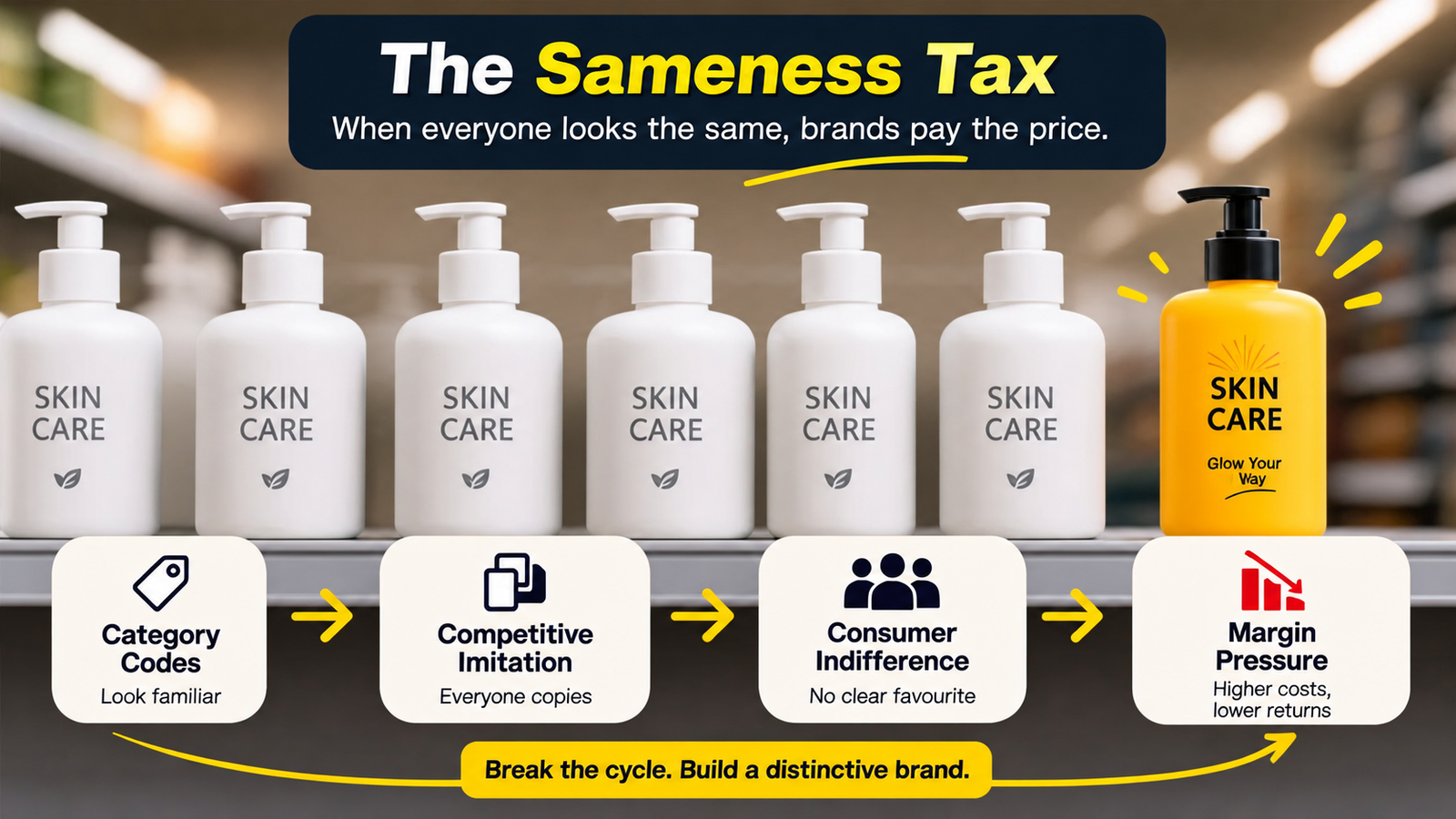
When brands copy the same packaging, influencer strategies and product claims, differentiation becomes expensive. Explore how brand sameness fuels consumer indifference, pricing pressure and declining marketing effectiveness, and discover how businesses can build distinctive identities that drive preference and profitability.
Walk through the skincare aisle of a modern retail store, scroll through Instagram advertisements for direct-to-consumer brands, or browse the websites of competing food delivery services. A curious pattern emerges. Different brands appear to have attended the same marketing school. They use similar colours, follow identical packaging conventions, collaborate with comparable influencers, make familiar claims about quality and performance, and communicate through almost interchangeable language. Everyone promises better living, superior experiences, authentic ingredients, personalised solutions and products designed around the consumer.
At first glance, this similarity seems logical. Businesses watch what works, learn from successful competitors, and adopt practices that reduce the risk of expensive mistakes. A minimalist skincare bottle signals scientific credibility. A premium coffee brand uses restrained typography and earthy colours. A fitness brand employs athletic influencers to demonstrate product benefits. A sustainable business chooses muted greens, recyclable packaging and language about conscious consumption. These conventions provide consumers with familiar signals that help them navigate crowded markets.
However, a strategy that helps consumers recognise a category does not necessarily help them distinguish one brand within it. When too many businesses adopt the same visual cues, product promises and communication styles, the very conventions that once reduced consumer uncertainty begin to increase competitive similarity.
This is where the sameness tax emerges. It is the commercial cost a brand incurs when its similarity to competitors makes it harder to attract attention, justify a price premium, establish a distinctive identity and retain customers without continually increasing marketing expenditure.
The tax rarely appears as a separate line item in the accounts. Instead, it spreads across higher customer acquisition costs, weaker brand recall, greater dependence on discounts, lower pricing power, declining customer loyalty, and the constant need to spend more to stay visible. A brand may execute every accepted category practice correctly and still struggle to build a meaningful competitive advantage.
The central paradox is that following category conventions can make a brand easier to understand while making it harder to choose.
1. Category Codes: Why Brands Learn to Look Alike
Category codes are the recognisable signals that tell consumers what a product is, what it does and which market it belongs to. These signals can be visual, verbal, behavioural or experiential. They include packaging shapes, colour palettes, typography, product demonstrations, advertising formats, pricing structures, retail displays and familiar claims.
Such codes perform an important economic function. Consumers rarely have the time or motivation to investigate every available product from first principles. They rely on shortcuts, especially in categories where products are unfamiliar, technical, or hard to evaluate before purchase.
For example, a white coat in a pharmaceutical advertisement communicates medical authority, while clinical typography and ingredient-led packaging suggest scientific rigour in skincare. A black-and-gold colour scheme often signals luxury, while bright colours and playful illustrations can suggest accessibility and fun. These conventions let brands communicate meaning quickly, sometimes before consumers read a single word.



Category codes also help new entrants establish legitimacy. A startup entering premium skincare may adopt clean packaging, transparent ingredient lists and restrained product descriptions because these cues reassure prospective customers that the business understands the category. A new speciality coffee brand may invest in origin stories, tasting notes and carefully designed bags because these conventions help consumers recognise the product as premium coffee rather than an ordinary commodity.
The difficulty begins when brands confuse the codes required to participate in a category with the characteristics required to win within it.
Consider three strategic decisions:
- Category recognition: Using familiar signals so consumers understand what the brand offers.
- Competitive differentiation: Creating distinctive associations that help consumers distinguish the brand from alternatives.
- Commercial preference: Giving consumers a reason to choose the brand, return to it, and potentially pay more.
These objectives overlap, but they are not interchangeable. A brand can be highly recognisable as a member of its category without being memorable as an individual brand. It can also be visually distinctive without offering a compelling reason to buy.
The strategic challenge, therefore, is not to abandon category codes altogether. It is to identify which conventions are necessary for comprehension and which can be challenged to create a commercially valuable difference.
2. Competitive Imitation: When Success Becomes a Template
Marketing imitation is not new. Businesses have always studied competitors, borrowed successful ideas and adapted emerging practices. What has changed is how quickly successful marketing patterns spread and how easily they can be reproduced.
Competitors’ packaging can be photographed, their advertisements analysed, their influencers identified, and their product claims catalogued. Social media platforms make successful creative formats visible to entire industries. E-commerce marketplaces expose competing prices, product descriptions, ratings and promotional tactics. Agencies often serve multiple brands within the same category, carrying familiar creative approaches from one client to another.
The result is an increasingly compressed cycle between innovation and imitation. A brand introduces a distinctive approach, competitors observe its apparent success, and the market gradually absorbs the idea until it becomes an expectation rather than a differentiator.
How imitation spreads across four dimensions
1. Visual imitation
A successful visual identity becomes a category template. Competitors adopt similar colours, typography, photography and packaging structures. In the process, distinctive design choices become generic category signals.
The rise of minimalist D2C branding illustrates the risk. Clean layouts, restrained colours, generous white space and simple typography can make products appear contemporary and premium. But when every challenger adopts the same aesthetic, minimalism no longer guarantees distinction. The shelf becomes a collection of brands that look individually refined but collectively interchangeable.
2. Verbal imitation
Brands frequently converge around the same vocabulary: natural, clean, authentic, innovative, conscious, personalised, premium and science-backed. Each term may have a legitimate meaning, but repeated without distinctive evidence, these claims become background noise.
Consider the skincare market. If every brand claims to be dermatologically tested, science-backed, and formulated with effective ingredients, consumers have little reason to prefer one brand based on language alone. The differentiating question shifts from what the brand claims to what it can substantiate, explain and consistently deliver.
3. Influencer imitation
Influencer marketing often follows a predictable pattern: product unboxing, personal testimonial, demonstration, discount code and a purchase recommendation. Once the format becomes familiar, the content may generate exposure without creating meaningful brand associations.
Imagine five competing protein brands using similar fitness creators, gym settings, transformation narratives and discount codes. Each brand reaches an apparently relevant audience, yet consumers may remember the creator, the category benefit or the promotional offer more readily than the specific brand being advertised.
4. Product and positioning imitation
Businesses also imitate product architecture, feature combinations, subscription models, benefit claims and positioning statements. One brand introduces a convenient format, a functional ingredient or a new usage occasion, and competitors quickly replicate it.
The danger is particularly acute when the original advantage is easy to reproduce. If every brand offers the same ingredients, similar pack sizes, comparable delivery promises and nearly identical benefits, consumers have fewer meaningful reasons to pay a premium.


The irony is that every brand may be making a rational decision individually. Copying a successful practice reduces uncertainty. Collectively, however, these decisions erode the practice’s value.
What is commercially sensible for one competitor can become commercially destructive when the entire category adopts it.
3. Consumer Indifference: When Difference Disappears
The next stage in the sameness tax is consumer indifference. This does not necessarily mean that customers dislike the products. It means they struggle to identify a meaningful difference between them.
Consumers can be satisfied with a category and still remain indifferent to individual brands. They may appreciate the convenience of online grocery shopping, the effectiveness of skincare or the functionality of a fitness supplement without developing a strong preference for any particular provider.
When brands communicate similar promises and appear to offer comparable value, consumers simplify their decisions. They may choose whichever product is cheaper, more accessible, better rated, or most visible at the time of purchase.
Three consequences of consumer indifference
- Brand recall weakens. Consumers encounter many advertisements but retain few distinctive brand associations. Exposure increases without a corresponding improvement in memory. A business may achieve impressive reach and engagement metrics while still being absent from the consumer’s mind when they make a purchase decision.
- Brand preference becomes fragile. Consumers may purchase a product because of a temporary discount, a creator’s recommendation or a convenient marketplace listing rather than a durable preference for the brand. When a competing offer appears, switching becomes easy because the original purchase was not anchored in a distinctive perceived value.
- Price becomes a substitute for differentiation. When consumers cannot identify a compelling reason to choose one brand over another, price becomes an increasingly convenient decision rule. Discounts, bundles, cashback and promotional codes then do the work that brand preference should have done.
Consider the Indian packaged food market. A consumer browsing for packaged snacks may encounter numerous products claiming authentic flavours, high-quality ingredients, convenience and great taste. These are legitimate expectations, but they are not necessarily differentiating propositions. A brand that builds a recognisable identity around a particular regional food culture, a distinctive consumption ritual, or a demonstrably superior product experience is better positioned to create meaningful associations.
The same principle applies to personal care, electronics, apparel and pet wellness. Consumers do not always need more features or stronger adjectives. They need a reason to believe that one brand is meaningfully more appropriate for their needs.
The difference between satisfaction and preference
A satisfied customer is not automatically loyal. Satisfaction reflects an evaluation of an experience; preference reflects a comparative inclination to choose one option over others.
A brand can deliver an excellent product and still struggle with loyalty if competitors deliver similar experiences. Product quality may be necessary to stay in consideration, but in a crowded market, quality alone may not create a compelling reason to return.
This matters most in categories where consumers can’t easily evaluate functional performance in advance. They may rely on reviews, influencers, familiar claims or price because the underlying differences are unclear. Brands that explain their value in credible, specific, and memorable ways can reduce this uncertainty and create stronger reasons to choose.
The objective is not to manufacture artificial differences. It is to make genuine differences easier to recognise, understand and value.
4. Margin Pressure: The Financial Cost of Sameness
Consumer indifference eventually becomes an economic problem. When customers perceive little difference between competing offerings, brands have less freedom to charge a premium. They must work harder to attract attention, persuade customers to try their products and encourage repeat purchases.
The resulting pressure can affect several components of the business model.
- Higher acquisition costs: Brands spend more on advertising, promotions and influencers to generate the same level of customer interest.
- Lower pricing power: Premium prices become harder to defend when alternatives appear comparable.
- Greater promotional dependence: Discounts and offers become routine rather than occasional tools for stimulating demand.
- Weaker retention: Customers switch more readily when competitors offer a lower price or a more convenient buying experience.
- Reduced marketing efficiency: Advertising generates reach and traffic but fails to build distinctive, durable brand associations.
These effects can reinforce one another. Lower margins reduce the resources available for product development, customer research, and distinctive brand building. The business then relies even more heavily on familiar promotional tactics, further increasing its similarity to competitors.
An illustrative example: The discount trap
Consider two fictional skincare brands, A and B. Both offer a moisturiser with comparable ingredients, similar packaging, nearly identical claims and similar influencer-led campaigns. Each sells the product for ₹999.
Brand A invests in discounts to attract customers. Brand B responds with a competing offer. Consumers become accustomed to buying only during promotional periods, and the original price gradually loses credibility.
The following figures are illustrative, not actual market data.
How sameness can erode contribution
Illustrative economics for one moisturiser, per unit sold.
| Metric | Before discounting | After discounting |
| List price | ₹999 | ₹999 |
| Average discount | ₹0 | ₹200 |
| Net selling price | ₹999 | ₹799 |
| Product and fulfilment costs | ₹400 | ₹400 |
| Contribution before marketing | ₹599 | ₹399 |
The discount does not merely reduce the selling price. It reduces the funds available for customer acquisition, innovation, and future brand development. If the brand also needs to increase advertising expenditure to maintain sales volumes, the pressure becomes more severe.
This is the financial significance of the sameness tax: the business pays more to attract customers while earning less from each transaction.
The problem is not that discounts are inherently wrong. They can support trials, manage inventory, stimulate seasonal demand and encourage larger baskets. The problem arises when a brand cannot sustain demand without them because consumers see little reason to choose it at full price.
A strong brand does not eliminate price sensitivity. It gives the business more opportunities to compete on something other than price.
5. When Category Conventions Become Commercial Liabilities
Not every category convention should be challenged. Some exist because they help consumers make informed decisions, fulfil regulatory expectations or navigate products safely. The challenge is distinguishing useful conventions from habits that competitors follow without examining their commercial value.
Four warning signs indicate that category codes may have become liabilities.
- Warning sign 1: Your brand could be mistaken for a competitor
Place your packaging alongside five competing products. Remove the logos and brand names. Can consumers still identify yours through its design, colour, structure or distinctive visual assets? If not, your visual identity may be communicating category membership more effectively than brand identity.
- Warning sign 2: Your claims could belong to anyone
Review your website, advertising and packaging. Replace the brand name with a competitor’s name. If the copy still sounds entirely credible, the communication probably lacks distinctive meaning.
Claims such as premium quality, customer-centric innovation, and scientifically formulated products aren’t necessarily weak. They become weak when they lack specific evidence or when every competitor makes the same promises.
- Warning sign 3: Your campaigns generate engagement but little preference
Views, clicks, likes, and influencer reach are useful indicators, but they don’t independently show that marketing is building a brand. Businesses need to examine whether campaigns improve branded recall, strengthen distinctive associations, increase consideration, and drive profitable repeat purchases.
- Warning sign 4: Your customers buy primarily when prices fall
If conversion rates rise sharply during discounts but full-price sales remain weak, investigate whether customers value the brand or value the offer. Promotional dependence may indicate a pricing problem, but it can also reveal a lack of differentiation.
These warning signs do not prove that sameness is the only cause of weak performance. Distribution, product quality, competitive pricing, customer service and changing demand can also influence results. Their purpose is to identify where further investigation is warranted.
6. Breaking the Sameness Cycle: Five Strategic Responses
The answer is not to become different for its own sake. Unfamiliarity can confuse consumers, increase adoption barriers and weaken category recognition. Effective differentiation requires a clear understanding of which conventions to retain, which to reinterpret and which to abandon.


- Retain the codes that make the category understandable
A brand entering a familiar category should not automatically reject all established conventions. Consumers still need to recognise what the product is and why it matters.
A new sunscreen brand, for example, must communicate sun protection, appropriate usage and credible product information. A pet supplement needs to explain its intended benefit, ingredients and directions for use. These are essential elements of category comprehension, not opportunities for superficial disruption.
The strategic task is to preserve the signals that reduce confusion while finding distinctive ways to express the brand’s value.
- Build differentiation around a specific consumer problem
Generic positioning begins with the category. Stronger positioning often starts with an unmet need, an overlooked customer, or a problem existing solutions address poorly.
Consider the difference between a pet supplement brand promising better health and one that helps pet parents understand a specific nutritional concern through transparent formulations, clear ingredient explanations and evidence appropriate to its claims.
The second approach offers a clearer basis for differentiation because it connects the brand to a specific need and a credible way to address it.
The same principle applies to Indian food brands that build around regional culinary traditions, apparel brands that solve a specific fit problem, and financial services that make complex decisions easier to understand.
- Develop distinctive assets, not just distinctive campaigns
A clever advertisement can attract attention without building long-term memory. Brands need recognisable assets that persist across campaigns and touchpoints.
These might include a distinctive colour combination, a recurring character, a recognisable sound, a particular visual composition, a memorable verbal expression or a consistent way of demonstrating the product.
The objective isn’t to make every campaign look identical. The goal is to create continuity so different executions build meaning rather than starting from zero each time.
- Make proof part of the positioning
When competitors make similar claims, evidence can become a meaningful differentiator. This may include transparent ingredient disclosure, independently verified performance, clear demonstrations, traceable sourcing, documented service standards or credible customer outcomes.
For example, a food brand claiming authenticity can explain its sourcing and preparation methods. A technology company promising reliability can publish relevant performance data. A skincare brand making ingredient-led claims can explain concentrations, formulation rationale and the limits of the available evidence.
Evidence must be relevant and credible. More technical language does not automatically mean more science, just as a longer ingredient list does not automatically mean a better product.
- Measure whether differentiation creates economic value
A distinctive brand identity is not a commercial achievement simply because it looks different. The difference must matter to customers and contribute to business performance.
Track indicators such as:
- Distinctive brand recognition: Can customers identify the brand without being shown its name?
- Unaided brand recall: Does the brand come to mind when consumers consider the relevant category?
- Consideration and preference: Is the brand increasingly included in customers’ shortlists and chosen over alternatives?
- Full-price sales: Can the business sustain demand without frequent discounting?
- Customer retention: Do customers return because they value the brand rather than merely respond to incentives?
- Contribution margin and acquisition efficiency: Is the business generating more profitable customer relationships from its marketing investment?
No single measure proves differentiation has succeeded. The strongest assessment combines consumer research with sales, retention and profitability data over time.
7. A Practical Framework: From Category Codes to Commercial Advantage
The sameness tax can be understood through four connected stages.
Stage 1: Category Codes
Brands adopt familiar packaging, claims, language and marketing practices to establish legitimacy and reduce consumer uncertainty.
Stage 2: Competitive Imitation
Competitors copy successful conventions until distinctive practices become category expectations.
Stage 3: Consumer Indifference
Consumers struggle to identify meaningful differences, weakening brand preference and making switching easier.
Stage 4: Margin Pressure
Brands become more dependent on promotion, lose pricing power, and pay more to attract and retain customers.
The cycle is not inevitable. A brand can interrupt it by identifying conventions that no longer create value, developing a meaningful point of difference, and consistently reinforcing that difference through its product, communication, and customer experience.
The framework also suggests an important diagnostic question for marketing leaders: Where in the chain is our brand losing its advantage?
If the problem lies in category codes, the brand may need a more distinctive identity. If competitors have copied its proposition, it may need to strengthen its underlying capabilities. If consumers are indifferent, it may need to clarify its value and build stronger associations. If margins are under pressure, it must determine whether pricing, acquisition costs and retention reflect a deeper differentiation problem.
The intervention should address the cause, not merely the symptom.
Conclusion: The Objective Is Not to Look Different. It Is to Be Chosen.
Markets need conventions. They help consumers navigate complexity, establish expectations and evaluate unfamiliar products. The problem begins when brands mistake these conventions for competitive advantage.
A familiar package can earn a second look, but it cannot guarantee preference. A popular influencer can generate reach, but reach alone cannot build loyalty. A compelling claim can attract attention, but if every competitor makes the same promise, the claim loses its power to distinguish.
Brands that escape the sameness tax aren’t necessarily the most unconventional. They understand which category expectations matter, which customer problems remain inadequately addressed, and which differences customers are willing to recognise and reward.
For marketing leaders, this requires moving beyond the question: Does our brand look and sound right for the category? More important questions are: What do consumers remember about us that they don’t associate with competitors? What credible reason do they have to prefer us? And does that preference translate into stronger commercial performance?
Category conventions may help a brand enter the conversation. Differentiation determines whether it remains memorable, desirable and commercially valuable.
In a market where everyone is trying to look like the category leader, the real competitive advantage may belong to the brand that understands the category well enough to know what not to copy.