Pet Abandonment and Surrender: The Hidden Challenge That Could Reshape India’s Pet-Care Industry
India’s rapidly growing pet-care industry faces a less visible challenge: pet abandonment and surrender. From affordability and veterinary costs to behaviour and housing, the issue could reshape the future of pet care in India.
India’s pet-care industry is entering one of its most important growth phases. Pet ownership is expanding beyond the traditional metropolitan markets, consumers are spending more on nutrition and healthcare, premium products are becoming increasingly accessible, veterinary services are becoming more organised, grooming is becoming a regular part of pet care, and an expanding ecosystem of retailers, e-commerce platforms, trainers, boarding facilities, insurers, shelters and pet-tech companies is developing around the Indian pet parent.


Yet beneath this attractive growth story is an issue that could profoundly affect the industry’s future: pet abandonment and surrender.
The industry has become increasingly successful at encouraging Indians to welcome pets into their homes, treat them as family members and spend more on their health and wellbeing. The next and considerably more difficult question is whether the ecosystem can help those families continue caring for their pets when circumstances change. Financial pressure, housing restrictions, behavioural problems, veterinary expenses, lifestyle changes and inadequate preparation for pet ownership can all turn a positive adoption experience into a difficult situation.
This makes abandonment and surrender much more than an animal-welfare concern. It has implications for India’s pet-care industry, veterinary services, shelters, retailers, municipalities, public health, housing communities and consumers. The issue could ultimately influence how the entire pet-care market defines sustainable growth.
A recent report in Petfood Industry highlighted a similar development in the United States, where economic pressures have contributed to increased pet surrender rates and greater demand for shelter resources. Pet companies have responded by providing food assistance and other forms of support. While India’s market and social conditions are very different, the underlying lesson is relevant here too: the pet-care industry cannot focus only on bringing more animals into homes. It also has to help keep them there. The report noted that US shelters were seeing both increased surrender rates and greater demand for pet-food assistance as economic pressures affected pet-owning households.
India Has an Abandonment Problem, Not Just a Stray-Animal Problem
India’s animal-welfare challenge is frequently discussed through the familiar issue of stray dogs and cats. That is undoubtedly a major concern, but it is only part of the picture. Another category of animals deserves considerably more attention: pets that once lived in households and were subsequently abandoned or surrendered.


The State of Pet Homelessness Index estimated that around 80 million dogs and cats were homeless in India. The study also reported a high level of relinquishment among surveyed Indian pet owners, with 50% of current and previous pet owners saying they had relinquished a pet at some point. Around 34% reported abandoning a dog on the streets, while 32% reported abandoning a cat. These figures come from a specific survey rather than a comprehensive national census, but they nevertheless indicate the seriousness of the issue.
The more recent State of Pet Homelessness Index estimates that 69.3 million of an estimated 100 million cats and dogs in India are homeless. The 2024 findings also estimated that more than 60 million homeless pets were living on the streets, while approximately 8.8 million were in shelters.
The numbers vary depending on definitions and methodology, but the broader direction is clear. India is not only dealing with animals that have never had homes. It is also dealing with animals that entered households and subsequently lost them.
That distinction is strategically important for the pet-care industry. A street animal born without an owner represents one type of challenge. An animal that has been adopted, purchased, raised in a household and then abandoned points to a weakness somewhere in the pet ownership ecosystem.
The question, therefore, should not only be how India can find homes for homeless animals. It should also be how the country can prevent animals that already have homes from losing them.
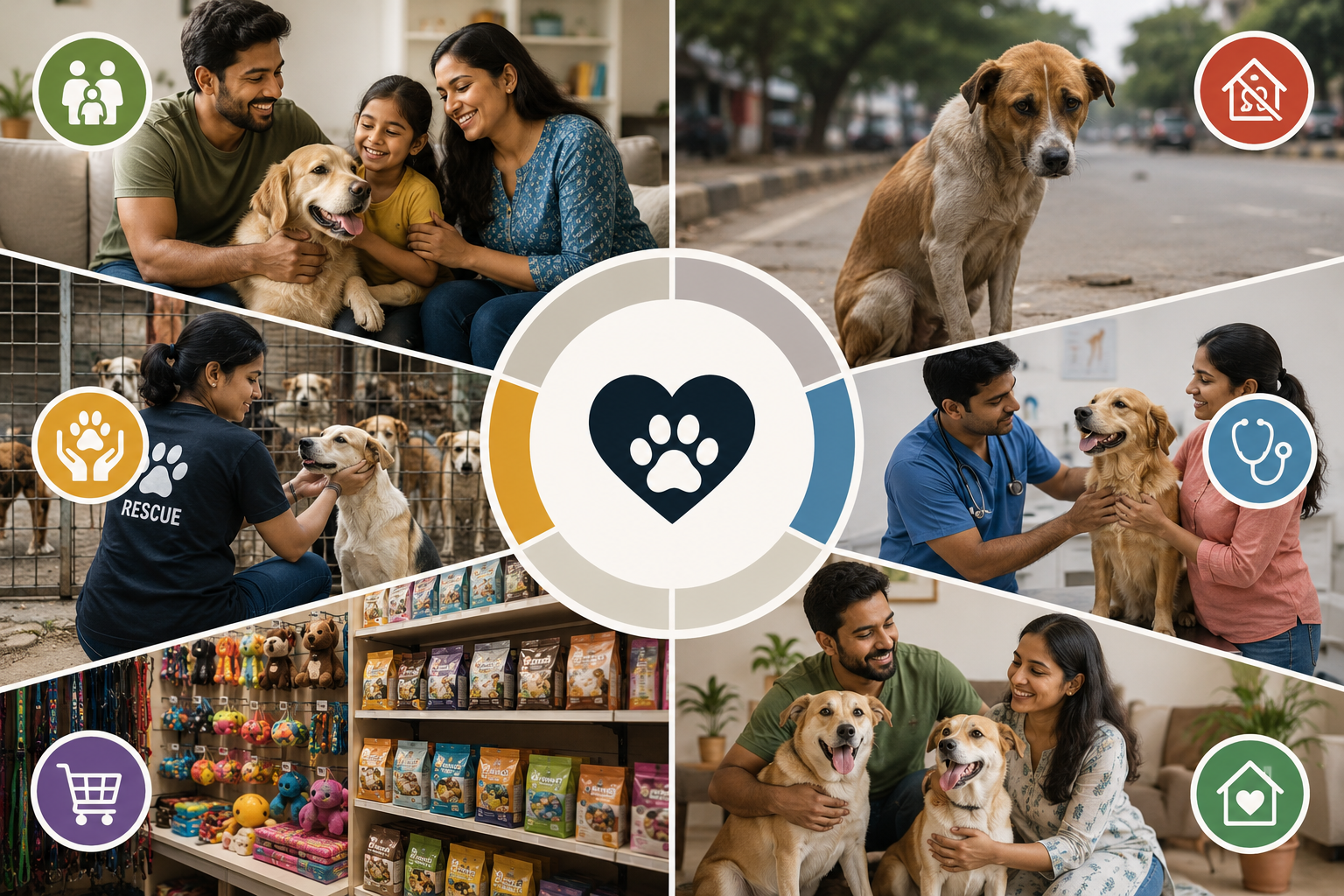
Visual: Indian rescue and shelter environments illustrate the burden created when animals lose homes and become dependent on already stretched welfare networks.
The Market Growth Equation Needs to Change
The Indian pet-care industry has traditionally viewed market opportunity through a fairly straightforward equation. More pets lead to more pet parents, which leads to more spending on food, healthcare, grooming, accessories, supplements and services.
That equation is incomplete.
A pet entering a household is only the beginning of a potentially 10- to 15-year relationship. During that period, the household may purchase food, treats, veterinary services, vaccinations, supplements, grooming, training, boarding, insurance, accessories and a wide range of other products and services.
The economic value of that relationship is therefore created over the pet’s entire lifecycle.
When a pet is abandoned or surrendered after a relatively short period, the consequences are not limited to the emotional and welfare impact on the animal. The entire consumption lifecycle is disrupted. The pet may move into a shelter, be transferred to a foster home, be adopted by another family or remain on the streets. Its patterns of nutrition, healthcare, and other consumption change accordingly.
This suggests a new way of looking at the category. Instead of measuring only how successfully the industry brings people into pet ownership, it should also consider how successfully it supports pet retention within responsible households.
That is a very different growth philosophy.
The Pet Is Often Not the Problem. The Ownership System Is


There is rarely one reason why a pet is abandoned or surrendered. In many cases, several pressures accumulate until the family feels that it can no longer cope.
Financial pressure can make regular food and veterinary care difficult. Housing restrictions can create conflict with landlords or resident communities. Behavioural issues can make daily life challenging. A family may relocate for work, have a child, experience a change in income or discover that the time required for responsible pet care is significantly greater than expected.
Some common pressure points include:
- Affordability: Rising costs of food, veterinary care, medicines, grooming and other essentials.
- Housing: Restrictions imposed by landlords, apartment communities or changing living arrangements.
- Behaviour: Separation anxiety, aggression, excessive barking, destructive behaviour or poor socialisation.
- Healthcare: Unexpected illnesses, accidents, chronic conditions and expensive treatments.
- Lifestyle changes: Marriage, childbirth, relocation, job changes, travel or longer working hours.
- Lack of preparation: Families may underestimate the time, money and emotional commitment involved.
- Impulse acquisition: A decision made because an animal is cute or desirable may not account for its needs throughout its lifetime.
A puppy that appears manageable at eight weeks can become a large, energetic dog within a year. A family that initially sees a pet as a source of companionship may discover that the animal needs training, exercise, medical attention and considerable daily interaction.
The animal has not necessarily failed. In many cases, the original ownership decision simply did not account for the full lifecycle of the commitment.
This is where the pet-care industry has a responsibility. The sector has become extremely good at communicating the emotional benefits of pet ownership. It now needs to become equally effective at communicating the practical realities.
India Has Become Better at Creating Pet Parents Than Supporting Them
The language around pets has changed significantly in India. Consumers increasingly describe themselves as pet parents rather than pet owners. Dogs and cats are presented as family members. Pet birthdays are celebrated, social media accounts are created for animals, premium food and wellness products are increasingly accepted, and veterinary care is becoming more sophisticated.
This cultural shift has been enormously positive for the pet-care industry. India’s expanding pet-parent culture has already been identified as a key driver of the country’s broader pet-care market, with younger consumers increasingly treating pets as family members and spending more on their care.
However, emotional attachment alone does not guarantee responsible ownership.
A family can genuinely love its dog and still struggle with behavioural problems. It can consider its cat a family member and still find an unexpected veterinary bill difficult to afford. It can be deeply attached to a pet and still discover that its new apartment does not permit animals.
This is why the next stage of the industry must move beyond creating pet parents to supporting pet parents.
The difference is significant. The first model focuses primarily on acquisition and consumption. The second focuses on the entire ownership journey.
COVID-19 Offered an Important Warning
The pandemic provided a useful lesson about the relationship between adoption and long-term ownership. During lockdowns, many people brought pets into their homes as they experienced isolation, worked remotely and sought companionship. For some households, this led to lasting, meaningful relationships. For others, the return to normal life exposed the difficulties associated with pet ownership.
As people returned to offices, relocated, changed routines and faced economic pressures, animal welfare organisations reported cases of abandonment and surrender. During the first wave, animal welfare groups reported receiving large numbers of calls concerning abandoned, hungry and distressed pets.
The lesson remains relevant. Whenever the pet market experiences a rapid increase in acquisition, the industry needs to ask whether consumers are adequately prepared for what comes next.
A growing number of pet households is not automatically evidence of a healthy pet-care ecosystem. The quality and sustainability of those relationships matter just as much.
The Impact Will Extend Across the Entire Pet-Care Industry
It is important not to reduce this issue to pet food. Abandonment and surrender can affect almost every part of India’s emerging pet-care ecosystem.
Pet Food
Affordability becomes a critical consideration. As households come under financial pressure, some consumers may move to lower-priced products, reduce quantities or compromise on nutrition. This creates a need for accessible product architectures that provide nutritionally adequate options at different price points while allowing consumers to trade up when they can afford it.
Veterinary Care
Affordability and unexpected medical costs become major concerns. Preventive healthcare, wellness programmes, transparent pricing, insurance and early intervention could help reduce the financial shocks that sometimes contribute to surrender.
Supplements and Wellness
As the category becomes more sophisticated, supplements can support specific nutritional and health needs. However, education and evidence-based recommendations become increasingly important as consumers navigate an increasingly crowded market.
Grooming
Regular grooming can be expensive for some households. Subscription services, mobile grooming, community-based services and tiered offerings could make essential care more accessible.
Training and Behaviour
Behavioural issues are an overlooked contributor to surrender. Professional training and behaviour support can potentially prevent situations in which families feel they can no longer manage an animal.
Pet Insurance
As veterinary costs rise, insurance could become an increasingly important tool for reducing the financial risk associated with pet ownership. India remains relatively underpenetrated in this category, leaving considerable room for innovation.
Boarding and Daycare
Urban pet parents increasingly require support when travelling or working long hours. Accessible boarding and daycare can help households manage lifestyle pressures without giving up their pets.
Pet Retail and E-Commerce
Retailers and online platforms can evolve from being purely transactional channels into sources of education, advice and access to the wider pet-care ecosystem.
Pet-Tech
Technology can support identification, vaccination records, health tracking, lost-and-found services, adoption and connections with veterinarians, trainers and other professionals.
The implication is clear. Abandonment is not a single-category problem. It is an ecosystem problem.
Visual: Veterinary care is an important part of the wider pet-care ecosystem and can also become an early intervention point when families face health or affordability challenges.
Prevention Could Become the Biggest Opportunity
The most effective intervention is often the one that takes place before abandonment occurs.
Today, much of the industry’s attention is focused on what happens after a person becomes a pet parent. The next opportunity is to intervene earlier and help people make better decisions before acquiring an animal.
Brands, retailers, breeders, adoption organisations and veterinarians could provide more information about the real cost and responsibility of pet ownership. Prospective pet parents should understand food expenses, vaccination, veterinary care, grooming, training, travel, boarding, housing and emergency costs.
This does not mean discouraging people from becoming pet parents. It means encouraging better-prepared pet parents.
A consumer who understands the commitment before adoption is potentially a more valuable long-term customer than one who makes an emotional purchase and abandons the animal a year later.
The “Keep the Pet at Home” Opportunity
One of the most important strategic opportunities for India’s pet-care industry could be creating programmes designed specifically to prevent avoidable surrender.
Imagine a pet parent facing a temporary financial crisis. Instead of immediately surrendering the animal, the family could access limited food assistance, discounted veterinary care, behavioural support or temporary boarding.
A family dealing with a difficult behavioural problem could be connected to a qualified trainer before the situation reaches the point of abandonment. A family moving to a new city could be given information about pet-friendly housing and local veterinary services.
The objective would not be to prevent every surrender. There will always be circumstances where rehoming is genuinely the most responsible decision. The objective would be to prevent avoidable abandonment and surrender.
This could become a significant area of collaboration between pet-care companies, NGOs, veterinarians, retailers, insurers and service providers.
Pet-Care Assistance Networks Could Be the Next Step
Pet food banks are one possible intervention, particularly for shelters and families experiencing temporary financial hardship. But the opportunity could be much broader.
India could develop Pet-Care Assistance Networks that combine several forms of support. A participating NGO or veterinary clinic could connect a vulnerable pet parent to temporary nutrition assistance, affordable veterinary care, behavioural support, grooming, boarding or rehoming services where necessary.
Such a network would effectively create a safety net around pet ownership.
The commercial sector could contribute through products, services, logistics, technology, discounts and funding. NGOs could provide local reach and verification. Veterinarians could provide professional support. Retailers could provide distribution. Technology companies could connect the various participants.
This is a more sophisticated model than traditional CSR because it addresses the underlying problem rather than simply responding after abandonment.
Veterinary Clinics Could Become Early Intervention Points
Veterinarians occupy a particularly important position in this ecosystem because they often see problems before other participants do.
A clinic may recognise that a family is struggling with a chronic condition, cannot afford a recommended procedure or is dealing with behavioural problems that are making ownership difficult.
A more integrated pet-care system could allow veterinarians to refer such families to appropriate support programmes.
The objective would not be to reduce legitimate veterinary expenditure. It would be to prevent financial or informational barriers from turning into abandonment.
This also reinforces the growing importance of preventive healthcare in India’s pet-care market.
Behavioural Care Deserves Greater Attention
The pet industry talks extensively about nutrition and increasingly about healthcare. Behavioural care remains relatively underdeveloped.
A family may be completely committed to its pet but still struggle with separation anxiety, aggression, excessive barking, destructive behaviour or poor socialisation. Without support, these problems can create conflict within families and communities.
Training should therefore become part of mainstream pet care rather than an optional service that families discover only after a problem emerges.
Puppy training programmes, behaviour consultations, veterinary referrals and post-adoption support can all play a role in reducing surrender.
This is also an attractive growth opportunity for the industry because it creates a new service category around an important unmet need.
Housing Is Becoming Part of Pet Care
Urban India presents another major challenge. Millions of pet parents live in apartments and gated communities, which means their ability to keep a pet can depend on the policies and attitudes of landlords, resident associations and neighbours.
Issues involving lifts, common areas, noise, waste disposal, safety and walking can create conflicts.
Pet-friendly infrastructure should consequently be regarded as part of the broader pet-care ecosystem.
The industry can contribute by promoting responsible pet ownership while also helping housing communities develop practical policies that allow pets and people to coexist. The objective should be to create predictable systems that protect the interests of both pet parents and other residents.
Abandonment Is Also a Social and Public-Health Issue
The implications of abandonment extend well beyond the individual animal.
More abandoned animals increase pressure on already stretched rescue organisations and shelters. Some eventually become free-roaming animals, contributing to the wider challenge of managing India’s street-dog and street-cat populations.
Municipal bodies then face additional responsibilities relating to animal management, sterilisation and vaccination. Communities may experience increased human-animal conflict, while public-health concerns involving dog bites and rabies remain important.
The scale of India’s free-roaming dog population and the continuing public-health debate around dog bites and rabies have made responsible ownership, vaccination, sterilisation and animal-management systems increasingly important national issues. Research drawing on the State of Pet Homelessness Index estimates around 62 million free-roaming dogs and 9.1 million free-roaming cats in India, while also cautioning that the underlying data sources are not fully publicly available and that the estimates may contain uncertainty.
The issue therefore connects several areas:
- Animal welfare
- Public health
- Municipal expenditure
- Urban planning
- Housing policy
- Responsible pet ownership
- Veterinary infrastructure
- Community relations
Abandonment should consequently not be viewed purely through an emotional lens. It is connected to a much larger social and economic system.
What Rising Abandonment Could Mean for the Pet-Care Industry
If pet acquisition continues to rise while abandonment and surrender remain significant, India’s pet-care industry may experience several important changes.
Affordability will become more important. Premiumisation will continue, but companies will also need accessible products and services that allow families with different income levels to participate in responsible pet care.
Services will become increasingly important. Training, behavioural support, preventive healthcare, insurance, boarding, daycare and other services could become major growth categories as pet parents look for support across the ownership lifecycle.
Adoption could become a larger acquisition channel. Animals that move from shelters into homes create new pet-care consumers, and brands that support adoption can build relationships with these households from the beginning.
Shelter and rescue markets could become more organised. Shelters need nutrition, medicine, grooming, sanitation, bedding, veterinary services and technology. Stronger partnerships with the commercial industry could help create a more sustainable ecosystem.
Consumer education will become strategically important. The industry’s responsibility will increasingly extend beyond selling products to helping consumers understand how to care for animals over their entire lifecycle.
Regulation and accountability may increase. As abandonment becomes more visible, governments and local authorities may introduce stronger systems around registration, identification, vaccination, sterilisation and owner responsibility.
Brand reputation will become increasingly connected to responsible pet ownership. Consumers may begin asking not simply whether a brand sells a good product, but what role it plays in improving the lives of animals and supporting the people who care for them.
The Bigger Opportunity Is to Build the Pet-Parent Ecosystem
India’s pet-care industry should avoid thinking about the market as a collection of unrelated categories.
Food is one category. Veterinary care is another. Grooming, supplements, accessories, insurance, training, boarding and technology are separate businesses. But the consumer does not experience them separately.
The pet parent experiences one relationship with one animal.
That relationship generates different needs at different stages of the pet’s life. A puppy needs vaccinations, nutrition and training. An adult dog may need grooming, preventive healthcare and behavioural support. A senior animal may require specialised nutrition, diagnostics, medication and more frequent veterinary care.
This lifecycle perspective creates a significant opportunity for businesses that can connect different parts of the ecosystem.
The future may therefore belong not only to companies with strong individual products, but also to companies that make responsible pet ownership easier.
From Pet Acquisition to Pet Retention
Perhaps the biggest strategic change India needs is a shift from pet acquisition to pet retention.
Acquisition asks how the industry can encourage more households to bring animals into their homes. Retention asks how the industry can help those households successfully care for their animals for the next 10 to 15 years.
The second question is harder, but it is also more sustainable. It requires better education, affordable care, accessible services, stronger veterinary networks, behavioural support, pet-friendly housing and emergency assistance.
It requires the industry to see pet parents not simply as buyers but as people managing a long-term relationship.
Visual: Adoption and community support show the other side of the story, where abandoned or street animals can move towards responsible, permanent homes.
A New Definition of Responsible Growth
The pet-care industry has traditionally measured growth through sales, market size, household penetration and consumer spending. These remain important commercial indicators, but the industry could eventually complement them with measures of welfare and ownership sustainability.
Companies could track outcomes such as:
- Animals supported through welfare programmes
- Adoption journeys facilitated
- Shelter animals helped
- Households receiving temporary assistance
- Veterinary interventions supported
- Training interventions delivered
- Vaccinations and preventive-care programmes supported
- Potential surrender cases prevented
- Lost pets successfully reunited with families
Such metrics would give purpose programmes greater credibility because they demonstrate actual outcomes rather than simply communicate good intentions.
The most powerful measure could ultimately be the simplest: How many pets did the ecosystem help remain safely in their homes?
What It Means for India Beyond the Pet Industry
The issue has implications for society more broadly.
For families, it reinforces the need to see pet ownership as a long-term responsibility rather than an emotional purchase. For housing communities, it highlights the need for practical systems that allow people and animals to coexist. For municipalities, it demonstrates the connection between abandonment, free-roaming animal populations, sterilisation, vaccination and public health.
For NGOs, stronger partnerships with the commercial sector could provide more predictable resources and professional capabilities. For veterinarians, it creates an opportunity to become more closely integrated into preventive and lifecycle pet care. For retailers and e-commerce platforms, it creates an opportunity to become sources of education and support rather than purely transactional channels. For brands, it provides an opportunity to demonstrate purpose through measurable action.
Most importantly, for consumers, it reinforces a simple reality: bringing an animal into a home is the beginning of a responsibility, not the completion of a purchase.
The Future of India’s Pet-Care Industry Is About Sustainable Pet Ownership
India’s pet-care opportunity remains enormous. But the next stage of growth cannot be based only on more pets, more products and higher consumer spending.
It has to be based on sustainable pet ownership.
That means making good nutrition accessible across income levels, improving preventive healthcare, expanding behavioural services, strengthening adoption systems, making veterinary care more accessible, developing pet-friendly urban infrastructure and providing support to families when temporary difficulties threaten their ability to care for an animal.
It also means recognising that abandonment and surrender are not simply problems for shelters to solve after the fact. They are signals that something within the larger ownership ecosystem has broken down.
The Indian pet-care industry has an opportunity to help repair that system.
The real measure of a mature pet-care market should therefore not be only how many people it persuades to become pet parents. It should also be how effectively it helps them remain responsible pet parents.
The next major opportunity may not be another food formula, supplement, grooming service, veterinary platform or pet-tech application in isolation. It may be the creation of a connected pet-care ecosystem that makes it easier for people to care for their animals throughout the entire ownership journey.
Because the true measure of India’s pet-care boom will not simply be how many pets enter homes.
It will be how many remain healthy, cared for and loved in those homes throughout their lives.