Ambush: Pepsi vs Coca-Cola and the 1996 Cricket World Cup – When “Official” Became a Weakness
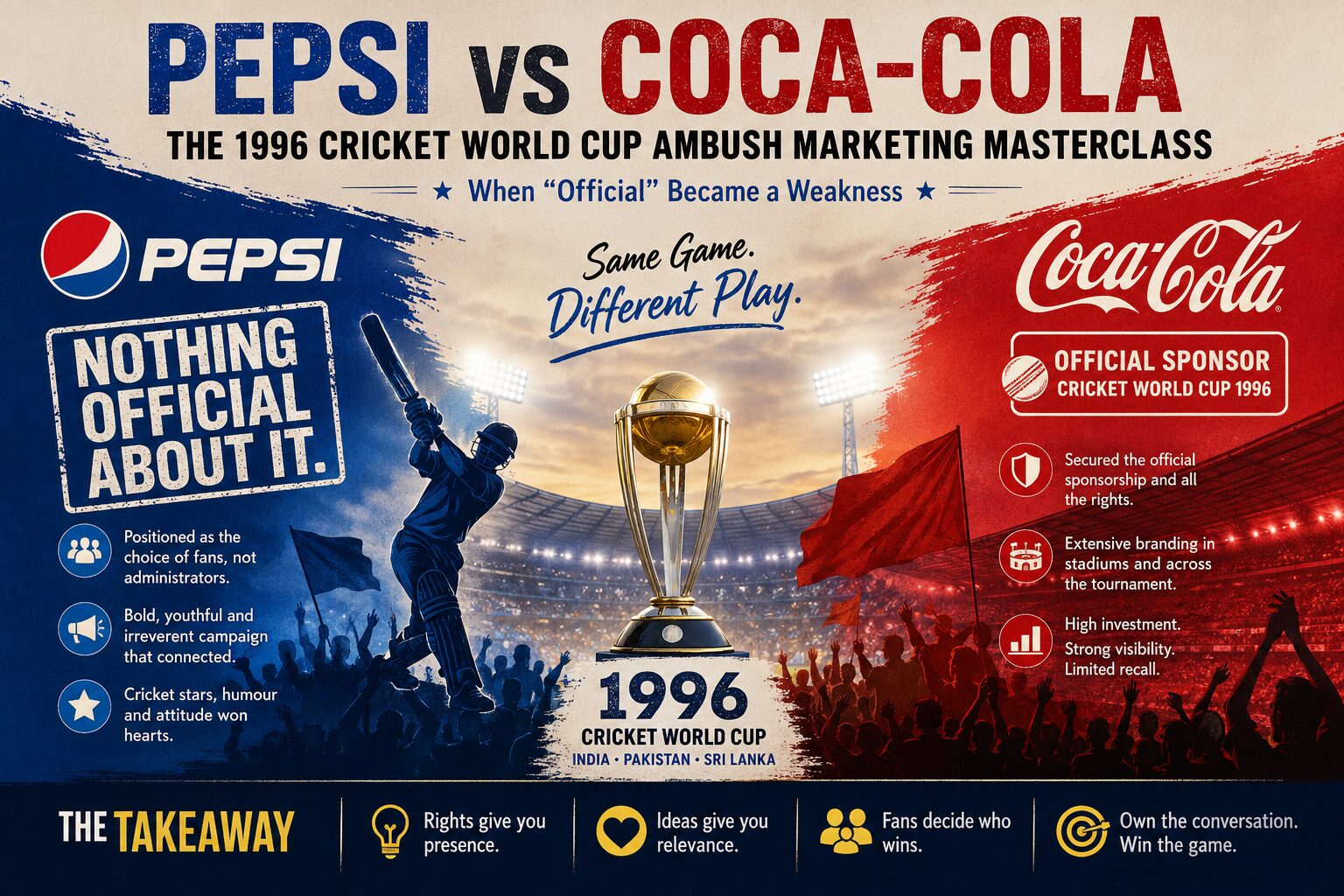
Despite Coca-Cola being the official sponsor of the 1996 Cricket World Cup, Pepsi stole the spotlight with its legendary ‘Nothing Official About It’ campaign. This article explores how creative positioning, cultural relevance, and bold messaging turned an unofficial brand into the tournament’s most memorable advertiser, making it one of the greatest ambush marketing case studies ever.


The World’s Biggest Cricket Tournament… and an Unofficial Winner
The 1996 Cricket World Cup was more than just a sporting spectacle. Co-hosted by India, Pakistan, and Sri Lanka, it captivated millions across the cricket-loving world and became one of the most commercially significant sporting events of the decade. For brands, it was a once-in-four-years opportunity to secure visibility among an audience united by passion, patriotism, and prime-time television.
Coca-Cola did what most global brands would have done. It acquired the official sponsorship rights to the tournament, expecting exclusive association with the event to strengthen its market leadership.
Pepsi, however, had been locked out.
Instead of accepting defeat, it created one of the most iconic ambush marketing campaigns in advertising history.
Its response was just four words:
“Nothing Official About It.”
With that single line, Pepsi transformed its biggest disadvantage into its greatest competitive weapon.
To read more about the advertisement, visit – https://onlykutts.com/index.php/2021/07/02/pepsi-nothing-official-about-it/
The Official Sponsor’s Advantage
Official sponsorships are designed to provide brands with exclusivity and legitimacy. Sponsors receive rights to tournament logos, promotional assets, official advertising, hospitality opportunities, merchandising, and on-ground branding.
For Coca-Cola, the investment promised several strategic advantages.
Official sponsorship typically delivers:
- Exclusive association with the tournament.
- Extensive stadium branding.
- Rights to use official tournament marks.
- Promotional tie-ins and contests.
- Media visibility throughout the competition.
On paper, Coca-Cola appeared to have secured an unbeatable position.
Yet marketing success is rarely determined on paper.
Pepsi’s Counterattack
Unable to use the tournament’s official identity, Pepsi decided to challenge the very idea that “official” mattered.
Rather than imitate Coca-Cola’s event-led communication, Pepsi built a campaign around attitude. Its advertisements celebrated youthful confidence, humour, and irreverence while subtly mocking the importance of official sponsorship.
The slogan, “Nothing Official About It,” implied that authenticity could not be purchased. Cricket belonged to its fans, not to the company that had paid for sponsorship rights.
The campaign was amplified through extensive television advertising, outdoor media, retail promotions, and endorsements from some of cricket’s biggest stars. Although Pepsi could not describe itself as the tournament sponsor, it ensured that consumers constantly associated the brand with cricket during the World Cup.
This was classic ambush marketing—not by violating sponsorship rights, but by occupying the audience’s mindshare.
Turning a Weakness into a Strength
Most brands attempt to hide competitive disadvantages.
Pepsi did exactly the opposite.
It openly acknowledged that it was not the official sponsor and then reframed that fact as evidence of independence, confidence, and authenticity.
Instead of appearing excluded, Pepsi appeared fearless.
The campaign effectively suggested that being “official” was corporate and predictable, while being “unofficial” was bold, youthful, and closer to the spirit of the game.
It was a masterclass in strategic positioning.
Why the Campaign Worked
Several factors contributed to the campaign’s extraordinary success.
It Changed the Conversation
Consumers rarely discuss sponsorship contracts. They discuss memorable advertisements.
Pepsi shifted public attention away from who had purchased rights and toward which brand created the more engaging campaign.
It Connected with Youth
The campaign reflected the aspirations and humour of younger audiences.
Rather than speaking like a multinational corporation, Pepsi spoke the language of cricket fans. The tone was playful, confident, and rebellious—qualities that resonated strongly with its target audience.
It Leveraged Celebrity Power
Pepsi had long invested in relationships with leading cricketers, many of whom featured prominently in its advertising. These endorsements reinforced the brand’s cricket credentials without requiring official tournament rights.
Consumers often associated the players with Pepsi rather than with the tournament sponsor.
It Created Exceptional Brand Recall
Years after the tournament concluded, many consumers continued to remember Pepsi’s slogan more vividly than Coca-Cola’s official sponsorship.
That remains one of the strongest indicators of successful marketing.
Attention, not contractual exclusivity, ultimately shaped consumer memory.
Coca-Cola’s Dilemma
Coca-Cola fulfilled every requirement of an official sponsor.
Its logos appeared throughout the tournament, and its branding enjoyed legal protection.
However, legal exclusivity could not guarantee emotional engagement.
Pepsi had succeeded in capturing the public imagination by creating a campaign that people discussed, quoted, and remembered.
The contrast highlighted an enduring marketing truth:
Sponsorship can secure presence.
Creativity secures relevance.
Marketing Lessons from the 1996 World Cup
The Pepsi-Coca-Cola rivalry remains one of the most studied examples of ambush marketing because it demonstrates principles that continue to shape modern brand strategy.
1. Rights Do Not Guarantee Attention
Purchasing sponsorship rights ensures visibility, but it does not ensure consumer affection or recall.
2. Positioning Can Beat Investment
Pepsi spent less on tournament rights but invested in a sharper creative idea.
The strength of the positioning allowed it to compete with a far larger sponsorship investment.
3. Consumers Remember Stories, Not Contracts
Very few fans could recall the legal details of tournament sponsorship.
Millions remembered the slogan.
Great campaigns create cultural memory that outlasts the event itself.
4. Emotional Connection Matters More Than Official Status
Consumers gravitate toward brands that entertain, inspire, and reflect their identity.
Pepsi positioned itself as the brand of cricket fans rather than the brand of cricket administrators.
That distinction made all the difference.
Legacy of an Ambush
The 1996 Cricket World Cup campaign remains one of advertising’s finest demonstrations of ambush marketing. Pepsi did not challenge Coca-Cola in the courtroom or attempt to imitate its sponsorship. Instead, it challenged the assumptions behind sponsorship itself.
By proudly declaring “Nothing Official About It,” Pepsi transformed exclusion into differentiation, turned official status into a perceived disadvantage, and proved that cultural relevance often outweighs contractual privilege.
For marketers, the lesson is timeless.
Owning the rights may secure a place inside the stadium.
Owning the idea is what secures a place in consumers’ minds.