When Both Sides Win: The Brand Logic of Contradictions
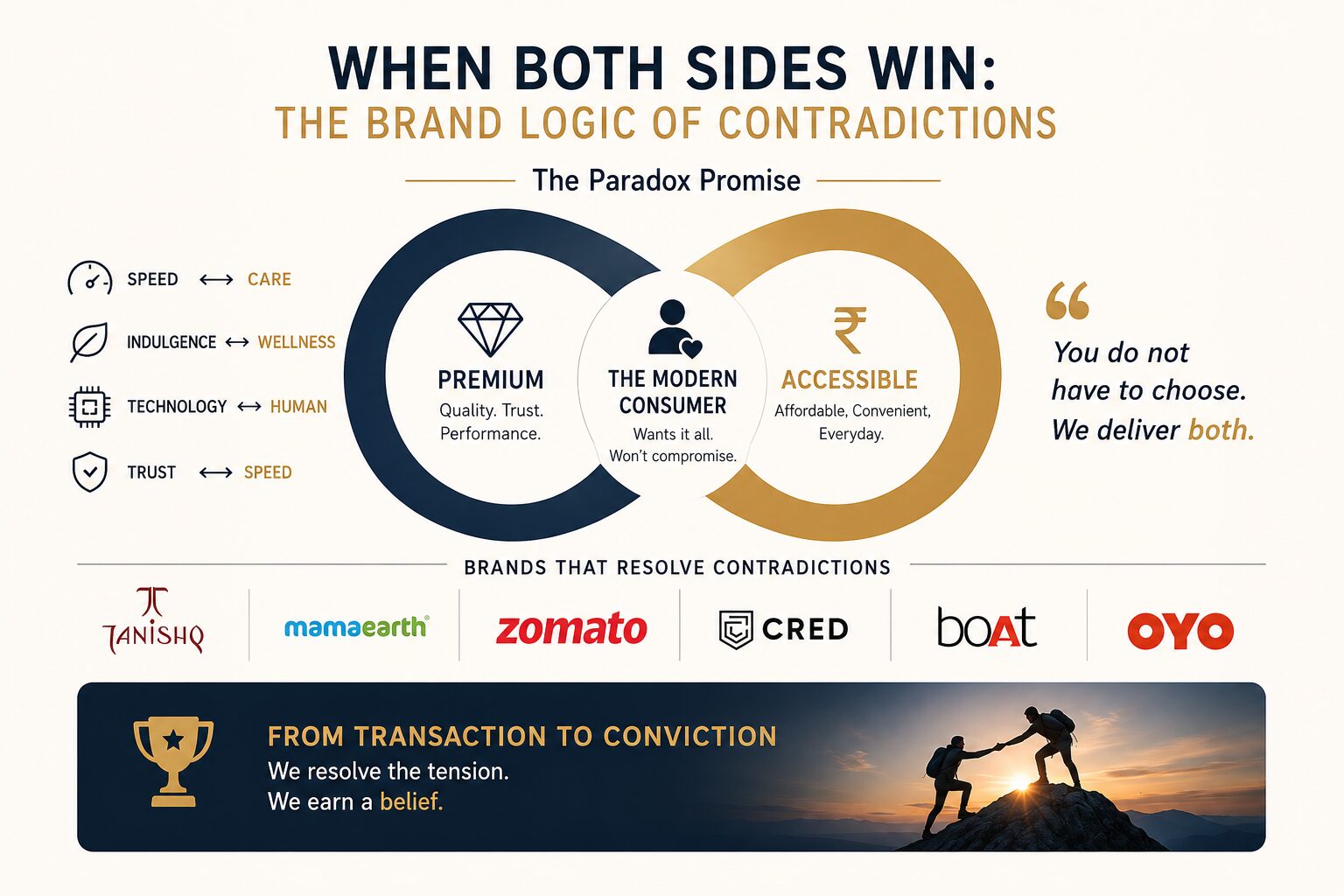
Why the smartest brands win by resolving contradictions. Discover the rise of the paradox promise in modern branding.
There is an old negotiation principle: every deal requires someone to give something up. You get the price, or you get the quality. You get the speed, or you get the care. Pick a lane.
Brands believed this for decades. Then the smartest ones stopped believing it.
The consumer has changed. She does not want to compromise. She wants the premium product at an accessible price. She wants the indulgence without the guilt. She wants the technology that feels human. She is not being unreasonable. She is being modern. And the brands that understand this are building some of the most durable competitive advantages in the market today.
The logic has a name: the paradox promise. A brand that holds two seemingly contradictory benefits and delivers both, without diluting either.
The Contradiction as a Strategic Tool
Most brand managers are trained to find a single, clear positioning. One benefit. One lane. Focused, differentiated, ownable.
That logic holds. But it misses something.
The real world is full of people who want things that should not go together. A beverage that is refreshing but also healthy. A vehicle that is powerful but also economical. A fashion brand that is exclusive but also everywhere. When a brand figures out how to resolve that tension rather than asking the consumer to choose, it stops being a product and becomes a belief.
This is not about making vague, sweeping claims. It is about structuring the entire brand experience around resolving a specific contradiction. The product formulation, the pricing architecture, the communication, the store experience: everything is built to prove that both things are true simultaneously.
India Has Been Doing This for a While
India is actually a fertile ground for paradox brands. The market demands it. You have consumers who aspire to global standards but live on Indian budgets. You have buyers who want modern solutions delivered through traditional values. The contradictions are not an anomaly here. They are the baseline condition.
Consider a few that stand out.
- Tanishq resolved what had been a stubborn contradiction in Indian jewellery retail: craft and trust. For generations, the unorganised jeweller held the craft. But trust was a transaction between families, and the modern consumer, especially the urban woman shopping for herself, had no such relationship. Tanishq offered hallmarked, verified gold with the aesthetic range of a heritage jeweller. Purity plus beauty. Institutional reliability plus emotional resonance. It was, structurally, a paradox promise.


- Mamaearth took a different contradiction: efficacy and safety. Most effective skincare came loaded with chemicals that new mothers worried about. Most “safe” products felt ineffective. Mamaearth positioned itself on “toxin-free” formulations that still claimed to work. Natural and effective. The contradiction was the entire brand story.

- Zomato, in its early growth phase, made a quiet, paradoxical promise that most people did not explicitly name: the indulgence of restaurant food with the comfort of home. You did not have to choose between a good meal and your sofa. The convenience layer resolved a real tension that millions of urban Indians faced every evening.


- CRED is perhaps the most interesting recent example. It made creditworthiness feel like cultural capital. Paying your credit card bill, historically a utilitarian act, became something people wanted to show off. Responsible and aspirational. Functional compliance wrapped in status. That is a paradoxical promise operating at a psychological level.


Global Examples
Palmolive – tough on grease. Gentle on hands. Same product. The brand did not ask you to choose. It resolved a daily domestic tension so cleanly that the contradiction became the entire proposition.
Diet Coke – The category had accepted that “diet” meant less. Thinner taste, smaller pleasure. Diet Coke refused that framing. Great taste, no calories: not almost, not close enough. The paradox was the product.
Apple – Technology had always demanded that you learn its language. Apple reversed the arrangement. The machine would learn yours. High capability, zero intimidation. Every design decision proved that ‘sophisticated’ could feel ‘effortless’.
The Gap – Identity through sameness. The Gap gave you a look that said something about you, and that look happened to be identical to everyone around you. Individuality through conformity. A difficult trick. For a long stretch, they pulled it off.
Target – Not cheap. Never cheap. Affordable style is a genuine design commitment, not a discount dressed up in better lighting. Target hired real designers, maintained real aesthetics, and kept the price within reach of the mass market. The gap between how it looked and what it cost was entirely intentional.
Chipotle – Fast food had made a quiet assumption: speed requires processing. Chipotle separated the two. Fast was never the problem. The problem was what ended up in the bag. Fresh, ethically sourced, and assembled quickly. The format stayed. The compromise is left.
Infiniti – Japanese luxury meant nothing in 1999. Luxury was German or American. Japan meant reliability, not aspiration. Infiniti had to invent a definition before it could own one. What emerged was coherent: tradition anchored in the future. Heritage and modernity are not opposites but a single design philosophy. The contradiction was the brand.
The Price-Value Paradox
One of the most persistent contradictions in the market is the tension between price and quality. Conventional logic says you cannot have both. The D2C wave in India has repeatedly challenged this.
Brands like Boat made premium-looking consumer electronics accessible to the mass market. The product did not feel cheap. The price was not premium. The contradiction between “looks expensive” and “is affordable” was the brand’s entire pitch. It worked because the entire experience, the packaging, the colour variants, and the influencer affiliations were built to resolve that tension visibly.


Similarly, OYO‘s early proposition was straightforward but genuinely paradoxical for the Indian budget traveller: standardised quality at the lowest price point. Not “cheap with low expectations”. Standardised. Predictable. That word carries enormous weight for a first-time solo traveller or a young professional on a work trip. The promise that you would not be surprised badly. Quality as reliability at economical pricing.


Where Brands Get This Wrong
The paradox promise is not a marketing claim. That is where most attempts fall apart.
Brands hear this idea and immediately reach for their communications team. They write a tagline that tries to hold two things at once. The product stays the same. The operations stay the same. Only the advertising changes.
Consumers are not fooled for long.
The paradox promise has to be structural. It has to be built into:
- What the product actually does or contains
- How it is priced and packaged
- Where and how it is sold
- What the customer service experience feels like
- What the brand says about itself versus what others say
Every layer has to resolve the contradiction, not just the headline. A brand cannot claim “luxury at every price point” and then have a customer service line that goes unanswered for three days.
The New Contradictions to Watch
Markets evolve, and so do the contradictions that brands can resolve.
A few that live in India right now:
- Convenience and wellness. Packaged food has always sat uneasily next to the idea of health. The brand that can genuinely deliver on both, not just claim to, will own a significant space in the FMCG aisle.
- Personalisation and scale. The D2C model promises personalisation. The unit economics demand scale. The brands that crack the technology and supply chain to deliver genuinely personalised products at scale will have a durable advantage.
- Premium and sustainable. The urban Indian consumer is increasingly aware of sustainability. But the sustainable category often feels austere or inconvenient. The brand that makes sustainability feel premium rather than sacrificial is sitting on a large, underserved opportunity.
- Trust and speed. In financial services, insurance, and healthcare, consumers want fast decisions. They also want to feel that someone responsible is looking at their case. Speed is associated with automation. Trust is associated with human review. The brands that resolve this in their product design, not just their copy, will win the next decade.
The Discipline Behind It
None of this is accidental. The brands that successfully hold contradictions together share certain traits.
They are extremely clear about the contradiction. They do not try to hold three or four things. They pick one genuine tension and resolve it completely.
They invest in the product or service layer first. The brand story comes second to the explanation of what the product already does.
They resist the temptation to compromise. A paradox promise collapses the moment you start saying “mostly quality at a mostly good price”. The power is in the absoluteness of both claims.
And they understand that the contradiction has to be meaningful to the consumer. Not an intellectual exercise. Not a brand manager’s favourite insight. A real tension that real people feel in the category before they have even heard of your brand.
Closing Thought
The brands that endure are the ones that resolve a real human frustration. Most frustrations in the market are not about the absence of a benefit. They are about being forced to choose between two things that both matter.
When a brand stands up and says, “You do not have to choose,” and then actually delivers on that, it does not just win a customer. It earns a conviction.
That is the difference between a transaction and a brand.