Brand Promise Is What You Deliver, Not What You Say
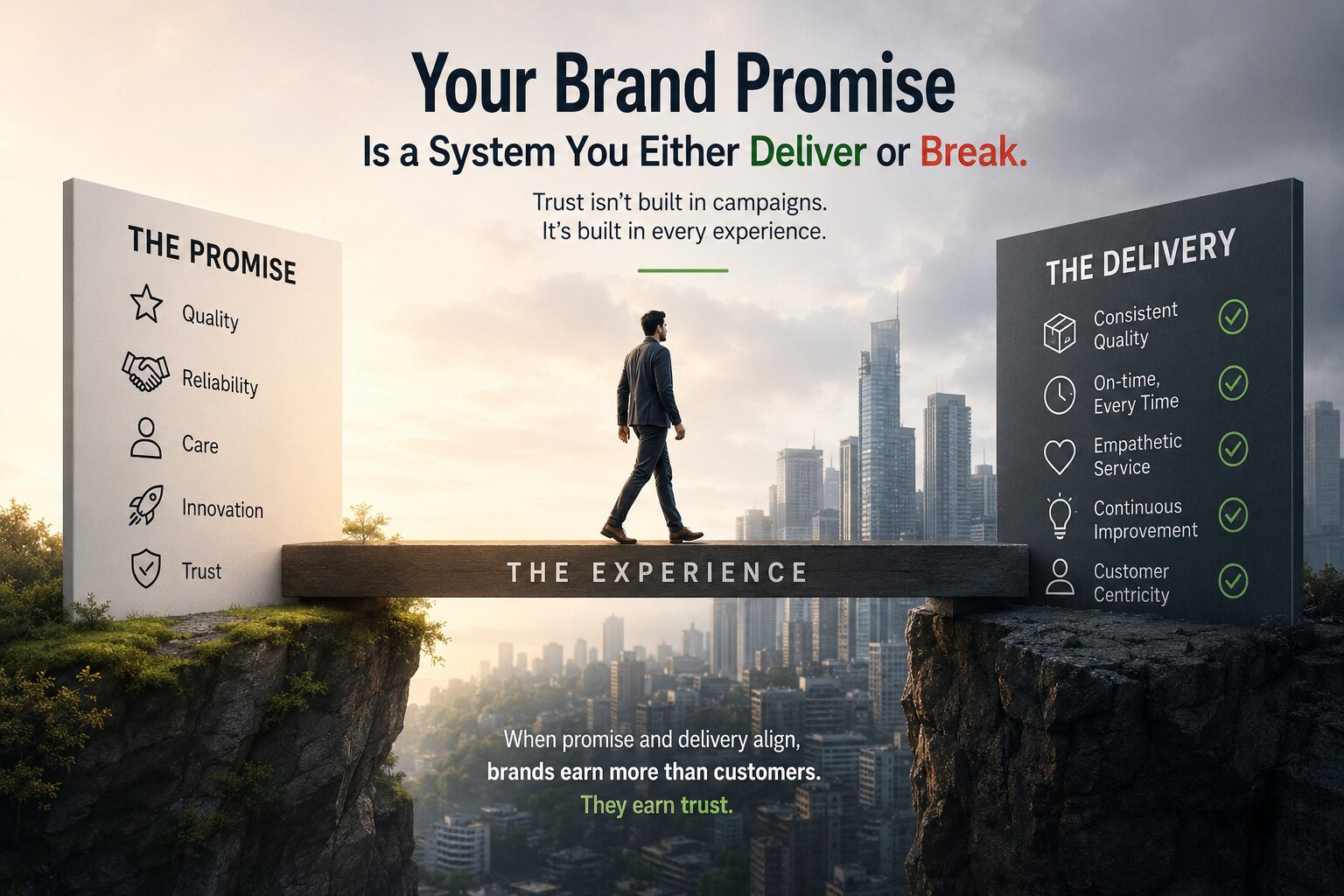
Your brand promise is not what you say but what you consistently deliver. Aligning marketing, operations, and customer experience builds lasting trust.
Most organisations spend an extraordinary amount of time refining what they want to say about themselves, yet far less time interrogating whether the business is actually structured to deliver what it claims. A brand promise, in that sense, is not a piece of communication or a positioning line. It is a contract, often implicit, between what a customer expects and what the organisation is consistently able to deliver across moments that actually matter.
This is where many brands begin to drift. The articulation of the promise becomes sharper, more emotional, and more ambitious over time, while the underlying experience evolves far more slowly. The result is not an immediate failure but a gradual erosion of trust, in which the brand continues to attract attention but loses credibility with each interaction that does not quite live up to its implied promise.
The Gap Between Narrative and Reality

In practice, the problem is rarely that companies are intentionally misleading. It is that marketing systems and operational systems often move at different speeds and are measured on different outcomes. Marketing is rewarded for differentiation, memorability, and reach, while operations is rewarded for efficiency, cost control, and scalability. Unless these two are tightly aligned, the brand promise begins to stretch beyond what the organisation can reliably deliver.
This misalignment tends to show up in predictable ways:
- A quick commerce platform promises delivery in minutes, but repeated delays during peak demand shift perception from convenience to unreliability
- An edtech platform positions itself around personalised learning, yet delivers largely standardised content with limited human intervention
- A premium healthcare provider communicates empathy and care, but patients experience long waiting times and transactional interactions at critical moments
None of these businesses fails because of poor communication. They struggle because the experience does not fully validate the promise.
Brands Are Built in Moments, Not Campaigns
Customers do not evaluate brands based on what they say in isolation. They evaluate them through a series of interactions that collectively shape perception. These interactions are often small, operational, and difficult to script, but they are precisely where trust is either reinforced or weakened.
When Promise and Delivery Align


Consider how this plays out in organisations that have managed to align promise and delivery more effectively.
- At Apple, the promise of simplicity is not confined to advertising. It is embedded into product design, packaging, retail environments, onboarding flows, and after-sales support, creating a coherent experience that feels intentional at every step.
- At Asian Paints, the shift from selling paint to delivering end-to-end home solutions reflects a deeper understanding that customers are not buying a product but an outcome, and the brand promise must therefore extend into execution, coordination, and service reliability.
- Similarly, hospitality brands such as Taj Hotels have built their reputation not merely on infrastructure but on the consistency of human interaction, where warmth and attentiveness become the true carriers of the brand promise.
These examples demonstrate that customers experience brands as systems, not as isolated messages.
Culture and Capability Define Credibility


A brand promise cannot be sustained externally if it is not supported internally. This is where organisational culture and capability become critical. If employees do not understand the promise or are not empowered to deliver it, the brand inevitably fragments across touchpoints.
This gap between intent and execution often emerges through:
- Frontline teams that are unclear about what the brand stands for in real situations
- Incentive structures that reward speed or volume over quality of experience
- Processes that prioritise efficiency but ignore the emotional or contextual needs of customers
- Leadership narratives that emphasise ambition without enabling delivery
For instance, a company that positions itself around premium service but operates with understaffed teams and high attrition will struggle to maintain consistency. A business that claims to be innovative but penalises risk-taking internally will find it difficult to produce outcomes that feel meaningfully different. Over time, these internal contradictions surface externally, often in ways that are visible to customers.
The Indian Consumer Context Is Shifting Rapidly


In India, this dynamic is becoming more pronounced as consumers become more informed, more vocal, and less tolerant of inconsistency. Access to information has reduced the asymmetry between brands and buyers, and expectations have risen across categories, from financial services to healthcare to direct-to-consumer products.
Customers today do not separate what a brand says from what it does. They expect alignment, and when that alignment exists, trust compounds quickly. When it does not, disappointment travels just as fast, often reaching far beyond the original interaction.
This is particularly visible in categories where the perceived risk is higher:
- Healthcare, where trust is directly linked to outcomes
- Financial services, where reliability and transparency are non-negotiable
- Pet care and childcare, where decisions are made on behalf of someone else
- Hospitality, where experience defines value more than the product itself
Reframing the Role of a Brand Promise
If we step back, the most effective way to think about a brand promise is not as an aspiration but as a commitment that must be operationalised. This requires a shift in how organisations approach branding, moving from communication-led thinking to system-led execution.
This shift can be structured around a few critical actions:
- Calibrate promises against what can be delivered consistently, not occasionally
- Align marketing narratives with operational reality rather than competitive pressure
- Map the customer journey in detail and eliminate friction that weakens perception
- Equip frontline teams with both clarity and autonomy to act in alignment with the brand
- Measure trust, repeat behaviour, and satisfaction, not just awareness and acquisition
These are not superficial changes. They require coordination across functions and a willingness to prioritise long-term credibility over short-term visibility.
Consistency Is the Real Differentiator
In a market where many brands can access similar tools, technologies, and channels, differentiation increasingly comes from the ability to deliver consistently rather than from the ability to communicate creatively.
The brands that endure are rarely the ones that make the boldest claims. They are the ones where expectations and experiences align with enough consistency that customers stop questioning and start relying.
Because ultimately, the question customers are asking is not whether a brand sounds compelling, but whether it is dependable in moments that actually matter.