When a Brand Becomes a Religion
When does a brand become a religion? Lindstrom’s 10 commandments, the Marketing Science evidence, plus Apple, Amul, Royal Enfield and more.
Some brands are bought. Others are believed in.
Walk past an Apple Store on launch day, and you will see queues that look more like pilgrimages than purchases. Spend a Sunday with a Royal Enfield owners’ group, and you will hear language usually reserved for faith: brotherhood, ritual, and devotion. Watch a Sabyasachi bride get dressed, and you will notice the vocabulary shift from “designer” to “vision”.
This is not an accident of branding. It is the result of a deliberate playbook, one that marketers have studied for nearly two decades and one that religion has practised for millennia.
The question worth asking is not whether brands can borrow from religion. They already have. The question is what they borrow, why it works, and where the line sits before devotion curdles into something exploitative.
The Theory: Why Religion and Branding Run on the Same Fuel
In 2007, branding expert Martin Lindstrom set out to answer a simple question: what makes people get a Gucci barcode tattooed on their neck? His answer, drawn from his study of world religions, was a list of ten components shared by powerful brands and faiths. He wanted to call it the Ten Commandments. His publisher talked him out of it.
The list still holds up:
- A sense of belonging. Communities such as Weight Watchers run on peer support, the same glue that holds congregations together.
- A clear vision. Steve Jobs’ 1980s framing of Apple as a tool for human creators outlived the products it was written for.
- Power from the enemy. Coke needs Pepsi the way most faiths define themselves partly against a rival doctrine.
- Authenticity. Real, relevant, rooted in ritual and story.
- Consistency. You know how to order at Subway anywhere in the world; the way a ritual stays the same across parishes.
- Perfection. Harley-Davidson owners obsess over engine detailing the way devotees obsess over correct practice.
- Symbols. The Apple icon, the Nike swoosh, the Om. Visual shorthand that needs no translation.
- Mystery. KFC’s eleven herbs and spices and the Coca-Cola formula. Secrecy manufactures reverence.
- Rituals. The lime was wedged into a Corona bottle. The Olympic torch relay. Religion’s oldest trick, repurposed.
- Sensory appeal. Incense and bells in a temple. Scent-marketing and signature soundscapes in a flagship store.
Lindstrom’s point was not that branding has corrupted religion. It is that branding has been quietly studying religion’s playbook for years, and the brands paying closest attention are the ones building the deepest loyalty.
Media researcher Mara Einstein went further, arguing that religion itself, facing a crowded attention economy, had to start behaving like a brand to survive, building recognisable symbols and spokespeople so that prospects could form instant connections. The traffic, in other words, runs both ways. Megachurches built around a charismatic pastor and an Apple keynote built around a charismatic founder are closer cousins than either side would like to admit.
The Evidence: What the Data Actually Shows
It is worth pausing here because “brands are the new religion” is one of those lines that gets repeated more often than it gets tested.
A 2010 paper in the journal Marketing Science, titled “Brands: The Opiate of the Nonreligious Masses?”, set out to test it properly. The researchers Ron Shachar, Tülin Erdem, Keisha Cutright, and Gavan Fitzsimons found something more nuanced than a simple substitution. They demonstrated that religiosity is related to “brand reliance”, meaning the degree to which consumers prefer branded goods over unbranded ones. Their theory: brands and religiosity can act as substitutes for each other because both allow people to express their sense of self-worth.
Crucially, the effect was not universal. The relationship between religiosity and brand reliance appeared only in categories where brands let consumers express something about themselves, such as clothing, but not in purely functional categories. Fewer religious people leaned more heavily on expressive brands to do identity work that religious belonging had done for everyone else.
That is the more honest, more useful version of the “brand as religion” idea. It is not that Nike is a church. It is that brands and religion compete for the same psychological territory: identity, belonging, meaning, transcendence. When traditional religious participation declines, some of that need for shared meaning does not disappear. It finds a new home, and consumer brands have been increasingly happy to provide one.


Global Examples: The Brands That Built Belief Systems
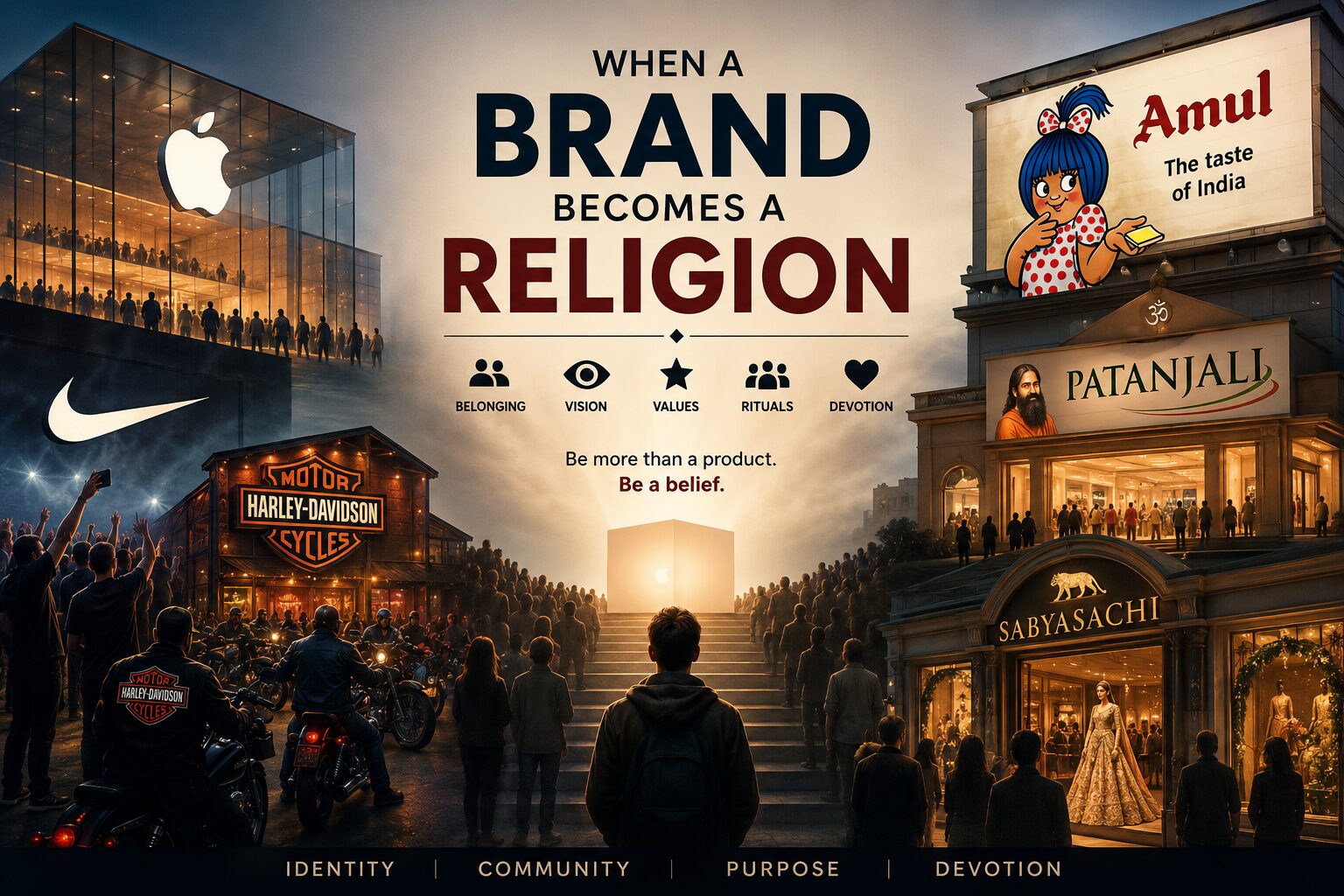
Apple. The keynote is a sermon. The product reveal is a relic unveiling. The store is a clean, white temple where staff dressed identically guide you through a ritualised purchase. The faithful queue overnight, not out of need but for proximity to a moment.
Harley-Davidson. The Harley Owners Group functions as a congregation with chapters, rallies, and a shared liturgy of road codes. Riders tattoo the logo onto their bodies, an act of permanent allegiance that almost no other product category inspires.
Nike. The brand sells victory as a creed, not a shoe. When Tiger Woods returned from personal collapse to win the Masters, Nike’s response was not a product ad. It was a redemption story, broadcast within hours, reaffirming that faith in the brand’s promise survives even when the man wearing it falls.
Supreme. Weekly drops function as a liturgical calendar. Scarcity is the doctrine. Resale culture is the proof of devotion, since paying multiples of retail price only makes sense if belief, not utility, is the currency.
Equinox. The brand literally calls its gyms “temples of fitness”, explicit spiritual language deployed to sell a membership.
Hello Kitty. Lindstrom’s most vivid example: two girls in Tokyo dressed head to toe in the character, down to their nails and phone cases. Nothing left unbranded, the consumer equivalent of total devotion.
Tesla. Owners defend the brand with an intensity usually reserved for political or religious identity, and Elon Musk has served as prophet-founder to a community that treats criticism of the brand as a personal affront.
Indian Examples: Faith, Built Locally


India offers some of the sharpest examples anywhere, partly because the country’s relationship with both religion and brand symbolism runs unusually deep.
Royal Enfield and Bullet Baba. Royal Enfield’s owner community is one of the most studied brand cults in the world, with riders bonded by shared rides, shared mechanics, and a shared sound. But the most striking proof of the brand-as-faith idea sits on a highway in Rajasthan. After a rider named Om Banna died in a motorcycle accident in 1988, locals built a shrine around his Bullet. The bike is worshipped to this day, garlanded, and treated as a deity that protects travellers on that stretch of road. No marketing department could engineer that. It happened because the brand had already done the deeper work of becoming meaningful.
Amul. For nearly sixty years, the Amul girl has commented on Indian news, politics, cricket, and Bollywood within days of events happening. The brand stopped selling butter through advertising decades ago and started narrating the nation instead. Indians who have never set foot in a dairy cooperative still feel proprietary about the Amul girl’s opinion on the news. That is closer to civic ritual than commerce.
Patanjali. Baba Ramdev built Patanjali on an explicitly moral proposition: swadeshi, purity, and a return to Ayurvedic tradition, fronted by a figure who already carried spiritual authority from his yoga following. The brand did not need to manufacture belief from scratch. It borrowed an existing congregation and converted it into a customer base.
Sabyasachi. Brides do not simply buy a Sabyasachi outfit. They describe wanting to become a “Sabya bride”, a phrase that frames the purchase as transformation rather than transaction, the language of conversion more than commerce.
Cricket and the IPL ecosystem. Less a single brand than a national liturgy. Stadiums function as places of congregation, jerseys as vestments, and player worship runs close enough to deification that a few cricketers have had temples built in their honour.
The Builder’s Checklist: How a Brand Earns This Kind of Devotion
For founders and marketers, the temptation is to treat this as a list of tactics. It is not, and that is the first lesson. A few starting points, drawn from the pattern across global and Indian examples:
- Write a doctrine, not a tagline. A manifesto should read like a statement of belief, something a follower could repeat without prompting.
- Design rituals, not just transactions. Drops, ceremonies, and habits convert customers into participants. A ritual repeated becomes a tradition.
- Build or borrow a prophet. A founder, a creator, or a guru figure gives the brand a face that can carry conviction in a way a logo cannot.
- Create sacred space. Physical or digital, a place where believers gather reinforces identity faster than any advertisement.
- Earn mystery instead of manufacturing hype. Genuine scarcity or genuine secrecy works. Artificial scarcity, once spotted, permanently breaks trust.
- Be consistent to the point of ritual. Predictability, oddly, is what makes a symbol feel sacred rather than arbitrary.
The Line Worth Drawing


Spiritual branding is powerful precisely because it works on the same psychological wiring as actual faith: identity, belonging, transcendence, meaning. That is also exactly why it carries responsibility.
Mara Einstein’s caution about religious marketing applies just as well in reverse. When the substance behind a brand gets hollowed out in favour of pure symbolism and ritual, the brand risks becoming a cult of belief with nothing underneath it. The strongest brands in this space, Apple, Amul, and Royal Enfield, earned their devotion by being genuinely excellent at the functional job first. The mythology was built on top of real product truth, not instead of it.
A brand becomes a religion when people stop asking, “Does this work?” and start asking, “What does this say about who I am?” That is an extraordinary position to hold in someone’s life. It should be built carefully and on something real.
Sources and further reading
- Lindstrom, M., “Religion: Inspiration For Brands,” Branding Strategy Insider, 2007
- Shachar, R., Erdem, T., Cutright, K. M., & Fitzsimons, G. J., “Brands: The Opiate of the Nonreligious Masses?”, Marketing Science, 30(1), 2011
- Dahlberg, T., “Brand Spirituality: Why More Companies Are Acting Like Religions,” The Brief, 2025
- Trischler, D.J., “On Brand and Religion Part 1,” 2019