The Shelf Was Yours. The Market Was Not.
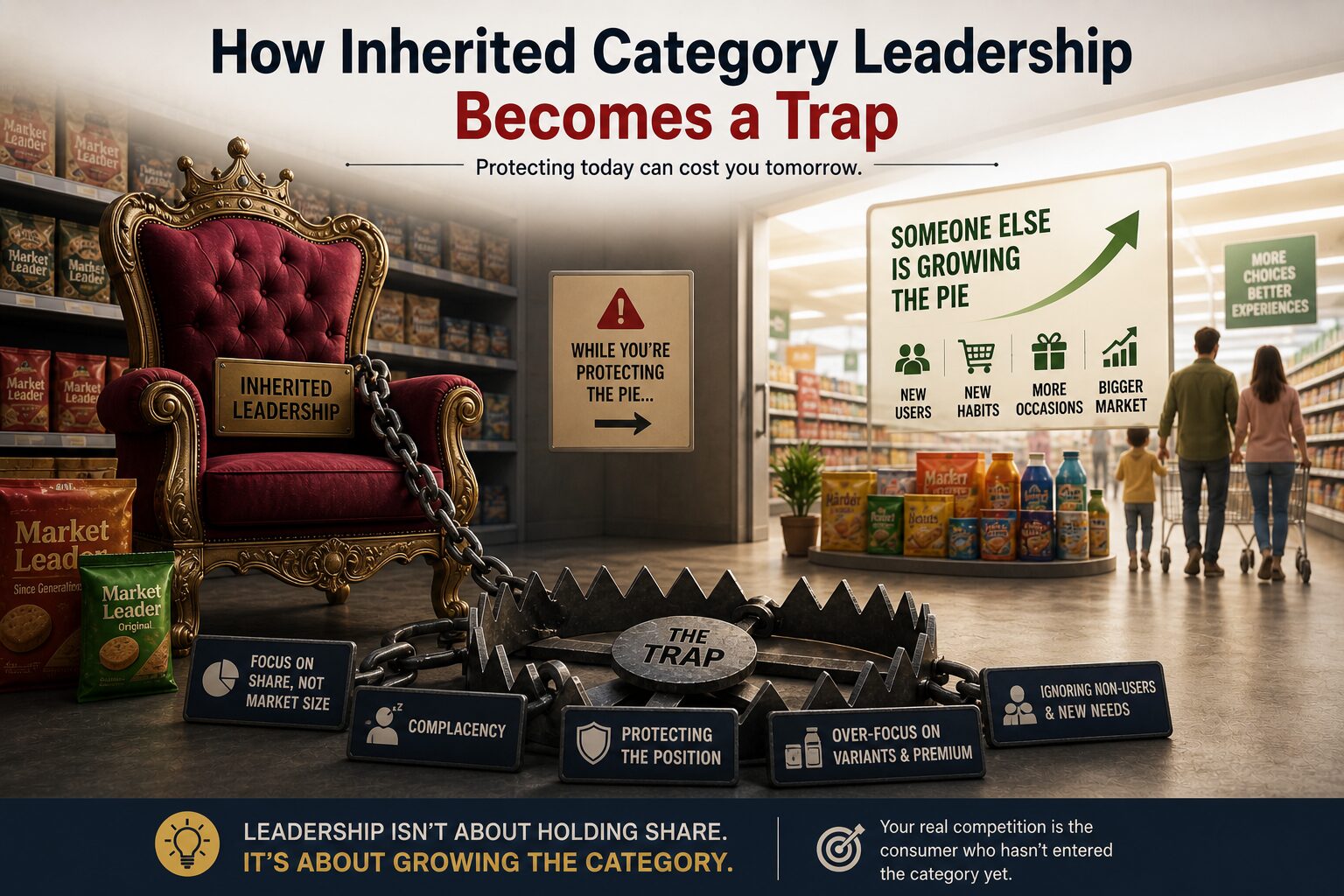
There is a particular kind of corporate confidence that appears strong from the inside and complacent from the outside. It lives in brand teams that have never had to fight for their position. It sits in boardrooms where the category review slide always has a green number at the top. It sounds like “We’re the leader. We’ve always been the leader.”
That sentence is not a strategy. It is a eulogy in slow motion.
Category leadership earned through battle teaches you something. You know why you won. You remember the decisions that got you there. You have the muscle memory of defending ground. But leadership that came to you by default, because the category was too small for anyone else to care about; because the organised segment was a footnote; or because you were simply the only credible player in the room – that kind of leadership teaches you nothing useful. It teaches you to protect. And protection, in marketing, is the beginning of the end.
The Illusion of Safety
Let us start in India, in a category most people take for granted: packaged atta.


For years, the branded atta market was dominated by ITC’s Aashirvaad. Good product. Good distribution. Strong equity in the homemaker segment. A brand that had built genuine recall through sustained investment. But the category itself, the proportion of households buying packaged branded flour versus loose chakki-ground or unbranded alternatives, remained low. The real market was still largely unorganised.
Aashirvaad had a share. The category was still being built.
When Hindustan Unilever entered with Annapurna and various regional players began consolidating, the conversation changed. Suddenly, the question was not “Which brand are you buying?” but “Why are you buying branded at all?” The real penetration game had begun. The smart players stopped competing over the existing pie and started asking why the pie was still so small.
Aashirvaad’s response, to its credit, was to invest rather than retreat. They leaned into quality credentials, expanded to multi-grain and speciality variants that addressed real dietary concerns, and continued media investment at a level that smaller players could not match. But the broader lesson held: until the category itself decided to grow the universe of buyers, every share gain was just a rearrangement.
The risk for any leader in an underpenetrated category is that they spend their energy on the rearrangement and leave the universe-building to someone else.
When Someone Else Builds Your Market


Globally, this dynamic has played out with such clarity that it is almost painful to study.
Consider the energy drink category from the 1990s through the early 2000s. Before Red Bull arrived in the United States in 1997, the category barely existed in any organised sense. There were some fringe products. There was no mainstream consumer behaviour around functional energy beverages. The shelf space was negligible.
Red Bull did not enter an existing market. They created one. Sampling at universities. Sponsorship of events that had nothing to do with beverages. A price point that was deliberately premium, because a cheap energy drink would not have changed behaviour. The small, expensive, aluminium can was not a design quirk. It was a signal. This is not a soft drink. This is something different. Pay attention.
Within a decade, the category was worth billions globally. Monster entered. Rockstar entered. Dozens of local players entered. Everyone who came later owed their existence to the work Red Bull had done in growing the universe of buyers.
Here is the question that matters: if a brand had been quietly selling a functional energy drink before Red Bull arrived, what would have happened to them? Almost certainly, they would have been overwhelmed. Not because their product was worse. Because they had spent their years in the market treating a niche position as a destination rather than a launchpad.
Being first in a category is only valuable if you use that time to grow the category. Otherwise, you are simply the person who warmed the seat.
The Variant Trap


There is a specific failure mode that category leaders fall into almost universally. It is understandable, because it feels like action. It is called the variant trap.
When growth slows, the first instinct of most brand teams is to launch something new. A new flavour. A new pack size. A new format. A limited edition. The logic seems sound: existing buyers need a reason to stay engaged, and new news keeps the brand feeling alive.
The problem is that variants, almost by definition, speak to people who are already in the category. A new flavour of a product you have never bought does not make you more likely to buy it. A premium variant of a brand you do not know does not build awareness. Variants recirculate the existing buyer pool. They do not expand it.
Britannia is a useful Indian reference here. The biscuit category is one of the largest FMCG categories in India by volume, yet per capita consumption remains significantly below that of markets such as Malaysia and Indonesia. The growth opportunity was always in getting more Indians to buy more biscuits, more often, at accessible price points. Britannia, like its competitors, has historically invested heavily in new product development and premiumisation, which has played its role. But the penetration story, getting biscuits into the hands of the next hundred million consumers, has often been the harder and less glamorous work, and the brands that have committed to it most seriously have found the returns compounding.
The variant is the brand manager’s friend. Penetration is the business’s friend. They are not always the same thing.
The Price of Comfort
Perhaps the sharpest global example of what happens when a category leader mistakes inherited position for earned strength is the story of Kodak.


Kodak did not just lead the film photography category; it also led the digital photography category. They were the category. Their share at peak was so dominant that the brand and the product were effectively synonymous. And yet, within roughly a decade of digital photography becoming viable for consumers, the company filed for bankruptcy.
The analysis of what went wrong has been done many times, and most of it is accurate. But the one thread that runs through all of it is this: Kodak had spent so long leading a category that they had forgotten what it felt like to build one. They were in the business of protecting film. They were not in the business of helping people capture memories, which was, if you think about it, always what they were actually selling.
When a challenger reframes the real category, the incumbent is almost always caught flat-footed because it has been managing the category as it is, not the need as it exists.
Nokia, similarly. Dominant in handsets. Irrelevant in smartphones. Not because they lacked engineers or resources. Because they understood their leadership as being about phones, not about communication, connection, or the things people actually wanted phones for.
Leadership defined too narrowly is always eventually disrupted by someone who defined it more broadly from the beginning.
What the Real Job Actually Is


If you are a category leader, inherited or earned, the job description is not “maintain share”. It’s about growing participation in this category, making the case for its existence, and removing barriers that keep potential buyers on the outside looking in.
Jyothy Labs did something interesting with Ujala fabric whitener. The category of fabric care additives was not new, but significant consumer behaviour around it had not been formalised in most households. Ujala went after the product differentiation story hard, yes, but they also invested in making the category habit-forming. Instructions on how to use it. Demonstration of results that made the benefit visceral and easy to see. Retail presence in markets where the category was new. The result was not just brand success. It was category creation at scale.
Similarly, when Tanishq began its sustained push into the branded jewellery segment in India in the late 1990s and 2000s, it was not simply competing with other branded jewellers. They were making the case for why a consumer who had always bought from the local family jeweller should consider a branded, certified, transparent alternative. Every advertisement about purity certification was also a category argument. It was not just “buy Tanishq. ” It was “Here is why branded jewellery matters.” The category grew. Tanishq grew with it. Then others grew too. That is how it works.
The Decision That Defines You
Category leadership is not a certificate. It is not a trophy that lives on the shelf while you run your business. It is a daily decision about whether you will grow the market before someone else does.
The brands that have retained leadership across decades, in India and globally, share one common trait. They never confused holding shares with building markets. They understood that their real competition was not the other brand on the shelf. It was the consumer who had not yet entered the category.
The ones who lost lost not because they were outspent or outmanoeuvred in the conventional sense. They lost because they stopped asking the harder question: why is this category still so small, and what are we going to do about it?
If you are sitting in a leadership position today, that is the only question worth taking seriously.
Everything else is just rearranging the shelf.