The Pet Wellness Number Nobody Is Talking About, And Why India Should Pay Attention
Pet wellness has crossed $5 billion in the US. Here’s what the undercounted growth, platform investors and clinical moats mean for India’s market.
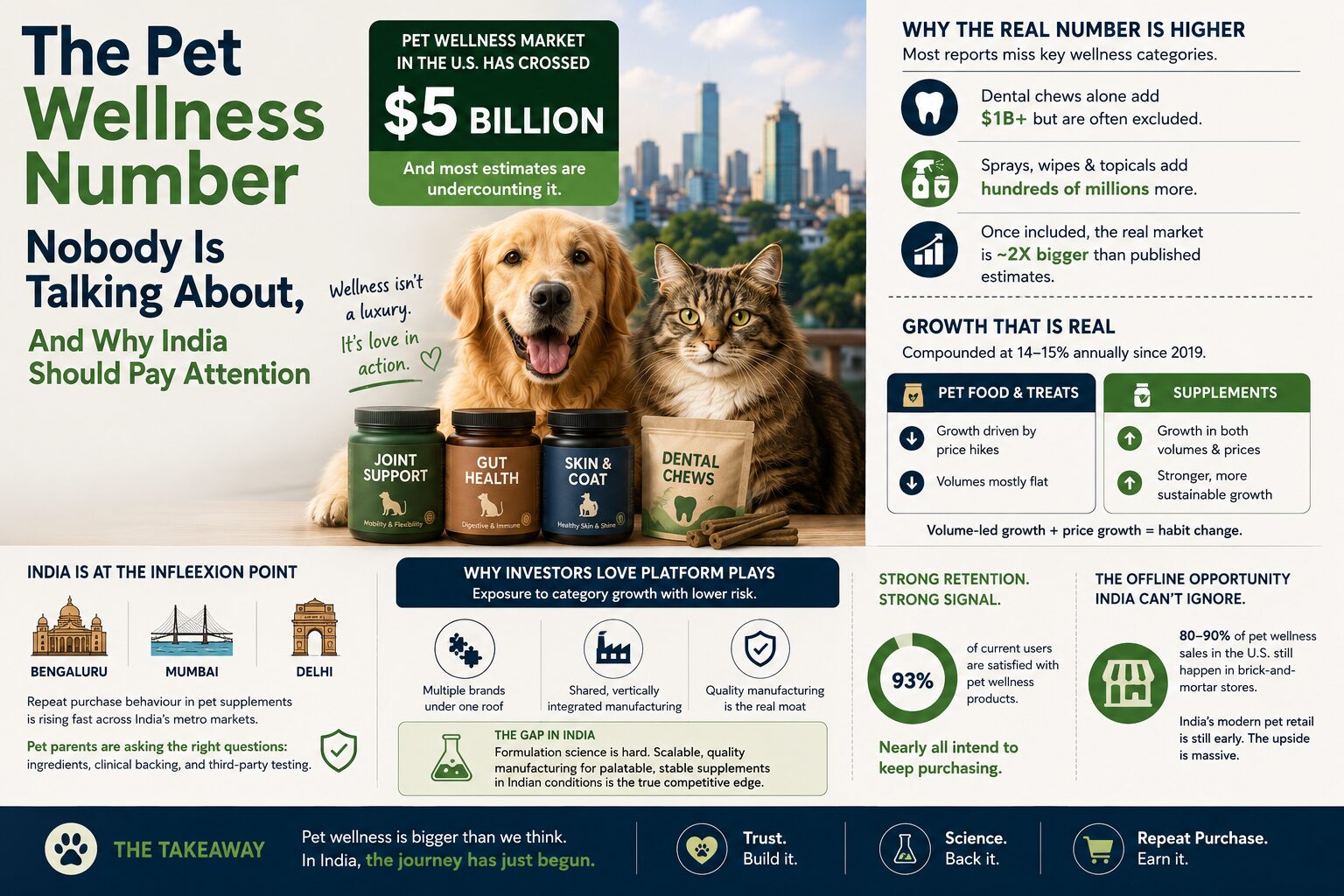
A consulting firm tracking the American pet category recently released a figure that surprised even people within the industry: the pet wellness market, when measured properly, has already surpassed $5 billion in the United States. Not the broader pet food market. Just wellness: supplements, functional treats, joint and gut formulas, skin and coat products.
The interesting part was not the headline figure. It was the explanation for why most published estimates undercount it.
Analysts at the firm pointed out where the undercounting happens:
- Dental chews add more than a billion dollars to the category on their own and are frequently excluded from supplement totals because retailers classify them separately.
- Sprays, wipes and topical products, often bought as grooming aids rather than wellness products, add several hundred million more.
- Once these adjacent categories are folded in, the real number is roughly double what most market reports state.
This is a useful lesson for anyone building a wellness brand in India, where the same undercounting problem exists, just with different categories hiding in plain sight.
Growth that is not inflation in disguise
The category has compounded at 14-15% annually since 2019, among the fastest growth rates in the entire pet industry. What makes this figure credible rather than suspicious is the composition of that growth.
Two kinds of growth, and why the difference matters
- Pet food and treats, broadly, have grown mostly because prices have risen while volumes have stayed flat.
- Supplements have grown on both counts: more units sold and customers willing to pay more per unit.
- Price-led growth is fragile. It collapses the moment a cheaper competitor enters, or a recession tightens wallets.
- Volume-led growth, especially when paired with price growth, signals that customers have changed a habit, not just absorbed a price hike.
That distinction matters enormously to anyone raising capital or pricing a new product.
What this looks like in India
In the Indian pet supplement market, where Much Petter operates, we are seeing early signs of the same pattern. Bengaluru, Mumbai, and Delhi pet parents are not simply buying a single sachet of joint support and stopping there. Repeat purchase behaviour, the real test of category health, is climbing across the metro markets faster than most founders expected eighteen months ago.
Why investors who do not love pets are still writing cheques
One observation from the report deserves particular attention from anyone watching the funding side of the category. Investors are increasingly drawn to platform plays: businesses that acquire or partner with multiple supplement brands rather than betting on one. This gives exposure to category growth without the binary risk of a single brand failing.
The platform logic
- Morgan Stanley has been combining several supplement brands under one roof with shared, vertically integrated manufacturing.
- The logic is straightforward. Quality manufacturing capacity is the scarce resource in this category, not branding.
- Whoever controls clean, scalable production lines for palatable, stable, well-dosed supplements controls the supply side of an entire emerging market.
The gap in India
This is precisely the gap in India today.
- Formulation science is genuinely difficult to get right, particularly for palatability across breeds and for cold-chain-free stability in Indian climatic conditions.
- Brands with strong manufacturing relationships and rigorous formulation discipline, rather than just clever packaging, will be the ones platform investors eventually consolidate around.
- We have felt this directly while sourcing manufacturing partners for the Much Petter range, where capability gaps in contract manufacturing are a bigger constraint on speed than capital or demand.
Humanisation has not peaked. It has barely started in India
The report’s most repeated theme was pet humanisation, the tendency of owners to treat animals as family members rather than property. The analyst’s framing was sharp: everyone already says their pet is family, but there is still considerable room to spend more and care more.
America versus India, side by side
- In the American context, this trend is mature.
- In India, it is closer to its inflexion point.
- A decade ago, the idea of a monthly subscription for a dog’s gut health would have sounded indulgent to most urban Indian households.
- Today, founders across the pet wellness space report customers asking unprompted about ingredient sourcing, clinical backing and third-party testing, the same questions human nutrition customers ask about their own supplements.
Why the retention numbers matter
Satisfaction data from the American market reinforces the idea that this category, once adopted, tends to stick.
- 93% of current users report satisfaction with the products they use.
- Nearly all say they intend to keep purchasing.
- The retention economics of pet wellness, in other words, resemble subscription health products for humans far more than they resemble impulse-driven pet treats.
The brick-and-mortar opportunity India cannot ignore
A genuinely useful insight from the report concerns distribution. Pet wellness products remain heavily skewed toward online sales in the West, and the analyst described offline retail as a significant, largely untapped unlock.
What shelf presence actually does
Wider shelf placement does two things simultaneously:
- It builds category awareness among browsers who were not actively searching.
- It builds the comfort that comes from seeing a product physically, next to familiar brands, rather than only in a search result.
India’s fragmented, opportunity-rich shelf
India’s pet retail landscape is at an earlier, messier stage than America’s, with large-format pet stores, veterinary clinics, and kirana-adjacent pet corners all competing to define where wellness products belong on shelves.
- This fragmentation is, in fact, an opportunity.
- A brand that wins veterinary endorsement and a presence in even a modest number of well-trafficked physical outlets in Bengaluru, Pune, or Hyderabad gains a credibility signal that no amount of online advertising can replicate.
- Offline presence, even at a small scale, functions as a trust device in a category where the customer cannot ask the product itself whether it works.
Clinical evidence as the next moat
The report also flagged a rising number of brands investing in formal clinical studies to support their claims. This is worth dwelling on because it marks a maturing of the category from marketing-led differentiation to evidence-led differentiation.
The early warning for Indian brands
For Indian pet wellness brands, this should be read as an early warning rather than a distant trend.
- The category is young enough here that claims can still be made loosely, on the strength of a good Instagram reel and a likeable founder story.
- That window is closing globally, and it will close in India faster than most founders expect, the moment one credible player publishes a clinical study and uses it competitively.
- The brands that invest early in veterinary trials, even modest ones, will own defensibility that competitors with bigger marketing budgets cannot match.
What this means for builders, not just investors
Strip away the American specifics, and three structural lessons remain, applicable directly to anyone building in India’s pet wellness space.
- Undercounting is an opportunity disguised as a measurement problem. If the market looks smaller than it is because adjacent categories are miscounted, the actual addressable opportunity for a well-positioned brand is larger than most founder decks currently assume.
- Manufacturing, not marketing, is the long-term moat. As platform investors consolidate around vertically integrated supply, founders who treat contract manufacturing as a commodity input rather than a strategic asset will find themselves squeezed out when scale-stage capital enters the category.
- Trust infrastructure beats trend-chasing. Clinical backing, veterinary endorsement and physical retail presence are trust devices. In a category built on a promise the customer cannot verify directly, these devices compound in value far longer than any single viral campaign.
The five-billion-dollar number is an American figure. The structural lesson underneath it, that wellness categories grow fastest when volume and trust compound together rather than when price alone does the work, travels well across borders and applies just as cleanly to a sachet of joint supplement sold in a Bengaluru pet store as it does to a premium probiotic chew sold in Ohio.