Brand Advantage Through Brand Extension: When Stretching the Name Builds the Business
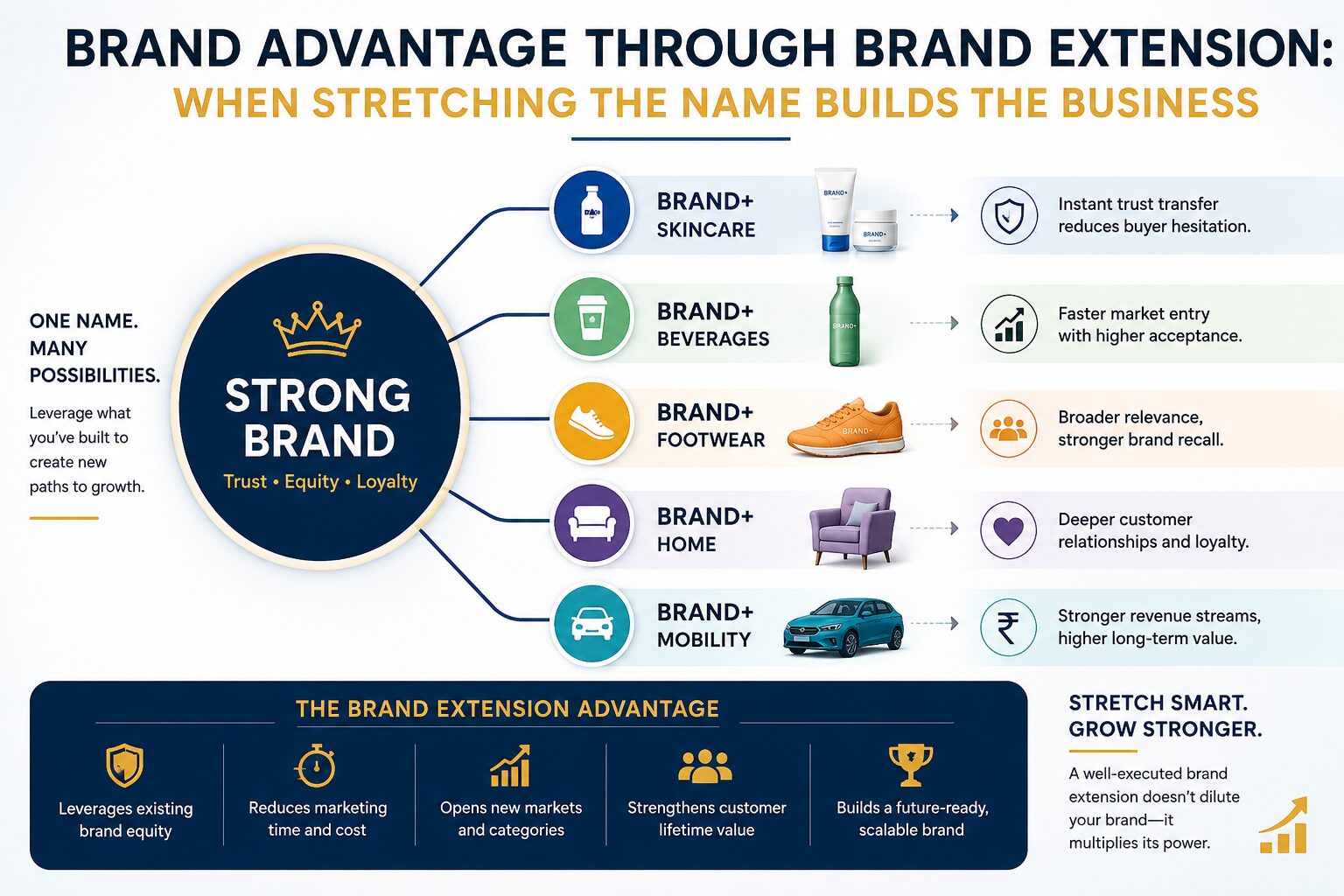
Brand extension turns brand equity into growth. Learn how Colgate, Dove and Arm & Hammer extend successfully, and why most extensions fail on fit.
Most founders think about growth as a product question. Build the next thing, ship it, and sell it. But the sharpest growth lever many businesses already own isn’t a new product. It’s an old name.
Brand extension is the practice of using an established brand to enter a new category. Done well, it converts years of accumulated trust into a shortcut for the next launch. Done badly, it borrows against that trust and leaves the original brand poorer for it. The difference between the two outcomes isn’t luck. It’s discipline.
What brand extension actually is
The textbook definition is simple: using an existing, recognised brand name to introduce a product in a new category, whether closely related to the original business or quite far from it. Marketing scholars Aaker and Keller, whose 1990 study remains the most cited work on the subject, called the parent the “core brand” and the new offering the “extension”. Investopedia frames it the same way: an established name, applied to a new product, to shorten the distance between launch and acceptance.
There’s a useful frame for thinking about how a brand changes the category game in its favour. It can expand the category, disrupt it, exceed it, or extend it. Colgate is the clearest illustration. Beyond the toothpaste aisle, Colgate has built Colgate Peroxyl for mouth irritation and Colgate Orabase for pain relief. Each extension doesn’t just sell a new product. It buys more shelf space and reinforces the brand’s authority over oral care as a whole.
That’s the real prize. Not just a new revenue line, but a stronger claim on the category itself.
Why it works: the economics of borrowed trust
A new brand starts at zero. Zero awareness, zero credibility, zero reason for a stranger to pick it off a shelf over something familiar. An extension starts somewhere else entirely.
Consumers use an established brand name as a shortcut for quality, which researchers call a “quality cue”. They don’t need to evaluate the new product from first principles because the brand has already done that evaluative work for them over the years, across other purchases. This is why brand extension needs less advertising support than launching a brand-new name. The awareness already exists. The trust transfers, at least partially, before the product has proven anything on its own.
The advantages that follow from this are well documented across the literature, and they cluster into a few clear buckets:
Lower perceived risk for the buyer. A known name reduces the psychological cost of trying something new. The consumer isn’t betting on an unknown; they’re extending an existing relationship.
Lower cost for the company. Introductory and follow-up marketing spend declines because the core brand is already handling distribution and credibility work. Packaging, labelling, and even retailer negotiations move faster because the infrastructure already exists.
Feedback that flows both ways. A successful extension doesn’t just sell units. It can sharpen what the parent brand stands for, refresh a tired image, and open the door to an extension afterwards. This is a compounding effect: one successful extension makes the next one easier to justify, internally and externally.
A real, measurable diversification premium. This is the part founders underrate. Focused single-category brands like Dell and Levi’s, when compared against diversified brands like GE and Disney, earned roughly 0.9% above their industry average. The diversified brands earned closer to 5% above the industry average. Brand extension, executed with discipline, isn’t just a defensive move. It’s a margin strategy.
The fit problem: why most extensions fail before they launch
None of this works without fit. Fit is the connective tissue between the parent brand’s existing meaning and the new category’s expectations, and the academic literature treats it as the single biggest predictor of success or failure.
Aaker and Keller identified three ways consumers judge fit:
- Complementarity – Does the new product get used alongside the existing one, in the same context?
- Substitutability – Could the new product reasonably replace the old one for the same need?
- Transferability – Does the manufacturing or service capability that built the original product plausibly extend to the new one?
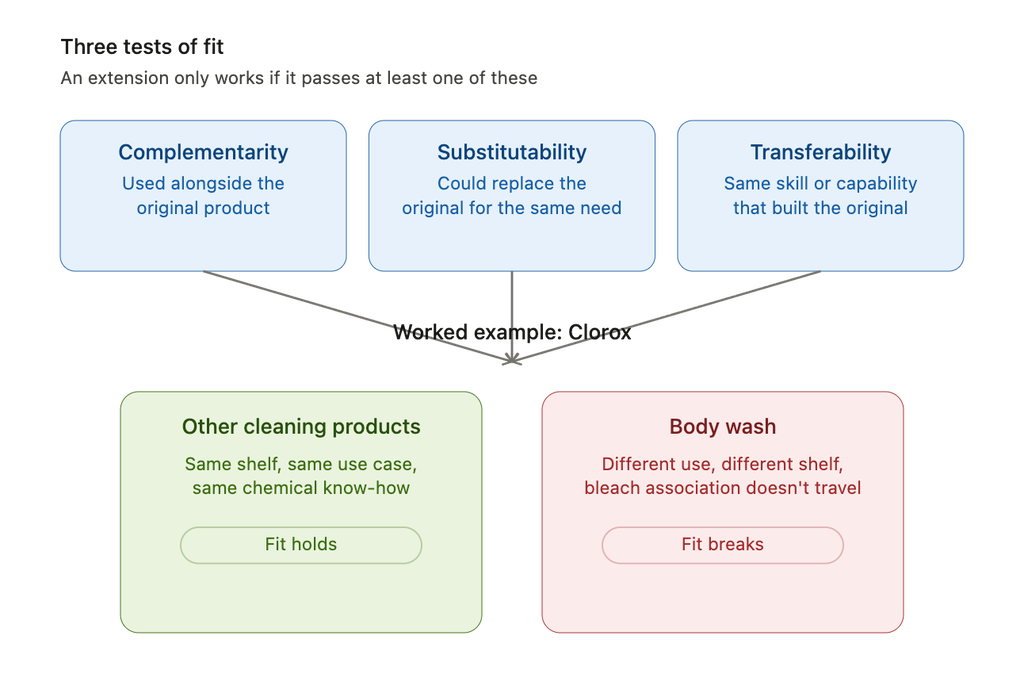
Harvard Business School’s Jill Avery frames this through the lens of brand architecture rather than just product logic. Her example is Clorox: strongly associated with bleach, the brand extends naturally into other cleaning products. A move into body wash, however, would strain the association past breaking point, because the brand’s entire meaning is anchored to a specific functional promise that doesn’t travel.
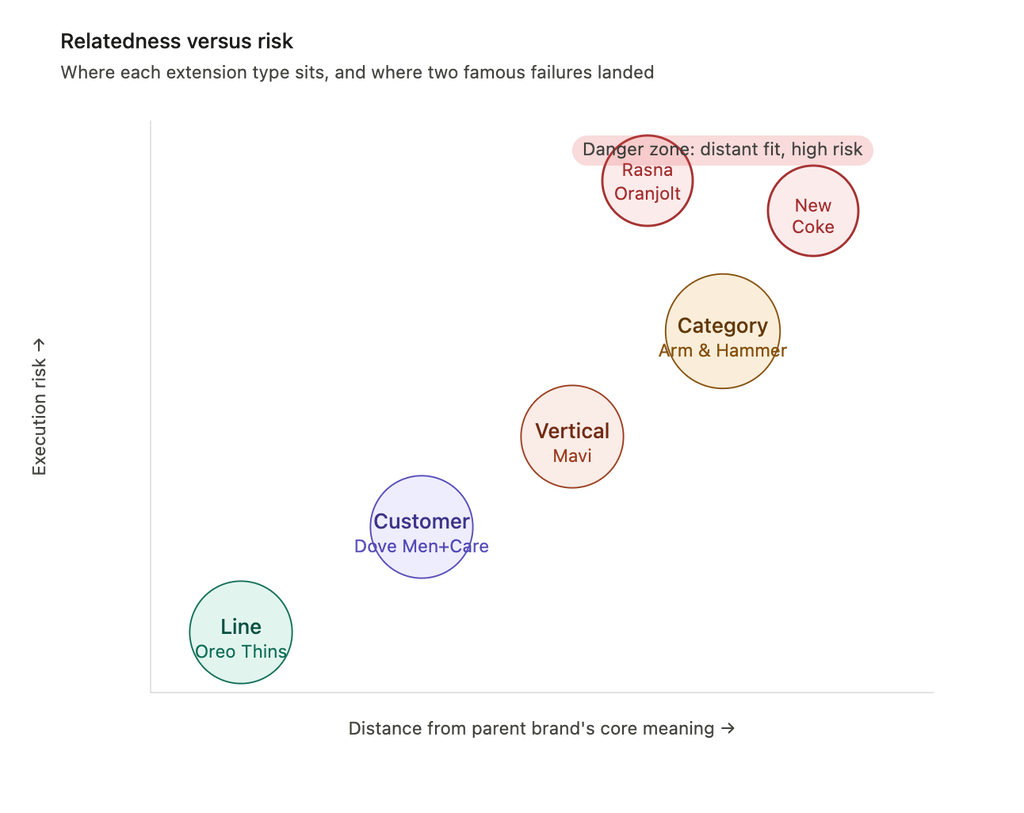
This is where most extension failures actually originate, not in poor execution but in poor category selection. Coca-Cola’s “New Coke” is the most famous cautionary tale in the Western canon: extensive R&D on taste and almost no research on the emotional attachment consumers had to the original. Closer to home, Rasna’s Oranjolt failed for more mundane but equally instructive reasons. A fizzy fruit drink that required refrigeration didn’t align with Rasna’s existing retail and distribution realities. The product idea may have been sound. The fit with the parent’s operating model wasn’t.
The four ways extension can hurt you
The evidence, both academic and practitioner, converges on a consistent set of risks. Worth holding in mind before any extension decision:
Brand dilution. Stretch a name across enough unrelated categories and its meaning blurs. Customers can no longer quickly articulate what the brand is actually for. Once that clarity goes, repositioning is expensive and slow.
Image transfer in the wrong direction. Extension is supposed to be a one-way street, with the parent lending credibility to the new product. But it isn’t always one-way. A weak or poorly executed extension can damage perceptions of the original. Brand extensions can dilute brand image regardless of how the extension itself performs; a failed extension simply makes the dilution worse.
Cannibalisation. A new line that competes for the same customer wallet as the original, without expanding the total pie, isn’t growth. It’s redistribution with an extra manufacturing cost attached.
Forgone optionality. Every rupee and every hour spent stretching an existing name is a rupee and an hour not spent building a new one. Sometimes the right call is a new brand, even though it costs more upfront, because the category genuinely doesn’t fit anywhere on the parent’s existing meaning.
Three patterns worth knowing
It helps to separate the extension strategy into three distinct shapes rather than treating it as one generic move.
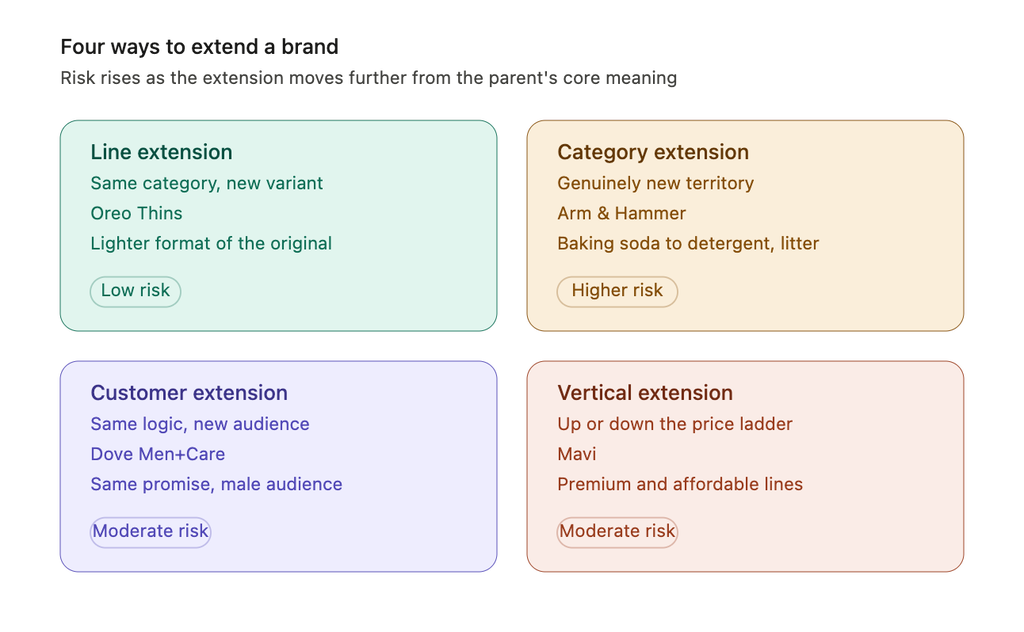
Line extensions stay inside the existing category: new flavours, sizes, and formats. Low risk, because the brand’s meaning transfers naturally. Oreo Thins is the standard example, a lighter format of an unmistakably familiar product.
Category extensions move the brand into genuinely new territory. Arm & Hammer’s journey from baking soda into laundry detergent, cat litter, and oral care is the textbook case. It’s riskier because it depends entirely on customers carrying their trust in the parent across a category boundary, against entrenched category leaders who already own that space.
Customer extensions keep the category logic largely the same but target a new audience. Dove Men+Care is the cleanest example: same brand promise, same care-and-confidence positioning, redirected at a male audience as that market opened up. This worked because Dove didn’t change what it stood for. It changed who it was speaking to.
A fourth pattern, common in Indian markets, deserves mention: vertical extension, which moves a brand up or down the price-quality ladder. Mavi, the Turkish apparel brand, did this in both directions simultaneously during an inflationary period, launching premium lines to capture aspirational buyers and more affordable lines to retain price-sensitive ones, without diluting the core. It’s a useful model for Indian D2C brands navigating similarly uneven consumer spending power across a single market.
The licensing route
There’s a structural option that founders without manufacturing capability in the new category often overlook: licensing. Instead of building or acquiring capability in an unfamiliar category, a brand owner can license the name to a third party. The licensee takes on manufacturing, distribution, and sales and pays the brand owner a royalty on net revenue. The brand owner extends reach without capital investment or the multi-month grind of business integration.
This is a meaningfully different risk profile from building the extension in-house and is worth considering seriously when the new category is a strong conceptual fit but an operational stretch.
A working checklist before you extend
Strip away the jargon and the decision comes down to four honest questions:
- Does the parent brand’s core association genuinely transfer to the new category, or are you hoping it will?
- Will the new product meet or exceed the quality standard the parent brand has already set, because anything less drags the original down with it?
- Is there a real, structural reason this extension belongs under your name rather than a new one, beyond “it’s cheaper to launch this way”?
- And does the team have the appetite to invest properly in the launch, rather than assuming the parent brand’s equity will do the heavy lifting on its own?
Brand extension is one of the most efficient growth tools available to a business with an established name. It is also one of the easiest ways to quietly erode years of brand-building if the fit isn’t real and the execution isn’t disciplined. The brands that get it right, Colgate, Dove, Arm & Hammer among them, treat extension as an act of stewardship over the parent’s meaning, not just a shortcut to a new revenue line. That distinction is the whole game.