The Obsession With New Customers Is Costing Businesses More Than They Realise
Why do some customers stay for years while others leave? Discover how customer retention drives profitability, loyalty, and sustainable business growth.
Most companies celebrate new customers.
Sales teams are rewarded for bringing them in. Marketing campaigns are judged by how many they attract. Investors often view customer acquisition as the clearest sign of growth.
Yet there is a paradox at the heart of modern business.
The customer who is hardest to acquire is often the most valuable one to keep.
And the customer who is easiest to lose is often the one a business can least afford to replace.
For decades, growth has been synonymous with acquisition. More leads. More prospects. More first-time buyers. The assumption is understandable. A growing customer base signals momentum.
But growth and profitability are not always the same thing.
Why Retention Makes Better Business Sense
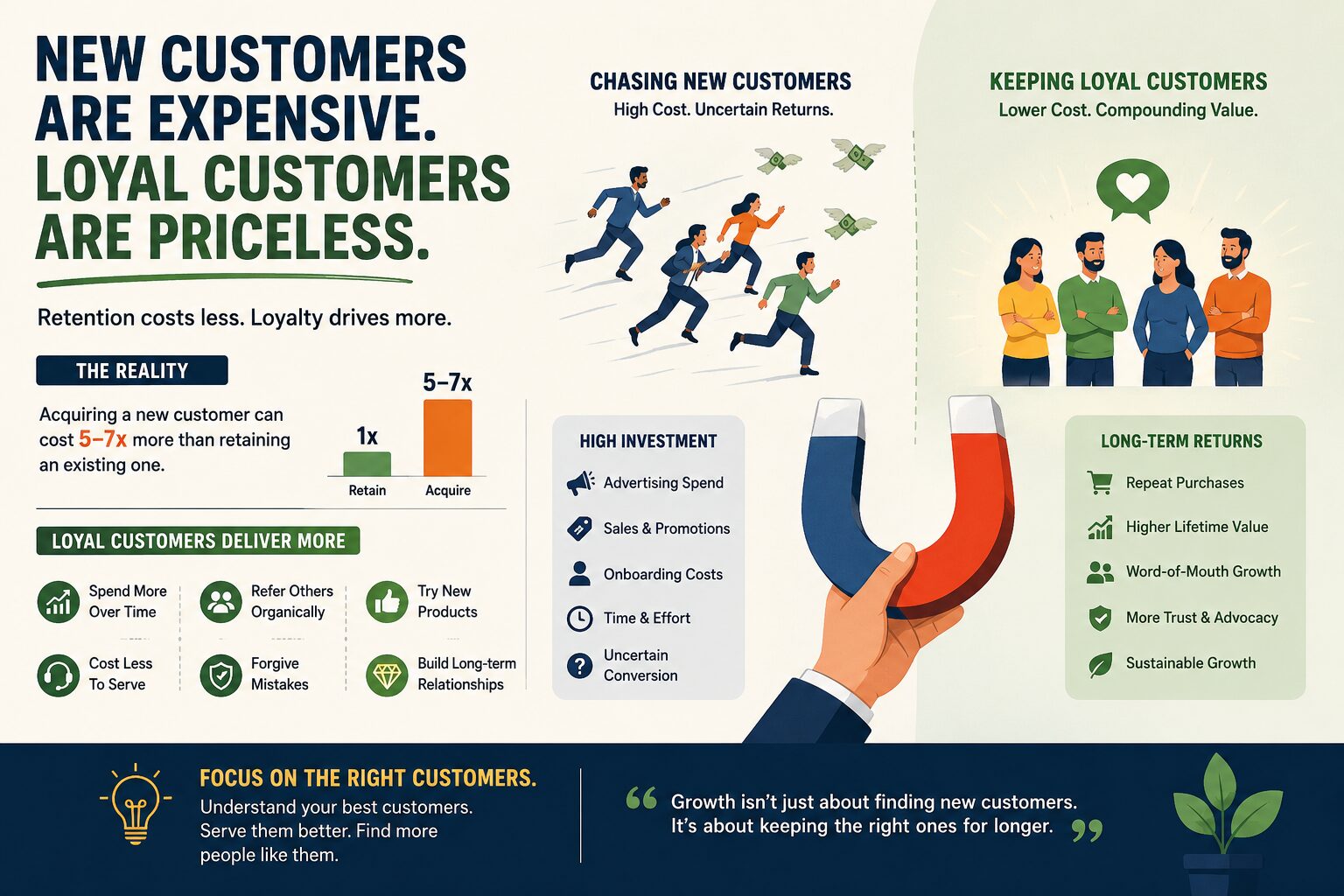
Every new customer comes with a cost:
- Advertising and media spend
- Sales and business development costs
- Promotional discounts and offers
- Onboarding and customer support expenses
- Time and effort required to build trust
Existing customers, on the other hand, already know the brand, trust the product, and require significantly less effort to convert into repeat buyers.
Research across industries consistently shows that retaining customers is far more cost-effective than acquiring new ones. More importantly, loyal customers tend to spend more over time, making them disproportionately valuable to the business.
The Hidden Value of Loyal Customers
A loyal customer contributes far more than recurring revenue.
They often:
- Purchase more frequently
- Try new products and services
- Generate word-of-mouth referrals
- Provide valuable feedback
- Show greater tolerance when occasional mistakes occur
- Become advocates for the brand
This is why customer retention is not merely a marketing metric. It is a business growth strategy.
The lifetime value of a customer often matters far more than the value of their first transaction.
What the World’s Best Brands Understand
Some of the most successful companies have built their growth engines around customer retention rather than customer acquisition.


Apple: Building an Ecosystem, Not Just Products
Apple’s success extends beyond selling devices.
An iPhone customer often becomes an Apple Watch user, an AirPods owner, an iCloud subscriber, and eventually a Mac customer. Each product strengthens the relationship and increases the value customers derive from remaining within the ecosystem.
Apple understands that long-term growth comes from deepening relationships, not simply expanding reach.
Costco: Turning Loyalty Into a Business Model
Costco’s business depends heavily on membership renewals.
The company focuses relentlessly on delivering value so that customers continue renewing year after year. Rather than maximising profits from individual transactions, Costco prioritises long-term customer relationships.
Amazon Prime: Making Loyalty Convenient
Amazon transformed customer retention through its Prime membership program.
Fast delivery, entertainment content, exclusive offers, and convenience combine to create a compelling reason for customers to remain engaged with the brand.
Indian Brands That Have Mastered Customer Loyalty
Indian businesses offer equally powerful lessons in retention.



Amul: Decades of Trust
Amul has become a household name by consistently delivering quality, affordability, and reliability.
Its success demonstrates that customer loyalty is often built through consistency rather than constant reinvention.
Asian Paints: Solving Bigger Problems
Asian Paints realised that consumers do not simply buy paint.
They want beautiful homes, expert advice, and a hassle-free experience.
By expanding beyond products into services and solutions, the company strengthened customer relationships and increased repeat business.
Titan: Creating Emotional Connections
Titan has positioned itself around important life moments such as graduations, weddings, anniversaries, and achievements.
When a brand becomes part of personal milestones, loyalty moves beyond functionality and becomes emotional.
Why Customers Really Stay
Many businesses assume customers remain loyal because of discounts or rewards.
In reality, loyalty is usually driven by deeper factors.
Customers stay when they experience:
- Consistent product quality
- Reliable service
- Convenience and ease of use
- Strong customer support
- Emotional connection
- Trust and transparency
- Superior overall experience
The strongest brands make customers feel that switching would involve giving up something valuable.
The Most Important Question Businesses Should Ask
Many companies spend significant resources studying potential customers.
Far fewer spend enough time understanding their best existing customers.
Instead of asking, “How do we get more customers?” leaders should ask:
“Why do our best customers continue to choose us?”
The answer often reveals:
- What truly differentiates the brand
- Which products create the most loyalty
- Which customer segments are most valuable
- What drives referrals and advocacy
- Where future growth opportunities lie
In many cases, the blueprint for future growth already exists within the current customer base.
Acquisition and Retention Are Not Opposites
This is not an argument against acquiring new customers.
Every business needs a healthy flow of new buyers.
The mistake occurs when organisations focus exclusively on acquisition while neglecting retention.
The most successful companies balance both by:
- Acquiring the right customers
- Delivering consistent value
- Building long-term relationships
- Increasing customer lifetime value
- Encouraging advocacy and referrals
Growth becomes far more sustainable when retention and acquisition work together.
Final Thoughts
Products can be copied.
Features can be replicated.
Prices can be matched.
Customer loyalty is much harder to imitate.
The companies that outperform over the long term are rarely those that acquire the most customers. More often than not, they are the ones who understand their existing customers better than anyone else.
Before spending millions to find the next customer, businesses should ask a simpler question:
What makes our best customers stay?
The answer may be the most valuable growth strategy hiding in plain sight.