Signal Is the New Currency
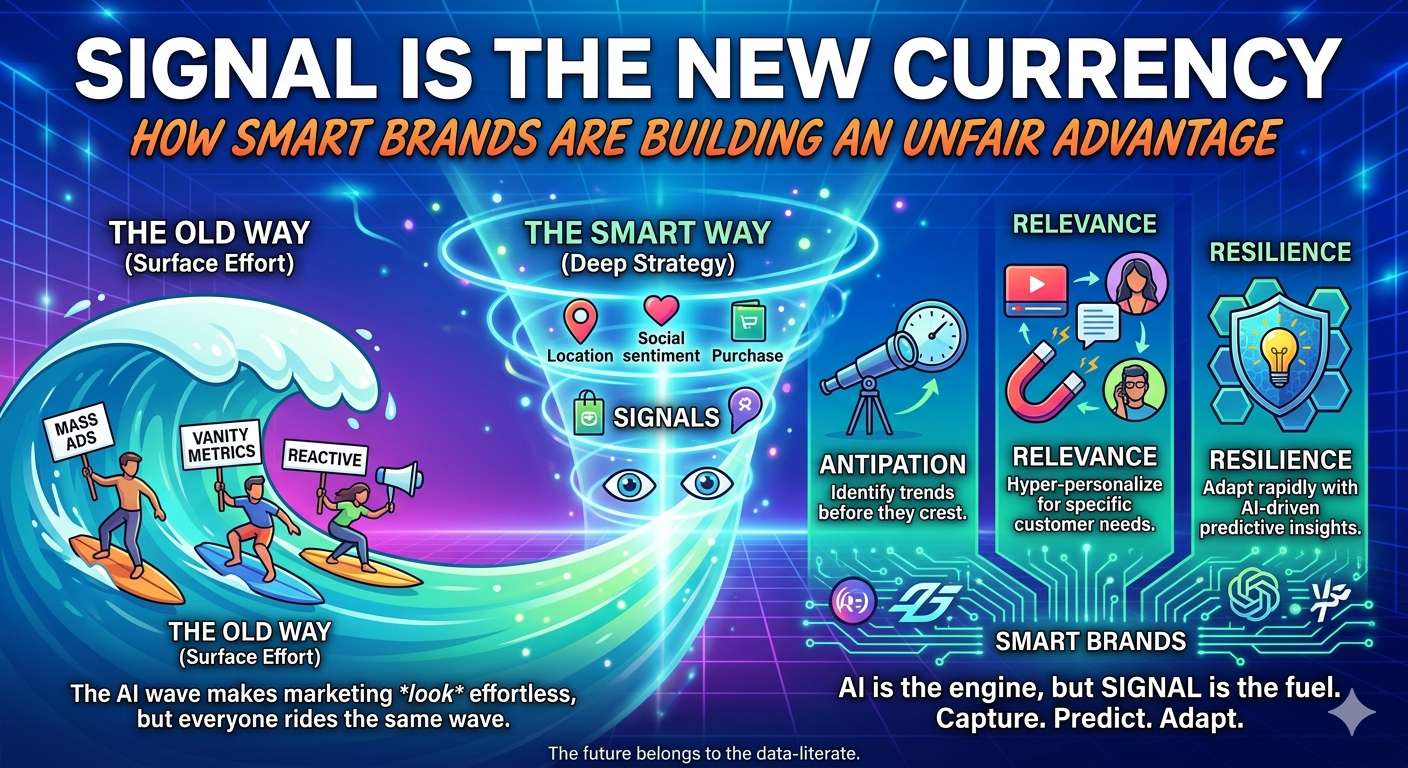
How Smart Brands Are Building an Unfair Advantage. The AI wave has made marketing look effortless on the surface.
Campaigns launch faster. Dashboards refresh in real time. Optimisation feels almost automatic. But beneath that smooth interface, the real competitive ground has shifted.
It is no longer about tools. It is no longer about which platform you are on, how large your team is, or even how sophisticated your creative is.
It is about signals.
And the brands that understand this are quietly pulling ahead, not because they have better technology, but because they have better inputs.
From Tools to Inputs: The Real Shift
Most marketing stacks today look remarkably similar. Whether it is Salesforce, HubSpot, or Adobe Experience Cloud, the functional gap between platforms is narrowing fast.
AI has accelerated this convergence. What once required teams of analysts can now be done in seconds. Campaign insights, customer segmentation, even creative suggestions – these are becoming commoditised capabilities.
So where does differentiation come from?
From what feeds these systems. A platform is only as powerful as the signals it receives.
The input quality problem is, in many ways, the central strategic problem of the AI era in marketing. Get it wrong, and you optimise faster toward the wrong outcome. Get it right and the advantage compounds.
Signal Quality Is Strategy, Not Plumbing
This is not a data architecture conversation. It is a strategy conversation.
Consider Amazon. Its recommendation engine is not powerful because of algorithms alone. It works because of the depth and fidelity of signals. Every search, every purchase, every review, and even the pause on a product page feeds the system. The algorithm has rich material to work with.
Contrast that with a smaller e-commerce brand relying heavily on third-party ads and marketplace data. It sees outcomes, not behaviour. It knows what sold, not why. That gap – the signal gap – is a strategic gap.
Netflix offers another instructive case. It does not merely track what you watch. It tracks when you pause, when you abandon, which thumbnail you respond to, and how your preferences shift across seasons and moods. These are high-fidelity signals tied to individual identity and real-time context. That is why its personalisation feels intuitive rather than mechanical.
In both cases, the signal quality is not incidental to the business model. It is central to it.
The Power of Owned Ecosystems
Brands that control their environments generate stronger signals – and stronger strategies.
Take Nike. Through Nike Training Club and Nike Run Club, the brand captures far more than purchase data. It understands fitness habits, engagement patterns, and lifestyle intent. This allows Nike to move from selling products to shaping behaviour – a fundamentally different market position.
Starbucks has built one of the most sophisticated first-party data ecosystems through its mobile app. It tracks purchase frequency, preferred items, visit times, and responsiveness to offers. The result is not just better marketing. It is predictive marketing. Offers feel timely because they are constructed on a foundation of strong, clean, owned signals.
In the Indian context, Tata Neu represents an ambitious attempt to build a similar owned signal ecosystem – aggregating data across retail, hospitality, financial services, and travel under a single loyalty identity. The strategic logic is identical: own the ecosystem, own the signal.
When You Do Not Own the Signal
The inverse case is instructive.
A restaurant brand operating primarily through Swiggy or Zomato sees transactions but has limited access to deeper behavioural patterns. Customer ownership and, therefore, signal ownership sits with the platform, not the brand.
This creates a structural disadvantage that goes beyond marketing. Without direct signals, personalisation weakens. Retention becomes harder. Loyalty becomes platform-dependent. And marketing becomes increasingly expensive because the brand is perpetually buying back access to its own customers.
The same dynamic plays out for any brand that has allowed an intermediary, whether a marketplace, aggregator, or social platform, to sit between itself and its customer. Convenience has a cost. That cost is often strategic invisibility.
Signals Across the Ecosystem
Signals do not come from one place, and the most valuable intelligence often emerges from connecting them.
Platforms like Google and Meta generate intent and engagement signals at scale. TikTok captures discovery and content behaviour. Retail networks like Flipkart and Amazon reflect purchase patterns. Each contributes a piece of the picture.
But the real advantage emerges when these signals are integrated.
Consider a consumer who discovers a skincare brand on Instagram Reels, searches for reviews on Google, reads a comparison article, watches a YouTube testimonial, and finally purchases through the brand’s own app. Individually, each interaction is a data point. Together, they tell a story about the length of the consideration journey, the role of different channels, and the questions that needed to be answered before trust was established.
Brands that integrate across these signals understand not just conversion, but the full arc of decision-making. That is a very different, and considerably more powerful kind of intelligence.
Measurement as the Hidden Engine
This is where the measurement layer becomes decisive.
Tools like AppsFlyer, Adjust, and Branch do not create demand. They make sense of it. They connect signals across platforms, accurately attribute outcomes, and help brands understand incrementality – not just correlation.
Did this campaign actually drive new users, or did it capture users who would have converted regardless? Did the influencer partnership expand reach, or merely reach the already-converted? These are the questions that separate efficient growth from its illusion.
Without a proper measurement infrastructure, signals remain fragmented and misleading. With it, they become genuinely actionable. The measurement layer is not a reporting function. It is a strategic function – and brands that treat it as administrative overhead tend to make expensive mistakes at scale.
AI Does Not Create Advantage. It Amplifies It
There is a persistent misconception that AI levels the playing field in marketing. The reverse is closer to the truth. AI widens the gap between those with strong signal ecosystems and those without.
Brands with weak signals get wrong answers faster. Brands with strong signals get the right ones faster.
Consider programmatic advertising. An AI system optimising bids based on poor conversion signals will burn budget efficiently – in the wrong direction. The same system, fed with high-quality event data and clean attribution, will compound returns. The difference is not the algorithm. It is the input.
Generative AI amplifies this further. A brand that has built a rich first-party data profile of its customers – their preferences, behaviour, context, and journey – can use AI to generate genuinely personalised content and communication. A brand working from thin, third-party data cannot. The AI is the same. The intelligence it draws on is not.
What This Looks Like in Indian Markets
This shift is visible and accelerating in Indian startups.
Zepto uses real-time purchase and browsing data to optimise inventory and personalise offers at a hyperlocal level, turning geographic constraints into a competitive advantage.
CRED has built its entire model around leveraging transaction-level insights to create highly targeted, contextually relevant experiences for premium users. The product is the data strategy.
Nykaa blends content, commerce, and behaviour tracking to understand not just what customers buy, but how they discover, evaluate, and return – creating a loop in which content generates signals, and signals improve content.
These are not accidental advantages. They are the result of deliberate architectural decisions made early and compounded over time.
The Three Signal Gaps Brands Must Close
Most brands have signal gaps in at least one of three areas. The strategic question is: which is costing you the most?
The first is the ownership gap, relying on platforms and intermediaries for customer data rather than building direct relationships. Every transaction that passes through a third party without a mechanism to recapture identity is a missed signal.
The second is the integration gap – holding signals in silos rather than connecting them across channels, devices, and touchpoints. Data that cannot talk to itself cannot produce coherent intelligence.
The third is the quality gap -collecting signals that are too proximate to outcomes and not proximate enough to behaviour. Knowing that someone purchased tells you less than knowing why they almost did not.
Closing all three requires both infrastructure and intent. Infrastructure to collect and connect. The intent to treat signal-building as a core business priority rather than a marketing function.
The Strategic Takeaway
The future of marketing advantage will not be decided by who has access to AI. Every serious brand will have access to AI. It will be decided by who owns the richest, cleanest, and most actionable signals.
That requires deliberate choices, made early and sustained over time.
Invest in owned platforms – particularly apps – that create direct, identity-linked relationships with customers. Build strong data governance and identity frameworks that allow signals to be attributed, integrated, and acted upon. Integrate signals across channels instead of optimising in silos. And stop thinking of data as exhaust – as a byproduct of commercial activity.
Data is infrastructure. Signal is strategy. The brands that build both today will not just adapt to the AI era. They will shape it.
Bibliography
References
1. Amazon recommendation engine and signal quality – McKinsey & Company. How Retailers Can Keep Up with Consumers.
2. Netflix personalisation and behavioural signals – Netflix Technology Blog. Artwork Personalization at Netflix.
3. Nike’s app ecosystem and first-party data strategy – Harvard Business Review. How Nike Became One of the Most Data-Driven Companies.
4. Starbucks loyalty programme and predictive marketing – Forbes. Starbucks: Using Big Data, Analytics And Artificial Intelligence.
5. AppsFlyer mobile measurement and attribution – AppsFlyer. Mobile Attribution: A Complete Guide.
6. Programmatic advertising and signal quality – WARC. The Signal Problem in Programmatic.
7. CRED data strategy and premium segment targeting – The Ken. CRED’s Playbook for Profitable Growth.
8. Nykaa content-commerce model – Economic Times. How Nykaa Uses Content to Drive Commerce.
9. Zepto hyperlocal data and inventory optimisation – Inc42. How Zepto Is Using Data to Win the Quick Commerce War.
10. First-party data and the post-cookie era – Google Think with Google. Build a First-Party Data Strategy.