No Toilet, No Wedding: How Harpic Turned a Toilet into a Status Symbol
What happens when a toilet becomes a marriage requirement? Harpic’s award-winning No Toilet No Wedding campaign used India’s matrimonial advertisements to make sanitation aspirational, demonstrating the power of culturally relevant marketing to influence social behaviour.
Harpic’s No Toilet, No Wedding campaign showed how advertising can change social attitudes by turning a clean household toilet into a symbol of dignity, status, and an essential marriage expectation.
Sometimes, the most powerful advertising idea is not about selling a product. It is about changing what society considers desirable.
In India, matrimonial advertisements have traditionally been about finding the right match. Families describe their sons and daughters through education, profession, income, family background and social standing. A good job, a respectable family and a comfortable home often feature prominently. But in 2017, one brand decided that something else deserved a place in these advertisements: a clean toilet.
It was an unusual proposition. What did a toilet have to do with marriage? Quite a lot, as Harpic was about to demonstrate.
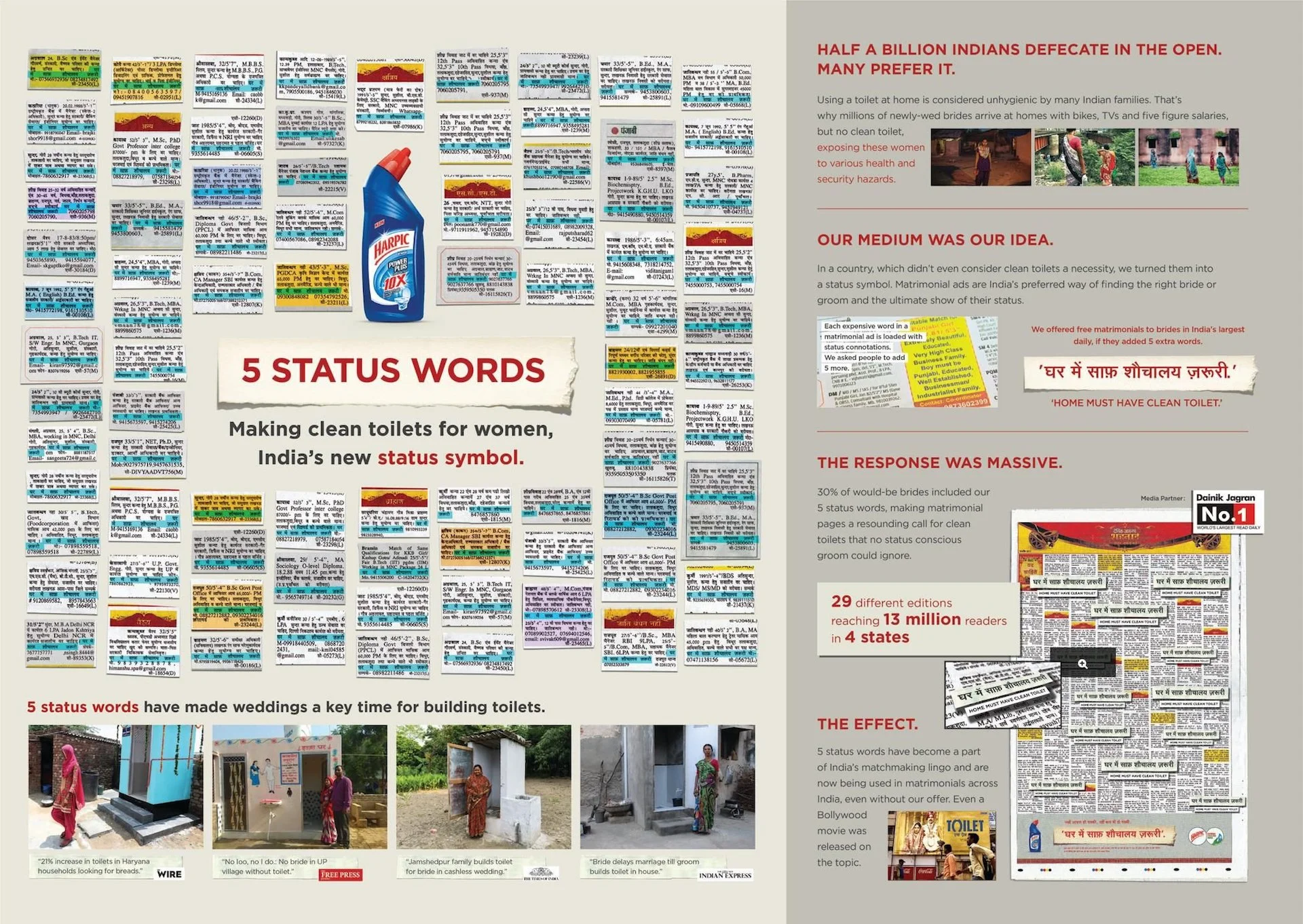
The campaign, called No Toilet, No Wedding, would use one of India’s most deeply embedded social institutions to challenge an equally deep-rooted problem: the absence of toilets and the continued practice of open defecation. Its central message was simple: Ghar mein saaf shauchalay zaroori (A clean toilet at home is essential).
Five words. A powerful social statement. And an advertising idea that would eventually win one of the industry’s most prestigious international strategy awards.
Finding the right place to make a difference
Harpic’s challenge was bigger than selling more toilet-cleaning products. In many rural households, building a toilet wasn’t a priority. Families might invest in televisions, motorcycles, better furnishings or other possessions that visibly demonstrated their financial standing. Despite its importance, a toilet often remained low on the list.
This created a peculiar business problem for Harpic. If households did not have toilets, they had little reason to buy toilet cleaners.
But it also created a much more serious human problem. Women and girls without household toilets often had to wait until dawn or dusk to relieve themselves in the open. This exposed them to health risks, compromised their privacy and, in some situations, left them vulnerable to harassment and assault.
Harpic had been associated with toilet hygiene. Through its broader Harpic Banega Swachh India initiative, the brand wanted to go beyond cleaning toilets and encourage people to build and use them.
The question was how to make families reconsider their priorities.
The answer came from an interesting observation about Indian society: marriage is not merely a union between two individuals. It is also an occasion when families demonstrate their status, aspirations and expectations. Matrimonial advertisements routinely list the qualities a prospective bride or groom should possess, as well as the attributes expected of their families.
What if a toilet could become one of those expectations?
Instead of telling people toilets were necessary for hygiene, Harpic made them necessary for marriage.
Five words that changed the conversation
In July 2017, Harpic launched its matrimonial campaign in partnership with Hindi newspaper Dainik Jagran.
The idea was disarmingly simple. Families of prospective brides were encouraged to include five additional words in their matrimonial advertisements:
Ghar mein saaf shauchalay zaroori.
A clean toilet at home is essential.
Harpic offered to pay for the matrimonial advertisements of families willing to include this condition. The campaign focused on Uttar Pradesh, Uttarakhand, Bihar and Jharkhand, regions where sanitation challenges were particularly significant.
Suddenly, something traditionally discussed as a matter of hygiene became a matter of social standing and family suitability.
The message also mattered because it gave prospective brides and their families a way to articulate an expectation directly connected to their dignity, privacy, and safety.
No long lecture about sanitation. No complicated explanation of the dangers of open defecation. Just five words inserted into a familiar social ritual.
And that was the genius of the idea.
The people behind the idea
McCann Worldgroup India created the campaign for Reckitt Benckiser (RB), the company behind Harpic. Initiative handled the media execution, while Dainik Jagran was the publication partner.
Jitender Dabas and Ankit Vohra are publicly associated with the strategic thinking. WARC’s documentation also credits Prateek Bhardwaj with the wider strategic work. Ankit Vohra, then Associate Vice President – Planning at McCann, was publicly associated with the Jay Chiat Grand Prix case study.
It is important to distinguish the publicly documented strategic contributors and agency leadership from a complete creative production credit list. Available award and campaign records do not list every individual involved in execution.
When matrimonial columns became a medium for social change
The campaign worked because it did not try to create a new social behaviour from scratch. It tapped into an existing cultural practice and subtly shifted its meaning.
Matrimonial advertisements were already public declarations of what families valued. By introducing the toilet requirement, Harpic made sanitation part of that conversation.
Several clever strategic decisions underpinned this execution.
- Cultural relevance: Instead of using conventional sanitation advertising, the brand chose matrimonial columns, where its message would feel relevant.
- Social aspiration: It transformed toilet ownership from a functional necessity into a symbol of a respectable household.
- Women’s dignity: It placed women’s privacy, safety and access to sanitation at the centre of the conversation.
- Social influence: When families saw the requirement appearing in matrimonial advertisements, it became easier for others to adopt the same expectation.
- An unconventional media choice: Rather than buying more conventional advertising space, Harpic used an existing newspaper feature to carry a meaningful social message.
The campaign reportedly reached approximately 13 million people. Around 30% of relevant matrimonial advertisements carried the five-word message. Its case-study reporting also attributed the construction of toilets in approximately 5.09 million previously toilet-less households to the initiative’s broader impact. These are campaign-reported outcomes rather than independently established causal measurements.
The recognition
The campaign received significant international recognition.
At the 2018 Jay Chiat Awards for Strategic Excellence, McCann Worldgroup India won the Grand Prix for the campaign, presented under the title Five Words That Made Toilets India’s New Status Symbol. McCann also received the agency of the Year recognition at the awards.
It also received recognition at the WARC Awards for Asian Strategy and Indian advertising effectiveness awards.
The campaign subsequently formed part of a wider Harpic effort to normalise toilet ownership and usage in India. Its broader sanitation communication included initiatives encouraging people not just to build toilets but also to maintain and use them.
The bigger lesson for marketers
What makes No Toilet, No Wedding particularly interesting is that it demonstrates how brands can influence behaviour without behaving like teachers or social campaigners.
Harpic understood the problem wasn’t simply a lack of awareness. For many families, the toilet was competing with other household investments that offered greater perceived social value.
Rather than asking people to change their priorities, the brand changed the way they perceived the toilet.
It found an existing social currency, marriage, and gave sanitation a place within it.
The campaign also demonstrated an important marketing principle: sometimes, the most effective way to sell a product is first to create the need for the category itself. Harpic could not sell more toilet cleaner to households without toilets. By encouraging toilet construction and ownership, it was also helping create a larger market for its own products.
But its achievement went beyond commercial opportunity.
A toilet became more than a household facility. It became a statement about dignity, security and the kind of home a family wanted its daughter to enter.
And it all began with five words in a matrimonial advertisement.
Sometimes, great advertising does not change what people buy. It changes what people believe is worth having.