Barriers to Pet Food Nutrition Communication by Vets: Making the Conversation Easier
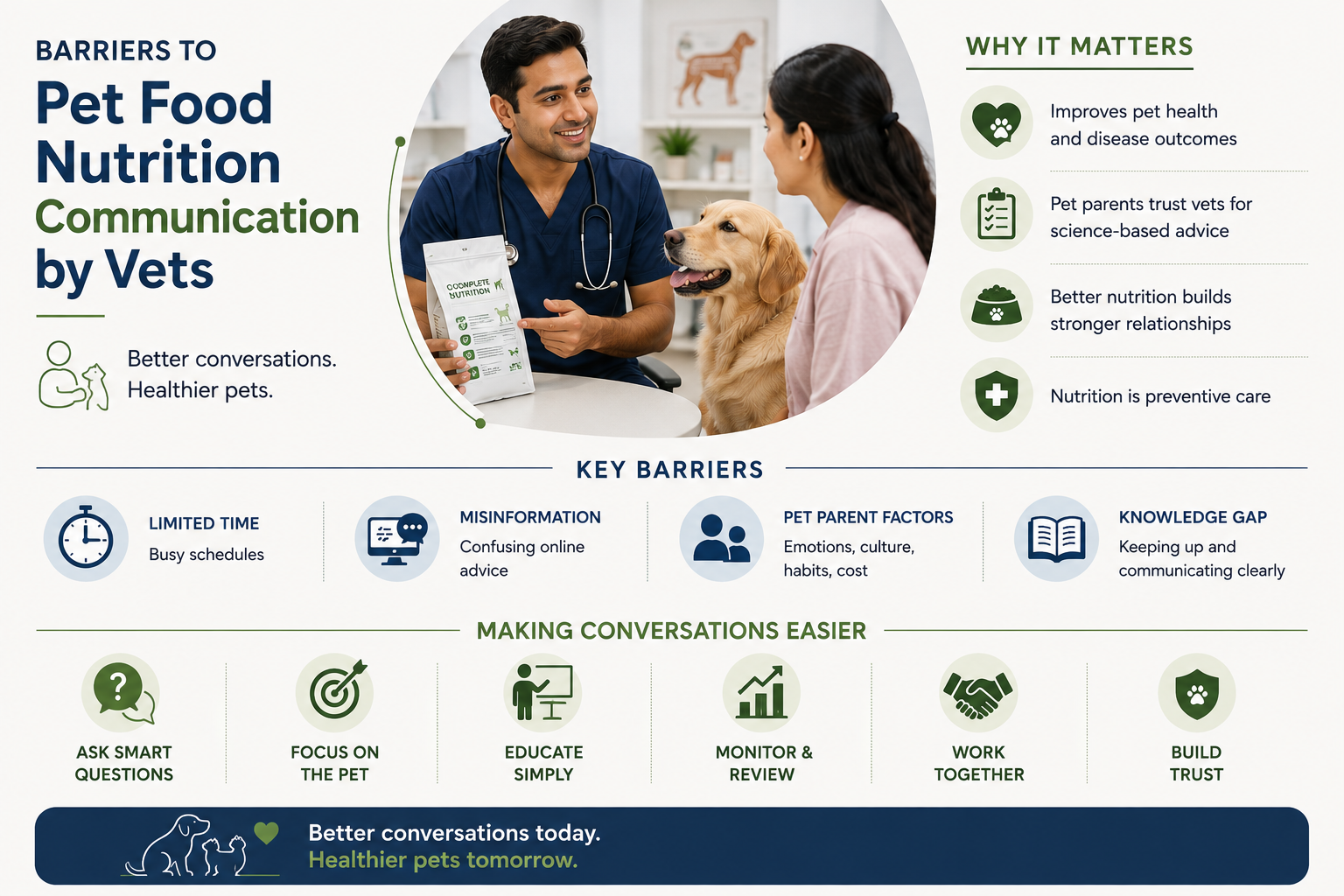
Veterinarians play a vital role in pet nutrition, but time constraints, misinformation and changing pet parent expectations can make nutrition conversations challenging. Here is how vets and the pet food industry can make those conversations easier.
For most pet parents, the veterinarian remains one of the most trusted sources of advice about their pet’s health. That trust creates an important opportunity for veterinarians to influence one of the most fundamental aspects of animal health: nutrition.
Yet nutrition conversations do not always receive the attention they deserve during veterinary consultations. This is not because veterinarians underestimate nutrition. Veterinary consultations are busy, clinical priorities compete for attention, pet parents often arrive with firmly held opinions, and the amount of nutrition information available online has exploded.
The challenge, therefore, is not simply to get veterinarians to talk more about food. It is to make good nutrition conversations easier, more practical and more useful for both veterinarians and pet parents.
Nutrition is part of preventive veterinary care
Nutrition is connected with virtually every aspect of companion animal health. Body weight, muscle condition, gastrointestinal health, urinary health, skin and coat condition, metabolic health and the management of chronic disease can all be influenced by diet. Global veterinary guidelines increasingly recognise nutritional assessment as part of routine veterinary care. The American Animal Hospital Association, for example, recommends nutritional assessment during every examination, including evaluation of body condition and muscle condition, followed by appropriate nutritional recommendations.
A veterinary nutrition conversation can help a pet parent understand:
- What should my pet eat?
- How much should my pet eat?
- How often should my pet eat?
- What treats are appropriate?
- When should the diet change as my pet ages?
- When should nutrition change because of a medical condition?
These are not simply food questions. They are healthcare questions.
The consultation clock is the first barrier
Veterinary consultations rarely happen in an ideal environment. A dog may arrive with vomiting. A cat may have a urinary problem. A puppy may require vaccinations. An older dog may have several age-related conditions. The veterinarian needs to examine the animal, establish a diagnosis, explain the condition, prescribe treatment, answer the owner’s questions and discuss follow-up, all within a limited amount of time. Nutrition can easily become secondary.
Research involving small animal veterinarians has identified limited consultation time as one of the important barriers to nutrition communication. Other challenges include misinformation, owner resistance and difficulties keeping pace with the expanding volume of nutrition information. The answer is not necessarily another lengthy discussion. Instead, nutrition needs to become part of the clinical conversation in a way that is quick, structured and relevant.
A few simple questions can open the door:
- What does the pet eat every day?
- How much does it receive?
- How many treats does it get?
- Who feeds the pet?
- Has its weight changed recently?
- Is the pet receiving supplements or human food?
These questions can reveal much more than a discussion about brands alone. They can also help the veterinarian identify whether nutrition needs to become part of the immediate clinical plan or can be addressed during a subsequent consultation.
The internet has changed the nutrition conversation
Veterinarians are no longer the only people providing pet nutrition advice. Pet parents now have access to YouTube videos, Instagram and Facebook posts, Reddit discussions, pet blogs, breeders, pet retailers, influencers, online communities and AI-generated information. Some of this information is useful. Some is misleading. Some is simply incomplete.
The difficulty is that misinformation often arrives packaged in very persuasive language. “Natural is always better.” “Grain free is healthier.” “High protein is always better.” “Chicken causes allergies.” “Commercial food is processed, so homemade must be healthier.” These statements may sound convincing, but nutrition cannot be evaluated through one ingredient, one claim or one social media post.
The veterinarian has something most online sources do not have: clinical context. The veterinarian knows the animal’s age, health status, body condition, medical history, lifestyle and treatment requirements. The challenge, then, is not simply to correct misinformation. It is to translate nutrition science into something the pet parent can understand, trust and apply.
This can actually strengthen the veterinarian’s relationship with the pet parent. Instead of competing with information available online, the veterinarian can become the person who helps the owner make sense of it.
Pet parents are not starting with a blank sheet
Nutrition is emotional. People choose food for their pets based on experience, culture, family habits, affordability, convenience and their own understanding of what constitutes healthy food. That is particularly important in India, where home prepared feeding has traditionally been part of companion animal care. Rice, roti, vegetables, eggs, meat, dairy products and other household foods may all find their way into a pet’s bowl.
This does not automatically make a homemade diet inappropriate. The issue is whether the overall diet meets the animal’s nutritional requirements. Research from India illustrates the importance of this distinction. Studies of pet dogs in regions including Kerala and Kashmir have found substantial reliance on homemade diets and have highlighted the need for greater awareness of scientifically appropriate feeding practices.
For veterinarians, this means nutrition conversations need to be culturally sensitive and practical. Rather than simply telling a pet parent that everything they have been feeding is wrong, the conversation can explore what is already working, where nutritional gaps might exist, what the animal specifically requires and what changes are realistic for the household. This approach respects the pet parent’s intentions while keeping the discussion evidence based.
In many Indian households, feeding a pet is also an expression of affection. A family member may cook specially for the dog, share food from the table or believe that a homemade meal demonstrates greater care than packaged food. A successful nutritional conversation needs to recognise that emotional dimension. The veterinarian is not simply changing a diet. In some cases, the veterinarian is asking the family to change a behaviour associated with caring for its pet.
The conversation should begin with the pet, not the product
One of the most important opportunities for veterinary nutrition communication is to move away from starting with a food brand. The starting point should be the animal. Relevant considerations include age and life stage, breed and body size, activity level, body condition, muscle condition, medical history, current diet, treat intake, supplements and specific health concerns.
The veterinarian can then explain why a particular nutritional approach makes sense for that individual animal. This makes the conversation clinical rather than commercial.
Instead of simply saying, “You should feed this food,” the conversation becomes, “Your dog is gaining weight, so we need to reduce calorie intake while maintaining adequate nutrition. This feeding approach can help us achieve that, and we will monitor the response.”
That is a fundamentally different conversation. It explains the clinical reasoning behind the recommendation and gives the pet parent a reason to trust it.
Ingredient conversations need context
Modern pet parents are increasingly interested in ingredients. They ask about protein sources, grains, probiotics, omega fatty acids, supplements, preservatives, additives and functional ingredients. This interest can be positive because it creates an opportunity for veterinarians to educate.
But individual ingredients do not tell the complete nutritional story. A food needs to be considered in terms of its overall formulation, nutritional adequacy, energy density, digestibility, feeding quantity and suitability for the individual animal. A food that contains a fashionable ingredient is not automatically the right food for every animal.
This is where veterinary expertise becomes particularly valuable. A pet parent may understand that a food contains high protein, but the veterinarian can explain whether that level is appropriate for this particular animal. A pet parent may understand that a food contains probiotics, but the veterinarian can explain whether there is a meaningful reason to use them and what outcome should reasonably be expected. A pet parent may prefer homemade food, and the veterinarian can explain how that diet can be made nutritionally complete.
The conversation therefore moves from ingredient marketing to nutritional relevance.
Veterinarians do not need to become nutrition lecturers
Another important consideration is communication style. Veterinarians have extensive scientific training, but pet parents do not necessarily need all the science behind a nutritional recommendation. They need to understand the practical implication.
For example, the scientific principle may be that energy intake needs to be appropriate for the animal’s metabolic requirements. The pet parent may simply need to hear, “Your dog is currently getting more calories than he needs, so we need to adjust his food and treats.”
The science remains important. The communication becomes actionable.
Research into veterinary nutrition communication has identified gaps not only in time but also in confidence and communication skills around nutrition. Some veterinarians have reported feeling that their formal training did not fully prepare them for the practical communication of nutrition recommendations. This is an opportunity for continuing veterinary education. Nutrition communication should be treated as a clinical skill, not merely a knowledge area.
The objective is not to make every veterinarian a specialist veterinary nutritionist. It is to ensure that every veterinarian feels comfortable initiating a basic nutrition conversation, identifying when more detailed nutritional intervention is required and knowing when referral to a veterinary nutrition specialist is appropriate.
Trust matters more than ever
There is another reason nutrition conversations can sometimes be difficult. Pet parents may wonder whether a recommendation is based on clinical need or commercial influence. This is a challenge for the entire veterinary and pet food ecosystem.
The solution is transparency. A veterinarian can explain the nutritional requirement first and then explain why a particular diet meets that requirement. The distinction is important.
“I recommend this because I sell it” creates a commercial relationship.
“I recommend this because it meets the nutritional requirements of your pet’s current condition, and here is what we will monitor” creates a clinical relationship.
The second approach strengthens trust. It also gives pet parents a framework for evaluating other foods responsibly. The veterinarian does not need to dismiss other brands or feeding approaches. Instead, the focus can remain on nutritional adequacy, individual requirements and measurable health outcomes.
India needs a practical nutrition conversation
India’s companion animal market is changing rapidly. Pet parents are spending more on food, treats, supplements, preventive healthcare, specialised diets and functional nutrition products. At the same time, the market has become crowded with nutritional claims.
This creates an unusual paradox. There is more pet nutrition information than ever before, but the pet parent may still struggle to answer a basic question: “What is actually right for my dog or cat?”
Veterinarians are uniquely positioned to answer that question because they can connect nutrition with the animal’s clinical condition. That position becomes even more important as Indian pet ownership evolves from traditional feeding practices towards a combination of commercial food, homemade meals, treats and supplements.
The veterinarian can help pet parents navigate that transition without dismissing their existing practices. The conversation can recognise the family’s feeding habits while introducing the principles of nutritional adequacy, portion control, life stage requirements and condition specific feeding.
This is particularly important as the Indian pet care market becomes more sophisticated. Pet parents may increasingly be willing to spend on premium food and supplements, but willingness to spend does not automatically translate into nutritional understanding. The veterinarian can help separate genuine nutritional value from marketing language.
The pet food industry can make the veterinarian’s job easier
The responsibility for better nutrition communication should not sit entirely with veterinarians. Pet food companies also have an important role. They can provide veterinary professionals with evidence based nutritional information, clear explanations of formulation and nutritional adequacy, practical feeding guides, portion guidance, client education material, resources addressing common nutrition misconceptions and transparent evidence supporting product claims.
The most useful resources should help the veterinarian have a better conversation. They should not turn the consultation into a product presentation.
This distinction is particularly important in a market where pet parents are increasingly sceptical of marketing claims. Veterinary professionals need information that enables independent clinical judgement. The stronger the scientific evidence and transparency behind the information provided to vets, the easier it becomes to build confidence.
The veterinary team can become part of the solution
Nutrition communication does not necessarily have to rest entirely on the veterinarian. Depending on the practice structure, veterinary nurses, technicians and trained support staff can reinforce basic nutrition messages.
The veterinarian can make the clinical recommendation, while the wider team can help reinforce:
- Feeding quantities
- Treat management
- Weight monitoring
- Feeding schedules
- Follow up requirements
- Changes that need to be reported
This creates continuity. The message does not end when the consultation ends. It becomes part of the pet’s ongoing care.
For practices, this can also create a more systematic approach to preventive healthcare. Nutrition does not have to be treated as an isolated subject that depends entirely on whether an individual veterinarian remembers to raise it during a busy consultation.
From one conversation to continuous nutritional care
Perhaps the biggest opportunity is to stop viewing nutrition as a one time recommendation. Nutrition changes throughout an animal’s life. A puppy becomes an adult. An adult dog becomes a senior. Activity levels change. Body weight changes. Medical conditions develop. Medications may influence appetite or metabolism. The diet may therefore need to change too.
This makes nutrition an ongoing clinical conversation.
A useful framework for veterinary practices could be:
Assess → Explain → Recommend → Monitor → Review
Assess: Understand the current diet, treats, supplements and nutritional status.
Explain: Explain what the animal needs and why.
Recommend: Suggest an appropriate feeding strategy based on the animal’s individual requirements.
Monitor: Track weight, body condition, muscle condition and relevant health indicators.
Review: Reassess the diet as the animal’s age, lifestyle or health status changes.
This approach turns nutrition into a continuous component of preventive veterinary care rather than a one time discussion about food.
Better communication does not mean more communication
The goal should not be to make every veterinary consultation longer. It should be to make nutrition easier to incorporate into the consultation.
One or two relevant questions can identify a nutritional issue. One clear explanation can correct a misconception. One practical recommendation can change feeding behaviour. One follow up question can establish whether the recommendation is working.
That is valuable clinical communication.
It is also an area where technology and practice systems can help. A simple nutritional questionnaire completed before the consultation, a body condition scoring tool, a standard feeding history or a follow up message can reduce the amount of consultation time required for basic nutrition assessment.
The objective is to make the right conversation easier to have.
The veterinarian remains the trusted bridge
The pet nutrition landscape will continue to become more complicated. New ingredients will emerge. New diets will appear. New supplements will enter the market. Social media will generate new claims. Pet parents will continue to experiment and ask questions.
In that environment, the veterinarian’s role becomes more important, not less.
The veterinarian does not need to compete with influencers, food brands or online communities. The veterinarian needs to provide something they cannot reliably provide: clinical context.
A food is not simply a food. It is part of an individual animal’s health management.
That is the conversation veterinarians are uniquely qualified to lead.
For India, this represents a significant opportunity. The objective should not be to replace traditional feeding practices with commercial food, nor to dismiss pet parents’ preferences. The objective should be to help every pet parent understand what their animal actually needs and why.
The best way to achieve that is not through more information.
It is through better conversations between veterinarians and the people who care for their animals.
Good nutrition communication does not make the veterinarian a food salesperson. It makes nutrition a stronger part of veterinary care.