Unforgotten Brands: Vidyarthi Bhavan – From Student Canteen to Bengaluru Icon
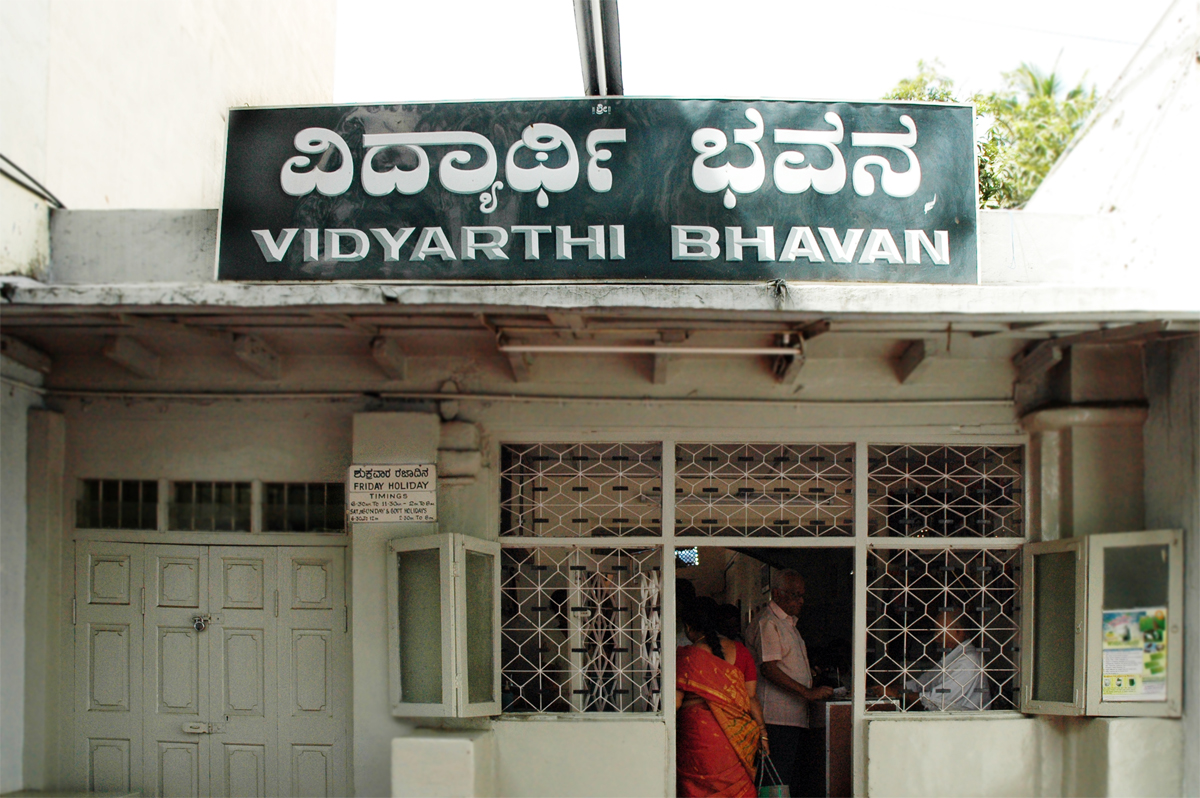
Discover Vidyarthi Bhavan transformed from a modest student canteen into Bengaluru’s iconic heritage restaurant.
Tucked away in Gandhi Bazaar, Basavanagudi, stands a small eatery that has managed to do something extraordinary: remain exactly as it was while the world changed around it. Vidyarthi Bhavan, whose name means ‘Student House’ in Kannada, isn’t just a restaurant. It’s a window into old Bengaluru, a place where time seems to have paused since 1943.
The restaurant has transcended its modest beginnings to become a cultural landmark. Not through franchises or marketing, but through something far more durable: the simple act of serving the same meal, the same way, every single day for over eight decades. Writers come here to think. Politicians stop by for breakfast. Cricketers and poets have sat at shared tables, waiting their turn.
Yet ask most people what Vidyarthi Bhavan is known for, and the answer is immediate: its masala dosa. That crispy, golden disc has become so synonymous with the place that people stand in queues, sometimes for hours, just to taste it.
How It Began: A Solution to a Problem
In 1943, Gandhi Bazaar was thriving with schools and colleges. Young students from small towns and villages had migrated to Bengaluru for education, but finding decent, affordable food was a challenge. Venkataramana Ural, a man from Saligrama near Udupi on the Karnataka coast, saw an opportunity in this gap.
He set up a small canteen to feed students from National High School, Acharya Patashala, and nearby institutions. The naming followed the convention of the time, adding ‘Bhavan’ (house) to reflect its purpose. ‘Vidyarthi’ meant student. The name wasn’t meant to be poetic; it was purely functional, a straightforward description of who the place served.
What Venkataramana brought with him was something deeper than just a business idea. He brought the culinary traditions of the Udupi region, centuries-old recipes and techniques refined across generations. These weren’t exotic or experimental dishes; they were honest, simple food: idly, vada, dosa. The kind of food that sustained students and kept them coming back.
Passing the Torch: Leadership Through Time
The Brother’s Watch
When Parameshwara Ural took over from his brother, he made a choice that would define the restaurant’s future. He didn’t tinker. He didn’t modernise or rebrand. He simply kept things as they were. The recipes stayed the same. The people who worked there, many of whom had been there since Venkataramana’s days, continued their routines. The customers noticed this steadiness. In a changing city, this constancy became valuable.
The Adiga Family Era: 1970 to Present
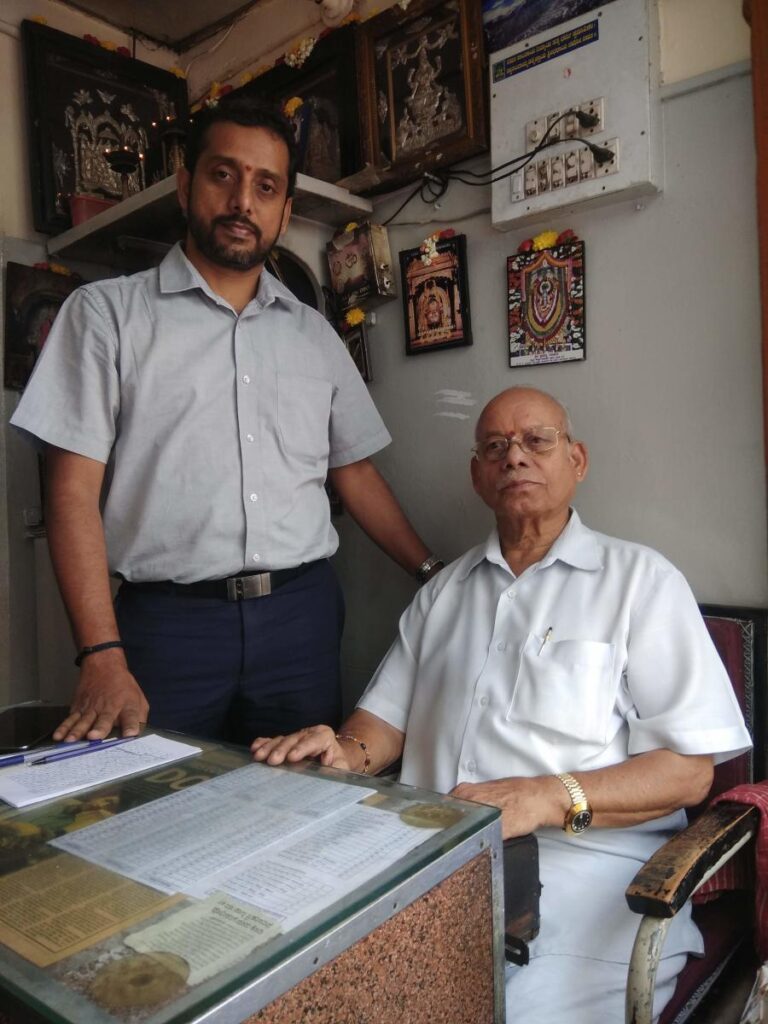
By 1970, the demand had grown enough that a change in ownership became necessary. Ramakrishna Adiga, who came from Shankaranaryana near Kundapura, another region steeped in South Indian culinary tradition, took over the operation. Like Parameshwara before him, Ramakrishna understood something fundamental: what worked shouldn’t be fixed.
He kept the menu. He kept the recipes. He even kept the staff members who had worked through the previous transitions. The only thing that changed was the signature on the checks. For the customer sitting at a worn table, waiting for their dosa, nothing was different. This proved to be a brilliant strategy, though it likely never seemed like a strategy at all. It was respect for what had been built.
In 2005, Arun Kumar Adiga, Ramakrishna’s son, left an engineering career to work alongside his father. A young man choosing to continue running a small restaurant in an old neighbourhood, in the era of startups and tech booms, was an act of faith. It meant he believed his father’s actions mattered. That continuity mattered.
The father-son team now runs the place together, supported by staff members who have often worked there for decades. The kitchen staff, the servers, the people who manage supplies-they’re the keepers of the rhythm. Without them doing exactly what they’ve always done, the masala dosa wouldn’t taste the way it does.
Building a Brand Without Trying
Somewhere between the 1970s and 2008, Vidyarthi Bhavan stopped being just a place to eat and became something with a name that mattered. The food had always been consistent, but eventually that consistency itself became the story people told. ‘You have to go to Vidyarthi Bhavan,’ they’d say. ‘Everything else is just food. Vidyarthi Bhavan is the real thing.’
By 2008, the reputation had grown to the point that the Adiga family felt the need to protect it. They trademarked the name. Years later, when other restaurants tried to capitalise on the similarity, they took legal action. It wasn’t arrogance. It was the protection of something they understood had cultural value.
The 75th anniversary in 2018 marked an unexpected honour: India Post issued a special stamp and commemorative cover in the restaurant’s name. Not many eateries get that kind of recognition. It signals something the government deemed worth remembering. The restaurant released a coffee table book documenting its journey-a physical record of decades of service in a single, unassuming location.
The Masala Dosa: Method, Not Magic
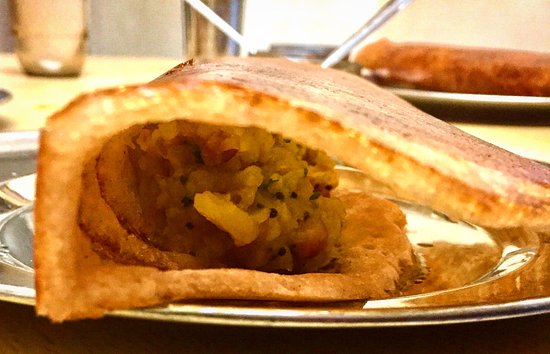
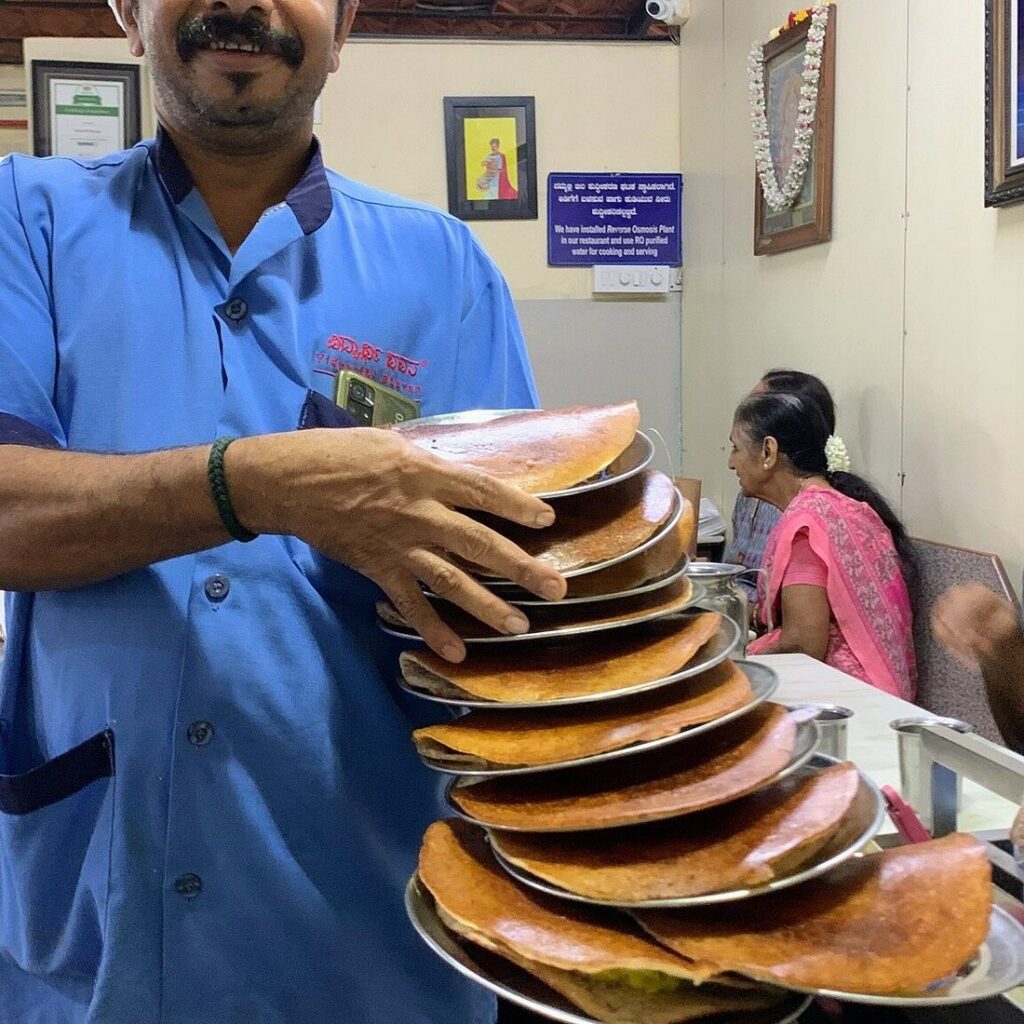
People often ask, “What’s the secret?” The Adigas don’t talk about a special ingredient because there isn’t one. What there is, instead, is a method.
The batter is made from a specific combination of red rice, methi seeds, and urad dal, in proportions that differ from those used by most other restaurants. This mixture is fermented for the right amount of time, not rushed, not overextended. Just before cooking, rice flour is added. The dosa then hits a screaming hot tawa, with ghee or oil already at the right temperature.
What emerges is crispy on the outside, golden with hints of reddish-brown at the edges. Not greasy. Not soggy in the middle. Just the right texture. The potato-onion filling inside is mild; it doesn’t compete with the dosa itself. The sambar and chutney are restrained, letting the main event speak for itself.
This isn’t cooking as theatre. It’s cooking as a craft. Every step matters because a single misstep-slightly lower temperature, batter that’s not quite fermented enough, oil that’s not hot enough-changes the result. The people who make these dosas have been doing it for years. Some of them have been doing it for decades. Their hands know.
A Menu of Many Things, a Signature of One
The restaurant isn’t one-dimensional, despite its reputation. The menu includes idlis, vadas, khara bath, pooris, kesri bath, and rava vade-the complete roster of traditional South Indian breakfast items. Each is competently made. Each has its admirers.
But if you ask the staff, or the family running the place, they’ll tell you honestly: the masala dosa is the ATM. Anytime Masala Dosa. It’s what people come for. It’s what they talk about. It’s the reason people stand in line.
The numbers tell the story. On weekdays, the kitchen churns out roughly 1,250 masala dosas. When Saturday and Sunday arrive, that number climbs to around 2,000. Think about that: 2,000 dosas. Each one made by hand, on a hot griddle, by a team that’s done this thousands of times before but treats each one like it matters.
To keep that production consistent, the restaurant goes through at least 4 kilograms of butter every single day. That’s not a gesture toward richness; it’s the ingredient that makes the final product taste the way it does. The ghee or oil hitting that hot tawa, the way it browns the batter to exactly the right shade, the subtle nutty flavour that develops-that’s what 4 kg of butter daily gets you.
The Experience: Waiting, Sharing, Belonging
Visit during breakfast hours, and you’ll immediately understand why ‘waiting’ has become part of the Vidyarthi Bhavan experience. The place isn’t large. The tables are simple. There’s no reservation system, no priority seating. You put your name down, and you wait. Sometimes it’s 10 minutes. Sometimes it’s an hour. During peak weekend mornings, people stand outside, occupying the street, waiting for their turn.
When you finally get a table, you might be sharing it with someone you’ve never met. A businessman next to a student next to a retired couple. The intimacy of shared tables in a crowded restaurant creates something unexpected: a sense of community. You’re not just eating; you’re part of a ritual that thousands participate in.
The restaurant has barely changed physically. The walls are the same. The decor is minimal. There’s no attempt to look trendy or Instagram-worthy. A few years back, minor renovations were done to improve comfort, but the place still feels like it did in 1970 or even 1960. There’s old-world charm in that, but more importantly, there’s authenticity.
Writers have found it to be a place for thinking. Politicians have passed through. Cricketers have eaten here between matches. Poets have scribbled notes on napkins. The place attracts a certain kind of person-not necessarily the wealthy, not necessarily famous, but people who value real things. Who understands that a masala dosa made with intention tastes different from one made as a mere transaction?
The Coastal Karnataka Connection
There’s a thread that runs through Vidyarthi Bhavan’s story: the coastal regions of Karnataka-Udupi, Kundapura, and Mangalore. Both Venkataramana Ural and Ramakrishna Adiga came from these areas. This isn’t a coincidence. These regions have a deep, centuries-long tradition of vegetarian cooking. Udupi, in particular, became synonymous with a particular style of South Indian food that spread across India.
When entrepreneurs from these regions migrated to Bengaluru in the early to mid-20th century, they carried these traditions with them. Many of Bengaluru’s most respected tiffin places were founded by people from Udupi, Kundapura, or the surrounding areas. They brought not just recipes but a philosophy: that vegetarian food, when made well, is complete. It doesn’t need to be complicated. It just needs to be made with care.
Vidyarthi Bhavan is an exemplar of this tradition. The food isn’t trying to impress through complexity. It impresses through quality, consistency, and respect for ingredients.
Why Some Things Last
In a city that reinvents itself every five years, Vidyarthi Bhavan hasn’t reinvented itself at all. That seems like a liability. In restaurants, especially, the pressure to innovate, modernise, and stay relevant is immense. Yet somehow, by choosing not to change, this place became more relevant, not less.
The reason is simple: consistency is a form of trustworthiness. When you eat the same dosa for the fiftieth time, and it tastes exactly like the forty-ninth time, you develop a relationship with that restaurant. You know what you’re getting. There’s no corporate speak, no ‘elevated’ versions, no premium tiers, just the same good meal.
The Adiga family understood that once you get something right, the job isn’t to fix, improve, or repackage it. The job is to protect it. To keep it exactly as it is, with the same people, the same methods, the same ingredients. That’s harder than innovation. Innovation gets you accolades. Protection gets you loyalty.
Over 80 years, this philosophy has turned a student canteen into a heritage landmark. India Post put it on a stamp. The government acknowledged its cultural importance. Yet the restaurant itself remains unchanged, still serving dosa to anyone who walks in and waits their turn.
A House That Has Held
Vidyarthi Bhavan is more than a restaurant. It’s proof that in a world obsessed with disruption, there’s something powerful about simply holding still. The name means ‘Student House,’ and that’s what it remains-a house. Not a brand. Not a franchise. Not a concept. A place where people gather to eat food made by hands that know exactly how to make it.
It has survived wars, city changes, economic shifts, and technological revolutions by refusing to be trendy. The very act of not changing became its identity. In Gandhi Bazaar, in the same spot since 1943, it remains: a room with simple tables, a kitchen that smells like cardamom and ghee, and a masala dosa that tastes exactly like it always has.
For anyone who’s ever wondered if it’s possible to build something that lasts, Vidyarthi Bhavan is the answer. Not through marketing genius or business innovation, but through something far older: consistency, respect for craft, and a refusal to change what works.





1 Comment