From Selling Pet Products to Creating Social Impact: The Next Opportunity for Indian Pet Brands
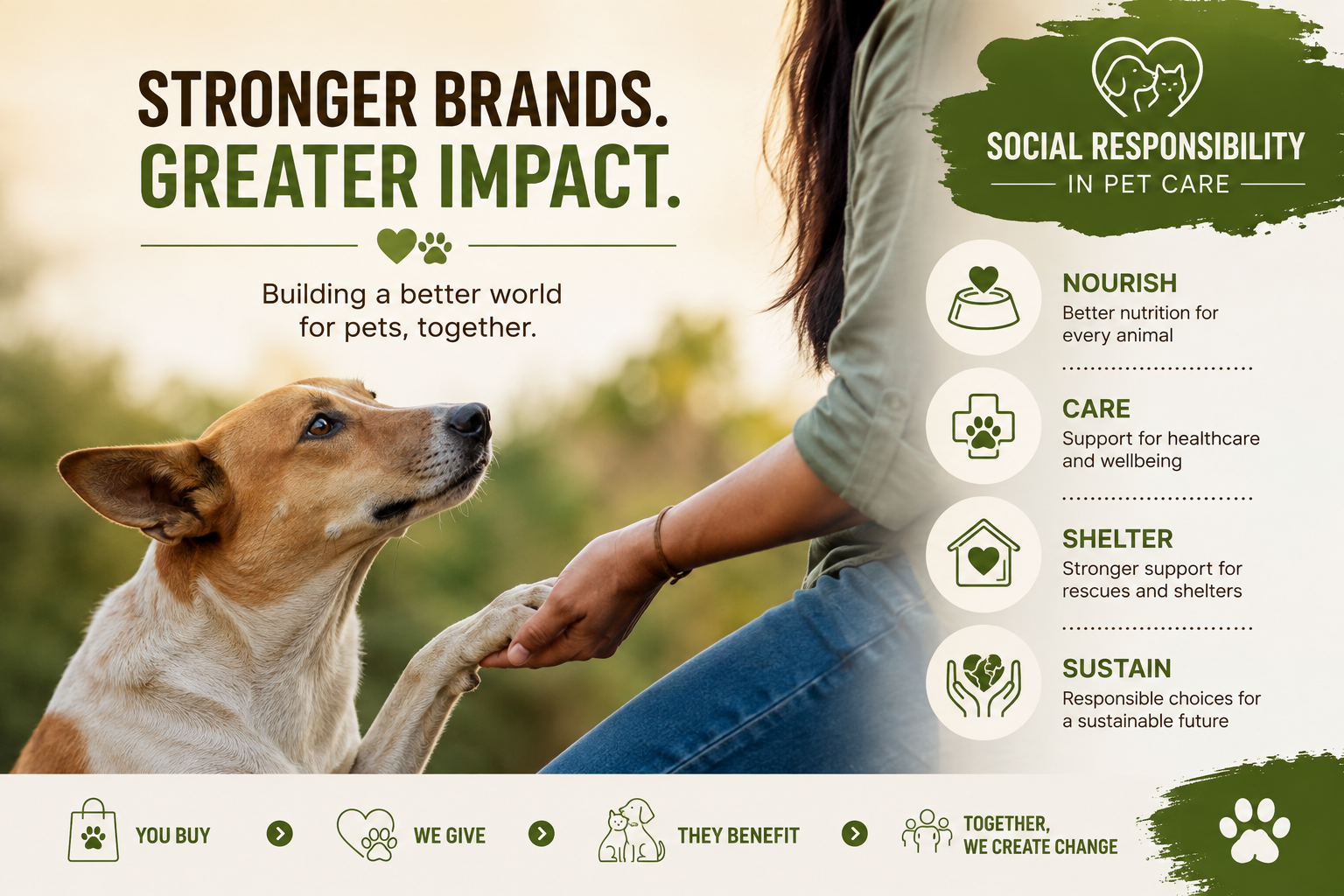
The future of pet branding may go beyond nutrition and wellness. For Indian pet brands, social responsibility, animal welfare and sustainability could become powerful sources of differentiation and consumer trust.


The pet care industry is changing. Pet food, treats, supplements and other pet products are no longer being marketed only around nutrition, taste, ingredients, convenience or price. An increasingly important question is entering the brand conversation: What does buying this product do beyond benefiting my pet?
Around the world, pet brands are increasingly connecting their products with social causes. Some support animal shelters, while others create employment opportunities for people with disabilities, support trauma recovery, conservation or community initiatives. For India, this represents a particularly interesting opportunity because our pet ecosystem extends well beyond households that own pets.
The Indian pet care market is growing rapidly, but alongside the growth of pet ownership is a much larger network of community animals, shelters, rescuers, veterinarians, foster parents and animal welfare organisations. This creates an opportunity for Indian pet brands to move beyond simply saying “we love pets” and demonstrate what that love actually means.
Social responsibility is becoming part of the product
Traditionally, social responsibility happened outside the product. A company sold pet food and separately donated money to a shelter. A pet treat company might sponsor an adoption event, while a pet care company might make a contribution during Diwali or another festival.
These activities are valuable, but they can feel disconnected from the brand itself. A more interesting model is emerging where the product becomes the mechanism through which the consumer contributes to a cause.
For example:
- A purchase could provide food to a shelter animal.
- A specific SKU could fund vaccinations.
- A percentage of sales could support sterilisation programmes.
- A grooming product could support parasite-control initiatives for rescued animals.
- A supplement brand could support the treatment of senior or recovering animals.
- A pet accessory could contribute towards the rehabilitation of injured animals.
The consumer is no longer simply buying a product. The purchase becomes an act of participation.
India Has a Much Bigger Social Opportunity


India’s pet ecosystem is very different from that of many Western markets. We have a growing population of owned pets, but we also have a huge population of community dogs and cats, abandoned animals, independent rescuers and shelters that operate with limited resources.
There are organisations working on rescue, veterinary care, sterilisation, vaccination, adoption and animal welfare, but many depend heavily on donations and volunteers. This creates an interesting intersection between commerce and social impact.
Indian pet brands do not necessarily have to invent a cause.
The causes are already around them.
The opportunity is to connect commercial activity with these genuine needs in a structured, transparent and sustainable manner.
Areas where Indian pet brands could create impact
- Community-animal nutrition
- Sterilisation and animal birth-control programmes
- Vaccination
- Emergency veterinary care
- Shelter support
- Adoption programmes
- Rescue and rehabilitation
- Foster care
- Senior-animal care
- Animal-welfare education
- Responsible pet ownership
- Support for independent rescuers
This gives brands a much broader canvas than conventional CSR.
“A Portion of Sales Goes to Charity” Is No Longer Enough
There is nothing wrong with donating a percentage of sales. But consumers increasingly want to understand the impact.
They may ask:
- How much is being donated?
- Who receives it?
- What is the money being used for?
- How many animals benefited?
- What actually happened because of my purchase?
- Can I see the impact?
- Is this a one-time campaign or an ongoing commitment?
Compare:
“A portion of our profits supports animal welfare.”
with:
“Every 20 packs sold funds one vaccination for a community dog.”
The second creates a much clearer connection between the product and the outcome. It converts an abstract donation into something tangible.
This is impact visibility, and it can become a powerful component of brand trust.
Indian Pet Brands Can Create Their Own “Buy and Give” Models


The familiar “buy one, give one” concept can be adapted creatively for India. The contribution does not necessarily have to mean giving another packet of food.
Brands could link purchases to:
- One vaccination
- A defined quantity of shelter food
- A sterilisation procedure
- A veterinary consultation
- Parasite-control treatment
- Emergency medical care
- A day of shelter nutrition
- A contribution towards adoption
- Rehabilitation of an injured animal
- Veterinary camps for community animals
This opens the possibility of creating cause-linked products.
For example:
- A pet shampoo brand could develop a Shelter Care programme.
- A supplement company could create a Senior Rescue initiative.
- A treat company could develop an Indie range supporting community dogs.
- A grooming brand could fund parasite-control programmes.
- A pet food company could create a Community Bowl programme supporting feeding initiatives.
The important principle is that the cause should have a natural connection with the product. Consumers should be able to understand why the brand is supporting that particular cause.
The Indian Indie Dog Deserves a Place in Brand Storytelling


There is another uniquely Indian opportunity.
Pet advertising often features familiar pedigree breeds. But India’s companion-animal story is much broader. The Indian Pariah Dog, commonly referred to as the Indie, is part of our everyday environment.
For a pet brand, supporting Indie dogs could therefore become more than philanthropy. It could become a distinctive brand platform.
Imagine a campaign built around:
“Every dog deserves a good meal.”
Not just pedigree dogs. Not just expensive breeds. Every dog.
A brand could support:
- Community-dog feeding programmes
- Indie adoption
- Veterinary care
- Sterilisation
- Vaccination
- Rescue
- Rehabilitation
- Adoption awareness
This creates a very different emotional territory from conventional “happy pet” advertising. It can also give a brand a point of view that competitors may find difficult to replicate.
From Donation to Participation


One of the biggest opportunities lies in moving beyond writing a cheque. Companies can encourage employees to become active participants in the cause. Employees could volunteer at shelters, help groom rescued animals, assist with adoption events, participate in vaccination camps or help shelters with digital marketing.
Companies can also contribute professional expertise. Employees in accounting, technology, design, marketing or communications can offer their skills to smaller animal welfare organisations that may not have access to these resources.
Employees could:
- Volunteer at shelters
- Help groom rescued animals
- Assist with adoption events
- Participate in vaccination camps
- Create adoption profiles
- Help shelters with digital marketing
- Provide accounting or technology support
- Offer design and communication expertise
- Support community-animal feeding initiatives
- Help organise responsible-pet-ownership programmes
This creates a deeper relationship between the company and the cause. The employee experiences the impact, the customer sees the impact, the animal welfare organisation receives practical support, and the brand develops credibility.
It also changes the internal meaning of CSR. It becomes less about writing a cheque and more about building organisational participation around a cause.
Show, Don’t Tell
Social media has made CSR easier to communicate, but it has also made superficial CSR easier to detect.
A brand can say:
“We care about animals.”
Or it can show its employees helping at a shelter, supporting a vaccination programme, assisting an injured animal or preparing food for rescued animals.
The second is much more powerful because it demonstrates action rather than merely communicating intention.
Instead of saying:
“We donated ₹5 lakh to animal welfare.”
a brand could tell the story of one rescued dog whose treatment was supported through its programme.
The story could show:
- Where the animal was found
- What happened
- What treatment was required
- How the brand contributed
- The animal’s recovery
- The eventual outcome
The difference is simple.
One communicates money.
The other communicates meaning.
Small Stories Can Create Big Brands
There is often a tendency to think that CSR needs to be a massive national campaign.
It doesn’t.
Sometimes, smaller stories are more powerful because they create a human-scale narrative.


A brand could tell the story of:
- One rescued puppy
- One injured community dog
- One senior animal
- One abandoned cat
- One shelter
- One veterinarian
- One rescuer
- One adoption
- One successful rehabilitation
These stories are easier for consumers to understand, remember and share.
This is where micro-impact storytelling can become a powerful marketing tool. Instead of continuously talking about the size of the company’s contribution, the brand can demonstrate what that contribution actually achieved.
Sustainability Should Also Enter the Conversation


Social responsibility is not restricted to animal welfare. It also includes environmental responsibility, particularly as the Indian pet care industry grows.
Pet brands can examine:
- Packaging materials
- Packaging recyclability
- Ingredient sourcing
- Food waste
- Manufacturing waste
- Water consumption
- Energy consumption
- Supply-chain emissions
- Responsible sourcing
- Appropriate use of upcycled ingredients
There is an opportunity for Indian brands to make sustainability easier for consumers to understand.
Instead of complicated environmental terminology, brands should answer:
- What are we doing differently?
- Why does it matter?
- What has changed because of it?
- How can the consumer verify it?
Consumers don’t necessarily need another sustainability slogan.
They need evidence.
But Beware of Cause-Washing
There is a danger as social responsibility becomes commercially attractive.
A brand may put a social cause on its packaging, post photographs with rescued puppies and declare itself purpose-driven.
That does not automatically make it socially responsible.
It can become cause-washing.
A credible brand should be able to explain:
- Which organisation it supports
- Why it selected that organisation
- What exactly it is funding
- How much it contributes
- How frequently it contributes
- What has been achieved
- How impact is measured
- Whether customers can see the results
Transparency therefore cannot be treated as an optional extra.
It has to become part of the proposition.
Long-Term Partnerships Are Better Than Festival Campaigns
Indian brands frequently associate animal welfare with specific occasions such as World Animal Day, Diwali, Christmas, New Year or adoption drives.
These campaigns can create visibility, but animals need support throughout the year.
A shelter needs food every month. A sterilisation programme needs continuity. An injured animal needs treatment until recovery. A vaccination programme requires scale.
Therefore, brands should consider annual impact programmes rather than seasonal CSR campaigns.
Instead of:
“₹10 lakh donated during Diwali.”
Consider:
“Supporting 500 community animals with nutrition, vaccination and veterinary care throughout the year.”
The second approach creates a stronger strategic foundation because it establishes continuity, accountability and measurable impact.
Social Responsibility Can Become a Genuine Brand Differentiator
The Indian pet care market is becoming increasingly crowded. Brands compete around:
- Protein
- Ingredients
- Functional benefits
- Natural formulations
- Veterinary recommendations
- Humanisation
- Premiumisation
- Convenience
- Price
Eventually, many of these claims begin to look similar.
Social responsibility can provide another layer of differentiation, but only if it is embedded into the brand’s DNA.
A strong purpose-led pet brand should be able to answer four questions:
- What do we believe?
- What problem are we trying to solve?
- How does our product contribute to solving it?
- What happens when a consumer buys from us?
That is far more powerful than simply adding “giving back” to the packaging.
A Framework for Indian Pet Brands
Before launching a cause-led initiative, brands should ask themselves six questions:
1. What cause naturally fits our brand?
Choose a cause that connects with the product, consumer and organisational values rather than simply following a trend.
2. Can the product directly contribute?
Create a mechanism through which a purchase generates measurable impact.
3. Can the impact be quantified?
Move from vague statements to specific outcomes.
4. Can customers see the impact?
Use stories, photographs, videos, dashboards and periodic reports to demonstrate what has happened.
5. Can the partnership continue for years?
Build relationships rather than short-term campaigns.
6. Can employees participate?
Turn social responsibility from a finance-department activity into an organisational experience.
The Future: From “Pet-Loving Brand” to “Pet-Impact Brand”
The next generation of pet brands may not simply compete on who makes the best food, treats, supplements or accessories.
They may also compete on what their existence contributes to the wider pet ecosystem.
That could mean:
- Better nutrition for shelter animals
- Better veterinary access
- More adoptions
- More sterilisation
- Greater support for rescuers
- Better livelihoods
- Less waste
- More sustainable packaging
- Greater acceptance of Indian dogs
- More responsible pet ownership
The opportunity is particularly significant in India because the pet ecosystem extends far beyond the person buying a bag of food. There is an entire community surrounding that purchase: the pet, the pet parent, the veterinarian, the shelter, the rescuer, the community animal and the environment.
The strongest brands will find ways to connect all of them.
Because ultimately, social responsibility in pet care should not be about asking:
“How much did we donate?”
It should be about asking:
“What became better because we exist?”
That is a much more demanding question.
And perhaps, for India’s rapidly evolving pet care industry, it is exactly the question brands should be asking next.