Culture Is Not a Campaign. It’s a Context.
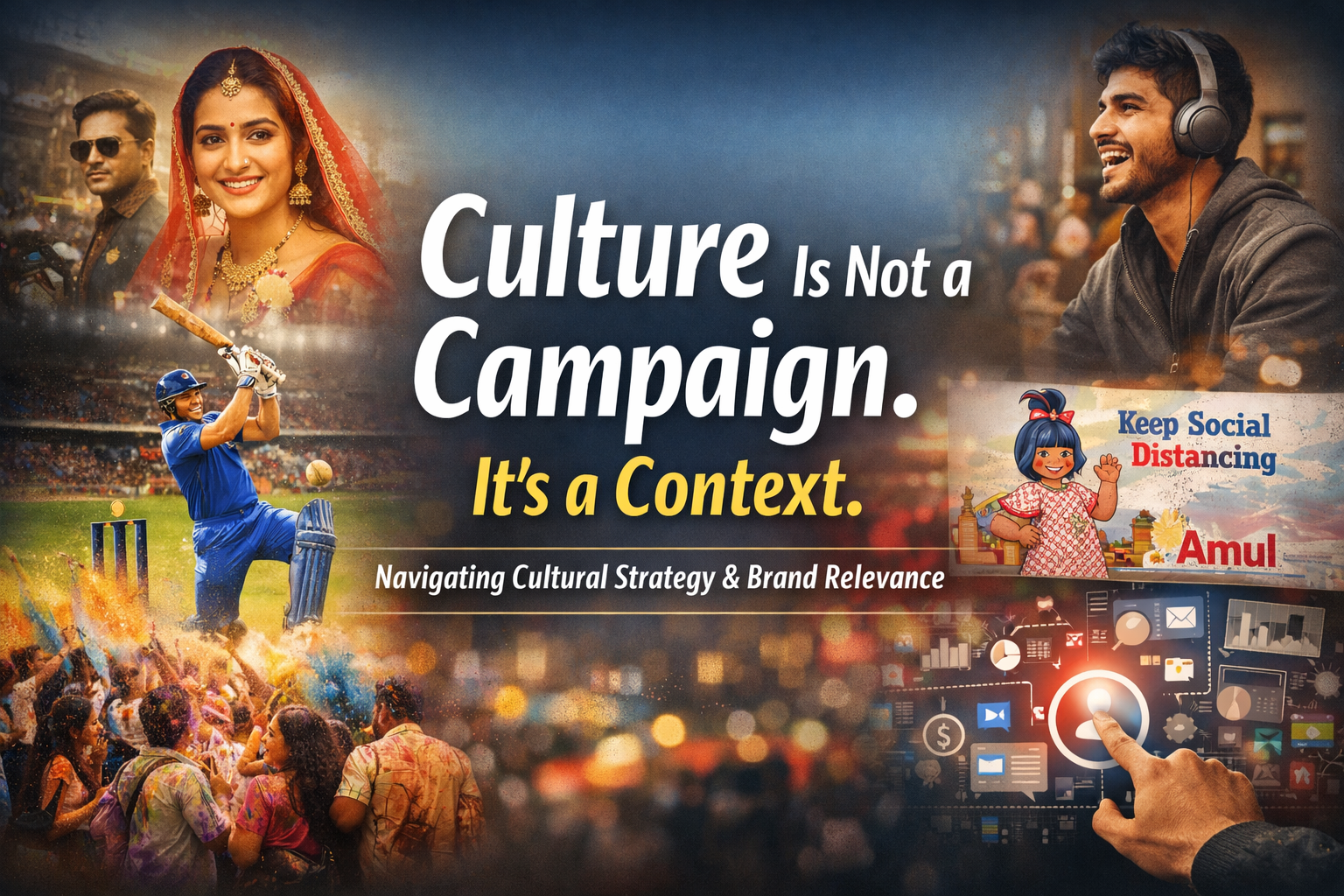
What does “culture” really mean in marketing? A sharp, India-focused perspective on cultural strategy, brand relevance, and why most campaigns get it wrong.


Here is a question most brand teams cannot answer cleanly: What does “culture” actually mean in your marketing strategy?
Not the word. The word is everywhere. Every brief has it. Every agency deck opens with it. Every conference panel has a title that is related to it.
But press anyone for a definition, and you get a pause.
The Comfortable Vagueness


At a recent industry gathering in New York, senior marketers found it easier to say what culture isn’t than to arrive at a shared definition of what it is. Is it casting a trending face in your TVC? Sponsoring a concert? Are you embracing a meme that only lasts for 48 hours?
All of those have been done. None of them, on their own, constitutes a cultural strategy.
The confusion is not accidental. “Culture” is a convenient placeholder, big enough to justify almost any spend and vague enough to avoid accountability. When it means everything, it risks meaning nothing.
Why It Matters Anyway


Despite the definitional fog, the strategic intent is valid. Brands that fail to engage authentically with their consumers’ cultural contexts risk irrelevance. In an era when consumers are increasingly vocal about their expectations, cultural missteps can trigger immediate backlash, while genuine engagement can forge lasting connections.
That is not a Western observation. It is especially true in India.
Consider what “culture” actually does in the Indian market:
It shifts what a brand means, not just what it says
It determines which communities grant a brand permission to speak
It separates brands that are seen as of the culture from those merely adjacent to it
The difference between Tanishq’s Ekatvam campaign, the backlash it faced, and the brand’s ability to recover teaches us how culture-led intent and culture-illiterate execution can coexist in the same brief.
The Indian Complexity


India does not have one culture. It has several hundred, folded one inside the other.
A brand operating nationally must navigate the following:
- Language: Not just Hindi and English. Tamil, Telugu, Kannada, Bengali, Marathi- each carries its own tonal register and emotional code
- Festival calendars: Diwali is not the same as Pongal. Eid is not Bakrid. The occasions overlap, but the meanings don’t
- Aspiration layers: Tier-1 urban consumers chase global cultural cues. Tier-2 and Tier-3 consumers are building their own – and those are often more authentic, more rooted, and more commercially underestimated
- Generational splits: Gen Z in Bengaluru is not the same animal as Gen Z in Patna. Same age cohort. Wildly different cultural operating systems
Brands that flatten the data into a single “India insight” are not doing cultural marketing. They are making demographic assumptions.
From Presence to Participation


A defining shift in marketing has been the move from brand presence to brand participation. Consumers no longer reward brands for simply showing up, they expect meaningful engagement, contribution to cultural conversations, and clarity of purpose.
This is the harder work. Presence is media buying. Participation is earned.
Look at how some Indian brands have navigated this landscape:
Fevicol has not chased trends. Over decades, it has built a specific comedic, rural-Indian cultural identity that no competitor has been able to replicate.
Amul participates in news cycles the same day they break, not as a news brand but as a cultural commentator. The topical dairy. It works because the voice is consistent, not because any individual topic is clever.
boAt built an entire youth-culture identity around audio products in a largely commoditised category. The cultural cue – India’s own streetwear-adjacent, gig-economy-adjacent identity – did more than any product spec sheet could
Each of these examples has one thing in common: the cultural strategy came before the campaign, not after.
The Psychographic Over the Demographic


The throughline is more about the psychographics that unite consumers versus the demographics that separate them. This perspective is the more useful framing for Indian marketers.
Age, income, and geography will only segment a market. Shared beliefs, aspirations, anxieties, and identity signals will build one.
Ask these questions before calling something a “cultural strategy”:
What does our target consumer believe about themselves?
What communities do they seek membership in?
What cultural signals would help them feel seen rather than pandered to?
Are we participating in an existing conversation or trying to start one from scratch?
The last question is especially important. Most brands try to create culture. Very few succeed. The ones that do have usually been showing up quietly, consistently, for a long time before anyone called it cultural.
What Brands Get Wrong

Brands that treated culture as a stunt rather than a system saw weaker returns. The ones that created systems of creativity – not singular hero moments – gained relevance faster and maintained it longer.
In India, the stunt version looks like this:
A one-off IPL activation that has no connection to the brand’s year-round positioning
A regional language post that is a direct translation of the English copy – same meaning, different script, zero cultural adaptation
Influencer tie-ups with creators whose audiences have no overlap with the brand’s actual consumer base
None of these is cultural marketing. They are cultural cosplays.
The system version looks different:
A consistent brand voice that does not shift with every new CMO
Creative that draws from the same cultural well across touchpoints – not just in the big campaign, but in packaging copy, customer service language, and retail presence
Partnerships that make sense beyond the press release
The Measurement Problem


Here is the honest part: culture is difficult to measure. That has always been the marketer’s dilemma with it.
But the refusal to measure it is not the answer. Some proxies worth tracking:
Unprompted brand mentions in cultural conversations (not just brand mentions)
Whether consumers associate the brand with a specific cultural identity, and whether that identity is the one intended
Share-of-conversation in category-adjacent cultural spaces, not just the category itself
Whether the brand’s cultural associations persist when the campaign goes off-air
The last one is the real test. If the cultural association disappears with the media’s spending, it was never cultural to begin with.
The Honest Summary

Culture is not a campaign mechanic. It is not a Gen Z activation. It is not a meme strategy.
It is the accumulated meaning a brand holds in the minds of the people who matter to it. The brand’s meaning is shaped by what it says and doesn’t say, who it partners with, what it ignores, and what it shows up for.
Cultural relevance is not a static achievement. It is an ongoing dialogue between brands and their audiences, and true cultural resonance still relies on human intuition, creativity, and emotional intelligence.
In India, where the cultural terrain shifts every hundred kilometres, that dialogue demands more rigour, not less. Brands that view culture as a strategy, rather than mere decoration, will endure long after the next campaign cycle fades into obscurity.
The rest will keep asking what “culture” means in the brief. And I’m never quite finding the answer.

1 Comment