AI Has Crossed the Rubicon in Marketing – And Indian Brands Cannot Afford to Look Away
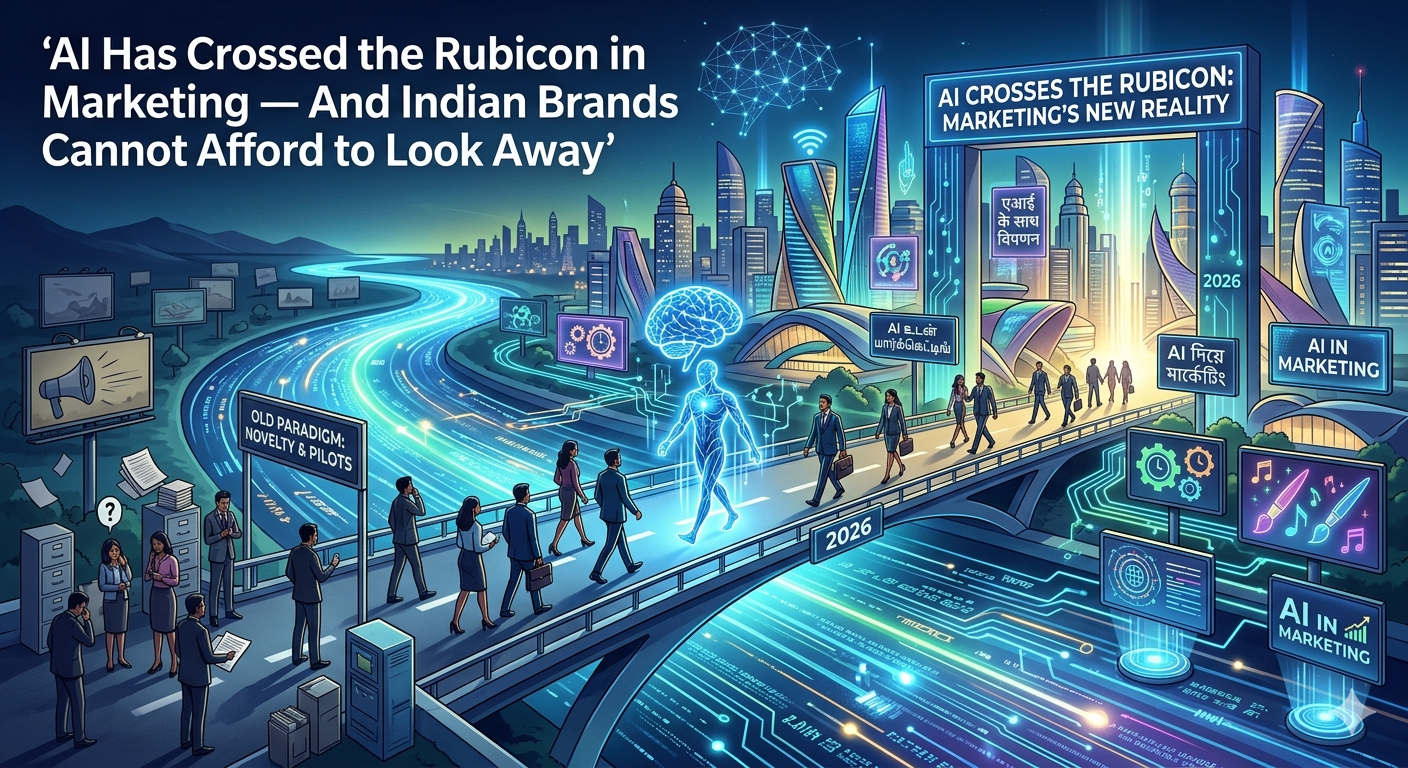
AI in marketing has moved from experiment to essential. Indian brands need to navigate adoption, integration, creativity, and AI literacy in 2026.
There is a moment in every technology cycle when a tool stops being a novelty and starts being a necessity. For artificial intelligence in marketing, that moment has not just arrived. It has passed.
We are now in 2026. The brands still debating whether to adopt AI are not late movers. They are, for all practical purposes, out of the race.
AI is no longer a pilot programme sitting in the margins of the marketing budget. It is the operating system of modern marketing. And India, with its unique cocktail of scale, cost pressure, multilingual complexity, and a fiercely competitive D2C landscape, had more to gain from this shift than almost any other market.
The question in 2026 is no longer whether to adopt. It is whether adoption has been deep enough, strategic enough, and human enough to generate real competitive advantage.
The Numbers That Set the Stage
The global data from 2024 and 2025 tells a clear story:
- 94% of marketers across major economies had allocated an AI budget in 2024
- 75% expected to increase that spend into 2025
- 62% anticipated AI budgets growing by at least 25%, even amid economic uncertainty
Those projections have since materialised. AI spend in marketing is no longer a line item that needs defending in budget reviews. It is baseline infrastructure.
For India, these numbers carry a different weight. Indian marketing budgets have historically been lean. Brand managers here have always been asked to do more with less – more languages, more geographies, more audience segments, fewer resources.
AI was never just an efficiency tool for Indian marketers. It was a structural solution to a decades-old constraint. In 2026, that solution is no longer theoretical. The brands that moved early are now operating with capabilities their slower peers cannot replicate overnight.
The Efficiency Argument Has Been Settled
The global productivity data from 2025 was unambiguous:
- 85% of marketers were reclaiming the equivalent of a full workday every two weeks
- That translates to at least four hours saved per week, per person
- One in five marketers was saving more than ten hours a week
Those numbers have only grown as tools have matured, workflows have been optimised, and teams have moved past the learning curve into genuine fluency.
In 2026, the efficiency conversation in Indian marketing has shifted from possibility to expectation. CMOs are no longer asking whether AI will save time. They are asking why their teams are not saving more of it. What was an impressive performance in 2024 is now the floor.
What the Ground Looks Like in India Today
The operational load of marketing in India remains uniquely demanding:
- Campaigns running simultaneously in Hindi, Tamil, Kannada, Bengali, and English
- Creatives calibrated for Tier 1 metro consumers and Tier 2 aspirational buyers with entirely different cultural reference points
- A content calendar shaped by a festival cycle that runs almost year-round
In 2026, teams managing this load without AI assistance are visibly struggling to keep pace.
The campaign manager who spent Monday mornings reformatting copy for five channels is now spending that time on audience strategy and message architecture. The creative lead who used to explain brand guidelines in every briefing is now working from AI-generated first drafts that already carry the brand’s tonal DNA.
The repetitive, low-cognition tasks that once consumed skilled hours have been absorbed. What remains is higher-order work. Indian brands running lean creative teams, which is most of them, are discovering that AI has effectively expanded their team size without expanding their payroll.
The Tool Chaos Has Begun to Resolve – But Not Entirely
In 2025, 64% of marketers globally felt the AI marketing space was saturated and overwhelming. In 2026, some of that chaos has settled:
- The market has begun to consolidate
- A smaller number of platforms have emerged as serious enterprise-grade solutions
- The frantic experimentation of 2023 and 2024 has given way to more deliberate tool selection
But India’s localisation problem has not been fully solved. The gap between AI tools built for global English-language markets and what Indian marketers actually need remains real. Tools that handle code-switching, regional dialects, and the cultural subtext for hyperlocal audiences remain underdeveloped.
Some Indian-built solutions have begun to address this. The opportunity for a genuinely Bharat-first AI marketing platform remains significant. In 2026, it is one of the more interesting white spaces in the Indian marketing technology landscape.
Creativity: The Debate Is Over
The question of whether AI would diminish or amplify human creativity in marketing has been answered, not by philosophers or futurists, but by practitioners who have spent two years working with these tools daily.
- 77% of marketers agreed in early 2025 that generative AI boosted their team’s creativity
- That was up from 69% the year before
- By 2026, that number reflects not optimism but lived experience
Indian advertising’s core strengths – emotional depth, cultural specificity, storytelling rooted in lived local experience- have not been displaced by AI. If anything, they have been given more room to breathe.
The Bottleneck Was Never Insight. It Was Execution.
A creative team in Mumbai or Chennai that previously had the intelligence to conceive ten campaign ideas but the bandwidth to execute only three is now executing eight.
The ideas that used to die in the briefing room because there was no capacity to bring them to life are now being built, tested, and refined at speed.
- 82% of marketers globally have used generative AI to create unique images and edit videos
- 75% now consider it an essential part of their creative toolkit
In India’s social-media-first brand environment, where a brand might be managing content across Instagram, YouTube, ShareChat, Moj, and WhatsApp simultaneously, this is not a statistic. It is a survival condition.
Trust Is High, But the Human Editor Is Not Going Anywhere
By 2026, trust in AI tools among marketers is substantial:
- Nearly 89% expressed confidence in generative AI tools as recently as 2025
- That figure has continued to climb as outputs have improved and hallucinations have reduced
And yet 94% of marketing professionals were still reviewing and refining AI-generated outputs in 2025. That discipline has not relaxed in 2026. Nor should it, particularly in India.
Why India Cannot Afford to Drop Its Guard
Brand safety in India is not a technical problem. It is a cultural one.
An AI-generated creative that:
- Misreads a regional cue
- References a politically sensitive symbol
- Misjudges the tone appropriate to a religious occasion
…can cause brand damage that no correction fully repairs.
The human editor in Indian marketing is not a relic of pre-AI anxiety. They are a strategic asset. The 86% of organisations globally that had implemented formal AI use policies by 2025 understood this. Indian organisations that have not yet formalised their AI governance frameworks are taking on unnecessary risk in an environment that will not forgive careless outputs.
The Integration Gap: Still the Defining Challenge
Despite rising investment and genuine enthusiasm, a persistent gap exists between AI adoption and AI integration. The 2025 numbers were telling:
- 61% of marketing leaders globally struggled to integrate AI tools into existing workflows
- 45% felt pressured to adopt AI without a clear strategy
In 2026, these numbers have improved, but not as dramatically as the investment numbers might suggest.
The gap between what organisations spend on AI and what they actually extract from it remains the defining challenge of this moment. Adoption without integration is expensive experimentation with no compounding return.
In India’s marketing landscape, where the pressure to demonstrate ROI is intense and the margin for waste is thin, this gap has real consequences. The brands that have done the harder work – redesigning workflows, retraining teams, building internal evaluation frameworks – are now pulling away from those that simply purchased licences and hoped for transformation.
Measurement: The Problem That Will Not Go Away
In 2025, one in three marketers globally admitted they could not:
- Measure the success of their AI initiatives
- Determine the return on investment on AI spend
- Attribute campaign outcomes to AI-assisted work
In 2026, this remains one of the most urgent unsolved problems in marketing leadership. The tools have matured. The metrics have not kept pace.
For Indian D2C brands and startups, where every rupee of marketing spend must justify itself against growth targets and investor expectations, this inability is more than an inconvenience. It is a governance failure.
The organisations building proprietary measurement frameworks – ones that connect AI-assisted content to engagement, conversion, and brand health- are developing a capability that will be as valuable as the AI tools themselves.
AI Literacy: From Future Skill to Present Requirement
In 2025, 92% of global marketing leaders believed AI literacy would be a must-have skill within two to four years. We are now inside that window.
In 2026, AI literacy is not a future competency to be planned for. It is a present requirement being tested in:
- Hiring decisions
- Performance reviews
- Campaign outcomes and team output quality
India’s Uneven Playing Field
India’s marketing talent pool is large, young, and fast-learning. But the distribution of AI literacy within it remains uneven in ways that matter.
A senior marketer at a well-funded Bengaluru startup has likely:
- Been working with AI tools for two years
- Developed genuine prompting instincts
- Learned to evaluate AI outputs with a trained, critical eye
A brand manager at a mid-sized FMCG company in a smaller city may have access to exactly the same tools, but:
- No institutional framework for using them
- No peer community to learn from
- No organisational signal that AI capability will be recognised or rewarded
That gap – between the AI-literate and the AI-adjacent – is now showing up in output quality, campaign velocity, and team productivity in ways that are difficult to ignore.
The Only Conversation That Matters in 2026
The technology has not just crossed the line from experimental to essential. In 2026, it is foundational.
The brands still treating AI as a supplementary capability, something the digital team handles, are making a category error. AI is not a channel or a tool category. It is infrastructure, as fundamental to modern marketing operations as a CRM or a media buying platform.
For Indian marketers, the productive conversation in 2026 is not about adoption. It is about:
- Depth of integration into real workflows
- Governance frameworks that protect brand safety
- Measurement systems that demonstrate genuine ROI
- Literacy programmes that build capability across the entire team, not just the digitally fluent
It is about whether the humans working alongside AI tools are skilled enough to direct them strategically, critical enough to catch their failures, and creative enough to take outputs somewhere the tools alone cannot go.
Access without ability is not a strategy. In 2025, it was a liability. In 2026, it is a competitive disadvantage that compounds with every quarter.
Bibliography
- The State of Marketing & AI Report 2025. Canva and Morning Consult. March 2025. https://www.canva.com/marketing-ai-report/
- From Experimental to Essential: 94% of Marketers Now Investing in AI. Business Wire. March 4, 2025. https://www.businesswire.com/news/home/20250304471433/en/From-Experimental-to-Essential-94-of-Marketers-Now-Investing-in-AI
- AI Moves from Experiment to Essential. Canva Newsroom. March 2025. https://www.canva.com/newsroom/news/marketing-ai-report/
- Getting Smart About AI in the Workplace: The Importance of AI Literacy. Canva Newsroom. 2025. https://www.canva.com/newsroom/news/ai-literacy/
- Generative AI Essential in Marketing Strategies: Canva 2025 Report. RMN Company. March 28, 2025. https://www.rmncompany.com/generative-ai-essential-in-marketing-strategies-canva-2025-report/
- AI Saves Marketers Four Hours a Week, Canva Report Finds. Futureweek. March 10, 2025. https://futureweek.com/ai-saves-marketers-four-hours-a-week-canva-report-finds/
- Top Marketing Trends for 2025. Canva. November 2025. https://www.canva.com/resources/marketing-trends/
- The Visual Economy Report 2024. Canva and Morning Consult. June 2024. https://www.canva.com/newsroom/news/visual-economy-report-2024/