What Drives Aspirational Markets: The Intangibles That Actually Matter
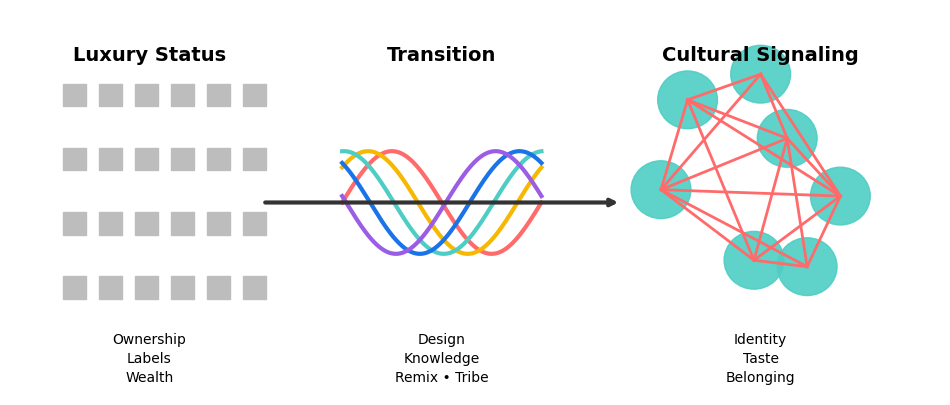
The aspirational economy does not reward scale or budget. It rewards fluency – in the visual, the narrative, the communal, and the curatorial.
Aspiration no longer lives exclusively in the luxury tier. It has migrated – quietly and completely – into virtually every category where consumers make choices that reflect who they are, not just what they need. A $12 turmeric latte, a cult running shoe, and a locally sourced grocery basket all carry the same structural logic as a Hermès bag. They are objects through which people project identity, signal belonging, and communicate a version of themselves to the world.
What changed is not the human desire to signal – that is as old as civilisation. What changed is the vocabulary of signalling. The old grammar was accumulation: more, bigger, newer, costlier. The new grammar is invisible to those who haven’t learned it. It is spoken in references, in choices, and in what you omit as much as what you display.
Six Intangible Drivers
- Form as Statement – Design sensibility has graduated from a supporting function to a primary competitive weapon. Visual intelligence transforms everyday goods into objects that project the consumer’s sense of self. A considered colour palette, deliberate material choices, and typographic restraint now constitute a brand argument as much as any campaign. Brands fluent in this language don’t decorate their products – they build with it. The package is no longer packaging; it is the first product.


- Intellectual Capital – In a world of product parity, inside knowledge becomes social currency. Understanding an object’s provenance – its maker, its moment, its material lineage – transforms ownership into connoisseurship. This is the engine behind vintage markets, expert-sourced retail, and the premium that heritage literacy commands. The person who knows why something matters holds a different kind of authority than the one who has it. Depth of understanding signals investment: in time, attention, and cultural education.



- Inventive Remix – Originality is rarely about invention from scratch. It is about synthesis – drawing unexpected connections among existing ideas, references, and visual codes to produce something that is simultaneously familiar and surprising. Compressed trend cycles make pure novelty unsustainable; the smarter move is intelligent recombination – the most culturally fluent brands sample, reference, and riff. The creative act is not generation – it is reframing the known in an unfamiliar context.



- Tribe Gravity – The most powerful motivator in the modern consumer cycle isn’t acquisition – it’s recognition. To be seen and claimed by a group that shares your exact sensibilities. Brand communities have replaced loyalty programmes as the engine of long-term affinity. Members recruit members; insiders make culture. The reward isn’t just the object – it’s entry into a shared language, a set of references, and the intimate pleasure of consuming alongside people who genuinely get it.



- Discernment & Selection – To select carefully is to make an argument. What a brand chooses to surface from its archive and what it deliberately leaves in the vault tell a richer story than any new launch. Under perpetual pressure to be novel, the most sophisticated brands return to what they already have, reframing overlooked work for a present audience. Restraint is a form of fluency. Editorial judgement – knowing what belongs and what doesn’t – is itself a competitive capability.



- Signal Value – Status performance has been fundamentally restructured. The inherited markers that once sufficed – the right label, the right address – have been devalued by their own ubiquity. What now commands the highest social premium is the earned signal: early adoption, deep expertise, and a cultural insider position. The consumer who knew the reference before it became a trend, who can trace the lineage of a collaboration, holds a form of social capital that money alone cannot manufacture. Cultural literacy has become the new measure of standing.



Five Brand Vectors
- Visual Grammar – A brand’s visual universe is its fastest-moving argument. Before a copy is read or a product touched, the visual language has already communicated belonging or exclusion, immediacy or timelessness. Coherence across every touchpoint – from packaging to platform to physical space – does more reputational work than most campaigns. Brands that master this vector don’t produce content; they produce a view of the world and invite consumers to inhabit it. (Signal over Style)
- Narrative Capital – Narrative is how objects acquire gravity. A product without a backstory is a commodity; embedded in history and intention, it becomes an artefact. The most durable brands don’t inherit heritage – they construct it, layer by layer, and continuously reinterpret it for new audiences. Consumers in aspirational markets aren’t evaluating specifications; they’re asking whether this brand’s narrative fits inside the story they tell about their own life. (Meaning over Message)
- Tribe Access – The most resilient loyalty is identity fusion. When consumers start describing themselves through the lens of a brand, the relationship crosses a fundamental threshold. They stop purchasing and start affiliating. Community participation produces what no loyalty scheme can replicate: unpaid advocacy, organic peer recruitment, and an inner circle with its own rituals, drop calendars, and hierarchy of insider knowledge. (Tribe over Transaction)
- Cult Objects – Scarcity is a production decision. Meaning is a cultural one. Objects that earn cult status derive their value from the density of significance layered onto them over time – limited runs, archive re-editions, improbable collaborations that land as cultural events rather than product releases. Acquiring one makes the buyer not just a consumer but a keeper of the brand’s history and a participant in its ongoing canon. (Canon over Catalogue)
- Refined Sensibility – The most elusive of the five and the hardest to displace. This is the sustained capacity to make culturally intelligent decisions – what to produce, what to withhold, who to align with, and which references to invoke. It cannot be purchased or reverse-engineered. Brands that genuinely possess it don’t respond to the market; they shape the conditions under which the market forms opinions. It is the only brand vector that compounds indefinitely, resists imitation, and grows more valuable the longer it is held. (Moat over Market)
The aspirational economy does not reward scale or budget. It rewards fluency – in the visual, the narrative, the communal, and the curatorial. Brands that learn to produce these vectors alongside their products are building something that grows in value, whether or not they launch anything new. The ones that don’t are competing in a market that has already moved on.
Bibliography
Primary Source – Framework Origin
Andjelic, A. (2022). Culture 3.0: Five new currencies of aspirational markets and how to trade in them. The Sociology of Business (Substack). https://andjelicaaa.substack.com/p/culture-30
Andjelic, A. (2020). Winning in aspirational markets. The Sociology of Business (Substack). https://andjelicaaa.substack.com/p/085
Andjelic, A. (2022). Culture 3.0. Medium. https://andjelicaaa.medium.com/culture-3-0-2ec49aa75efe
Interview
Andjelic, A. (n.d.). Ana Andjelic on the modern aspiration economy and future of mass brands. Contagious. https://www.contagious.com/news-and-views/ana-andjelic-on-the-modern-aspiration-economy-and-future-of-mass-brands
Supporting Theory – Status & Culture
Marx, W. D. (2022). Status and Culture: How Our Desire for Social Rank Creates Taste, Identity, Art, Fashion, and Constant Change. Penguin Random House. https://www.penguinrandomhouse.com/books/659558/status-and-culture-by-w-david-marx/
Foundational Sociology – Cultural Capital
Bourdieu, P. (1984). Distinction: A Social Critique of the Judgement of Taste. Harvard University Press. (Original work published 1979.) https://en.wikipedia.org/wiki/Distinction_(book)
Foundational Economics – Conspicuous Consumption
Veblen, T. (1899). The Theory of the Leisure Class: An Economic Study of Institutions. Macmillan. https://en.wikipedia.org/wiki/The_Theory_of_the_Leisure_Class
The three tiers here are intentional: Andjelic as the direct framework source, Marx and Bourdieu as the contemporary and classical intellectual scaffolding, respectively, and Veblen as the deep historical root of the entire aspiration-as-status-signal argument.