Why We Hate Breaking a Streak: The Psychology Behind Habit, Loyalty and Consumer Behaviour
Why do consumers hate breaking a streak? Explore the psychology of consumer streaks, how they influence habits and loyalty, and what Indian brands can learn from them.


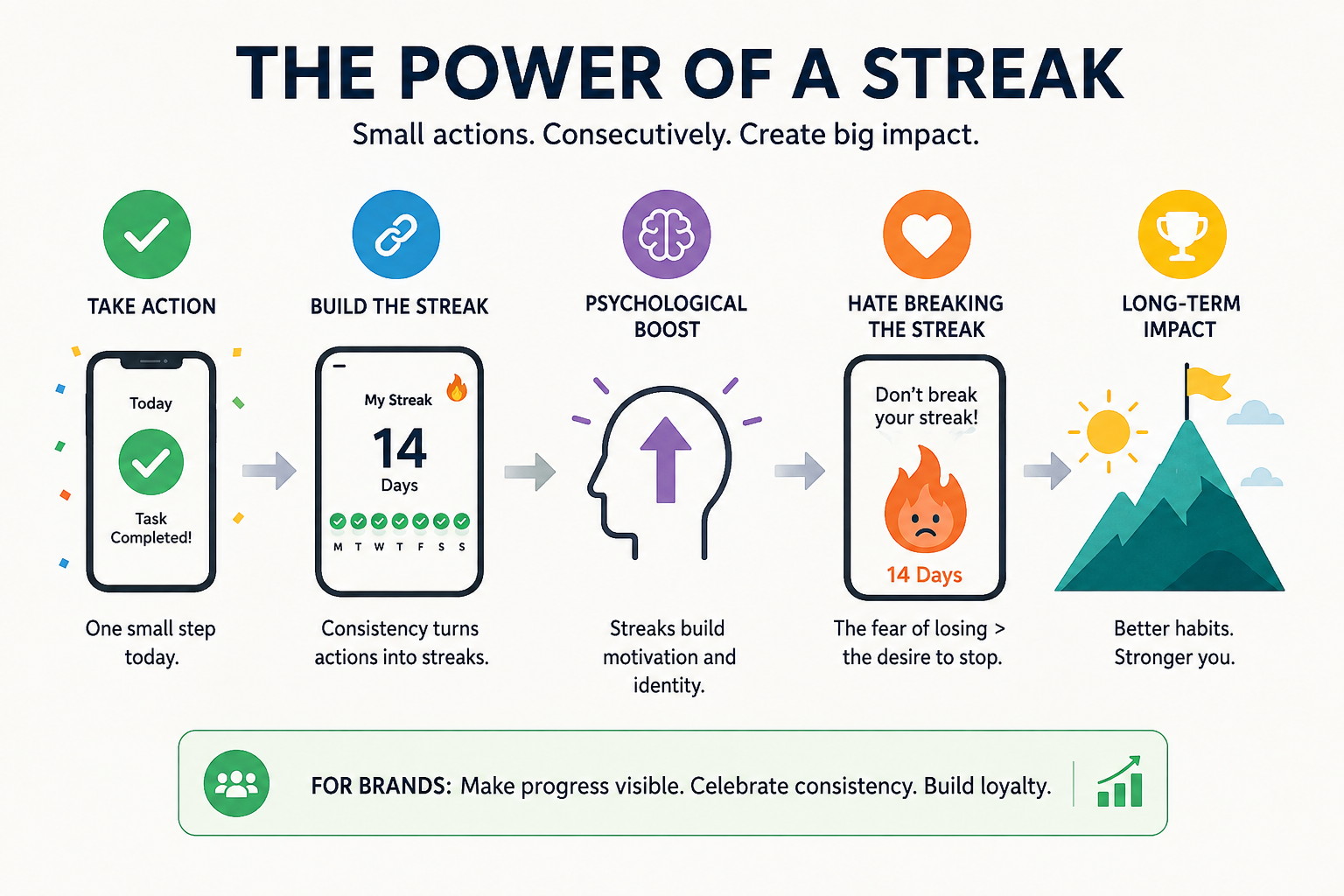
There is something strangely powerful about seeing a number increase on a screen. Seven days, fifteen days, thirty days, one hundred days. The behaviour itself may be relatively insignificant. You may have opened an app, completed a workout, learned a few words in another language, saved some money or simply checked in for the day. Yet once that activity becomes part of a visible sequence, stopping suddenly feels much harder.
This is the psychology of the streak. A streak transforms an ordinary action into an achievement. What began as a behaviour becomes a record, the record becomes a goal, and eventually protecting the record can become almost as important as the original reason for doing the activity.
That has significant implications for brands. Marketers have traditionally used rewards, discounts, loyalty points and promotions to encourage repeat behaviour. Streaks offer something different. They can make repetition itself rewarding by giving consumers a visible sense of continuity and progress. The consumer is no longer simply buying, exercising, learning or participating. The consumer is trying to keep the sequence alive.
A streak changes the meaning of an ordinary action
Consider someone who has exercised for six consecutive days. On the seventh day, going for a run may have little to do with fitness. The person may be tired, busy or simply not in the mood. But the thought of seeing six days become “streak broken” changes the decision.
It is no longer simply, “Do I want to exercise today?” It becomes, “Do I really want to lose my six-day streak?”
Research by Alixandra Barasch and Jackie Silverman examined this phenomenon across seven experiments involving more than 4,000 participants. The research found that consumers were more likely to repeat a behaviour when an intact streak was visible, while highlighting a broken streak could reduce subsequent engagement. Importantly, the underlying behaviour could be the same. What changed was how consumers perceived their behavioural history.
The lesson for marketers is powerful: a digital record is not always neutral. The way a brand presents past behaviour can influence what the consumer does next.
The goal can shift from the outcome to the journey


Most products are built around an ultimate outcome. A fitness app wants you to become fitter. A language-learning platform wants you to learn a language. A financial app wants you to save. A loyalty programme wants you to buy again.
A streak introduces another objective: don’t break the sequence.
This creates a goal within the larger goal. Someone may download a fitness app because they want to lose weight, but after completing workouts for 20 consecutive days, maintaining the 20-day streak can become a goal in its own right. Someone learning German may ultimately want fluency, but after 50 consecutive days, the immediate motivation may simply be to reach day 51.
The journey begins to acquire value independent of the destination. INSEAD’s research describes this phenomenon precisely: people can become attached to maintaining the streak itself because it represents perseverance, accomplishment and evidence that they are capable of sustaining a behaviour.
That is particularly useful for behaviours where the ultimate reward is distant. Passing an examination, improving fitness, learning a language or becoming financially disciplined may take months or years. A streak creates a much more immediate objective: continue today.
India is already a laboratory for streak behaviour


Indian consumers increasingly live within digital ecosystems that record and reinforce everyday behaviour. Payments, fitness, education, entertainment, food ordering and personal finance all generate data about what people do repeatedly.
The opportunities for streak-based engagement therefore extend well beyond gaming.
- Fitness: Track consecutive workouts, walking targets or weekly activity.
- Education: Recognise consecutive learning sessions or completed modules.
- Personal finance: Celebrate regular savings or investment contributions.
- Food and grocery: Recognise consistent purchasing or engagement patterns.
- Content: Encourage regular reading, listening or viewing.
- Digital services: Reward continued participation and completion of recurring tasks.
The important point is not whether a brand actually uses the word “streak.” The important question is whether it makes continuity visible.
India’s enormous digital consumer base makes this particularly relevant. As more everyday activities move online, brands can increasingly show consumers their own behavioural history and turn that history into motivation.
Language learning shows the power of a visible sequence


Language learning provides a particularly clear example. Imagine an Indian student learning German for higher education, a professional learning Japanese for career opportunities, or someone learning Korean because of an interest in the culture.
The ultimate goal may take months or years, but a daily streak provides an immediate objective. Day 1 becomes day 2, day 2 becomes day 3, and eventually “I am learning German” becomes “I have maintained a 37-day German streak.”
The second statement is psychologically more concrete. It provides evidence of consistency, and that evidence can eventually become part of identity. The consumer starts seeing themselves as someone who learns every day, someone who does not miss a session.
This is where streaks become more than a gamification device. They can reinforce the identity associated with the behaviour.
Indian fintech can move beyond rewards


Indian financial brands have an interesting opportunity. Instead of constantly telling consumers how much cashback or how many points they have earned, financial platforms could also celebrate consistency.
For example, an app could tell a customer:
- “You have saved for 14 consecutive weeks.”
- “You have invested every month for the last year.”
- “You have stayed within your monthly spending target for five consecutive weeks.”
- “You have maintained your emergency fund contribution for six months.”
The first approach emphasises the reward. The second celebrates the behaviour.
That distinction matters because cashback disappears once it is spent, while a streak creates a visible record of discipline. For savings and investment products, where success depends heavily on consistent behaviour over time, making that consistency visible could be particularly valuable.
The consumer does not necessarily need another incentive to understand why saving matters. What they often need is reinforcement that they are successfully maintaining the behaviour.
Loyalty programmes should think beyond points
Traditional loyalty programmes largely follow a transactional model: buy, earn, accumulate, redeem, buy again.
But points answer one question: What have I earned?
A streak answers another: How consistently have I behaved?
Imagine a coffee chain telling a customer that they have visited six Fridays in a row. A restaurant could recognise a customer for ordering every weekend for a month. An airline could acknowledge five consecutive business trips. A beauty platform could recognise 30 days of consistent skincare activity.
These messages create a sense of achievement independent of the monetary value of the reward.
This can also make loyalty more emotional. A customer with 4,000 points may switch brands if another company offers a better deal. But a customer who has maintained a 100-day relationship with a service may feel that abandoning it means giving something up.
The switching cost is not financial. It is psychological.
The danger comes when the streak breaks


This is where brands need to be careful. A streak is powerful precisely because it can be lost. But when a consumer misses a day, the brand has a choice.
It can say, “Your streak is broken.”
Or it can say, “You were on a 28-day run. Let’s get you started again.”
The two messages describe the same event, but create very different emotional responses. Research on consumer streaks suggests that highlighting a broken streak can reduce subsequent engagement, while giving consumers an opportunity to repair the streak can lessen the negative effect. The research also found that the negative impact is stronger when people feel personally responsible for breaking the streak.
This leads to an important principle: a streak should create tension, not despair.
If missing one day makes consumers feel that everything they accomplished has been erased, some will simply abandon the behaviour. The psychology becomes, “I’ve lost my streak. What’s the point?”
The brand wants the consumer to think, “I’ve missed one day. I can get back on track.”
Good streak design needs forgiveness
Brands can therefore build recovery mechanisms into their streak systems. These might include:
- Limited streak freezes
- Make-up days
- Weekly rather than daily streaks
- Opportunities to recover a broken streak
- Recognition of overall consistency rather than perfection
- Restart messages that emphasise previous progress
The idea is not to make streaks meaningless. It is to ensure that one lapse does not destroy a habit that took weeks or months to establish.
This is particularly important in India, where consumers have very different lifestyles and routines. A daily streak may work well for language learning, but a monthly consistency measure may make far more sense for investing. A fitness platform might be better served by measuring three meaningful workouts a week rather than demanding activity every single day.
The unit of the streak should reflect the natural rhythm of the behaviour.
INSEAD’s research similarly suggests that companies can make streaks more flexible, including by allowing broader definitions of the behaviour or measuring activity weekly rather than daily. The challenge is to maintain enough difficulty to keep the streak meaningful without making it unnecessarily fragile.
Streaks can build identity, not just engagement
The most powerful streaks eventually stop being about numbers. They become about identity.
Someone who has maintained a 200-day running streak may begin to think of themselves as a runner. Someone who has written every day for 100 days may start thinking of themselves as a writer. Someone who has saved consistently for a year may begin to see themselves as financially disciplined.
The streak provides visible evidence supporting that identity.
This is where behavioural design becomes especially interesting. The brand is not merely encouraging an action. It is helping consumers construct a story about themselves.
That is a much deeper relationship than simply offering another discount.
The lesson for marketers


The biggest lesson is simple: consumers do not always need a bigger reward. Sometimes they need a better record of what they have already achieved.
Instead of constantly asking, “What incentive can we offer the customer?”, marketers should also ask, “What progress can we make visible?”
That could mean:
- Creating milestones rather than relying only on promotions
- Showing consistency rather than only points
- Celebrating participation rather than only purchases
- Connecting repeated behaviour to a positive identity
- Designing streaks around the natural frequency of the behaviour
- Providing a recovery mechanism when consumers lapse
The opportunity is to move from rewarding transactions to reinforcing behaviour.
The future of loyalty may be about momentum
The most valuable consumer behaviour is often repeated behaviour. The challenge is getting consumers to repeat it long enough for it to become habitual.
Streaks provide a simple psychological mechanism for encouraging that repetition. They give consumers a visible measure of continuity and turn an ordinary repeated action into something worth protecting.
That makes the streak more than a number. It becomes momentum.
The smartest brands will therefore stop thinking about loyalty purely as a points-and-rewards problem and start thinking about it as a consistency-and-momentum problem.
Because once a consumer begins thinking, “I don’t want to break my streak,” the brand has achieved something far more valuable than another transaction.
It has become part of the consumer’s habit.
The marketer’s takeaway
A good streak strategy should answer five questions:
- What behaviour do we want repeated?
- How can we make continuity visible?
- What milestone will feel meaningful to the consumer?
- What happens when the consumer misses a day?
- How can we help them restart without making them feel that their previous effort was wasted?
Get those five things right, and a streak stops being a gimmick.
It becomes a behavioural design tool.
And for brands operating in India’s increasingly digital consumer economy, that could make the difference between being another app on the phone and becoming part of the consumer’s everyday routine.
The real power of a streak is not that it counts what consumers have done. It gives them a reason to do it again.
References
Barasch & Silverman, Consumer Streaks Are Motivating
Mehr et al., The Motivating Power of Streaks
Kivetz, Urminsky & Zheng, The Goal-Gradient Hypothesis
The Effects of Goal Progress Cues
Hwang & Choi, Gamification in Loyalty Programs
2024 Meta-Analytics Review of Gamification