The Royal Pop Is Not a Watch. It Is a Mood. How Swatch and Audemars Piguet built the Labubu of horology
The Royal Pop transformed a luxury watch into a cultural collectible. How Swatch and Audemars Piguet used hype, scarcity, Gen Z identity, and drop culture to redefine modern horology.
There is a pocket watch hanging off someone’s Birkin right now. It costs $400. It sold out in under two hours. And the horological community is furious.
Welcome to the Royal Pop.
What just happened
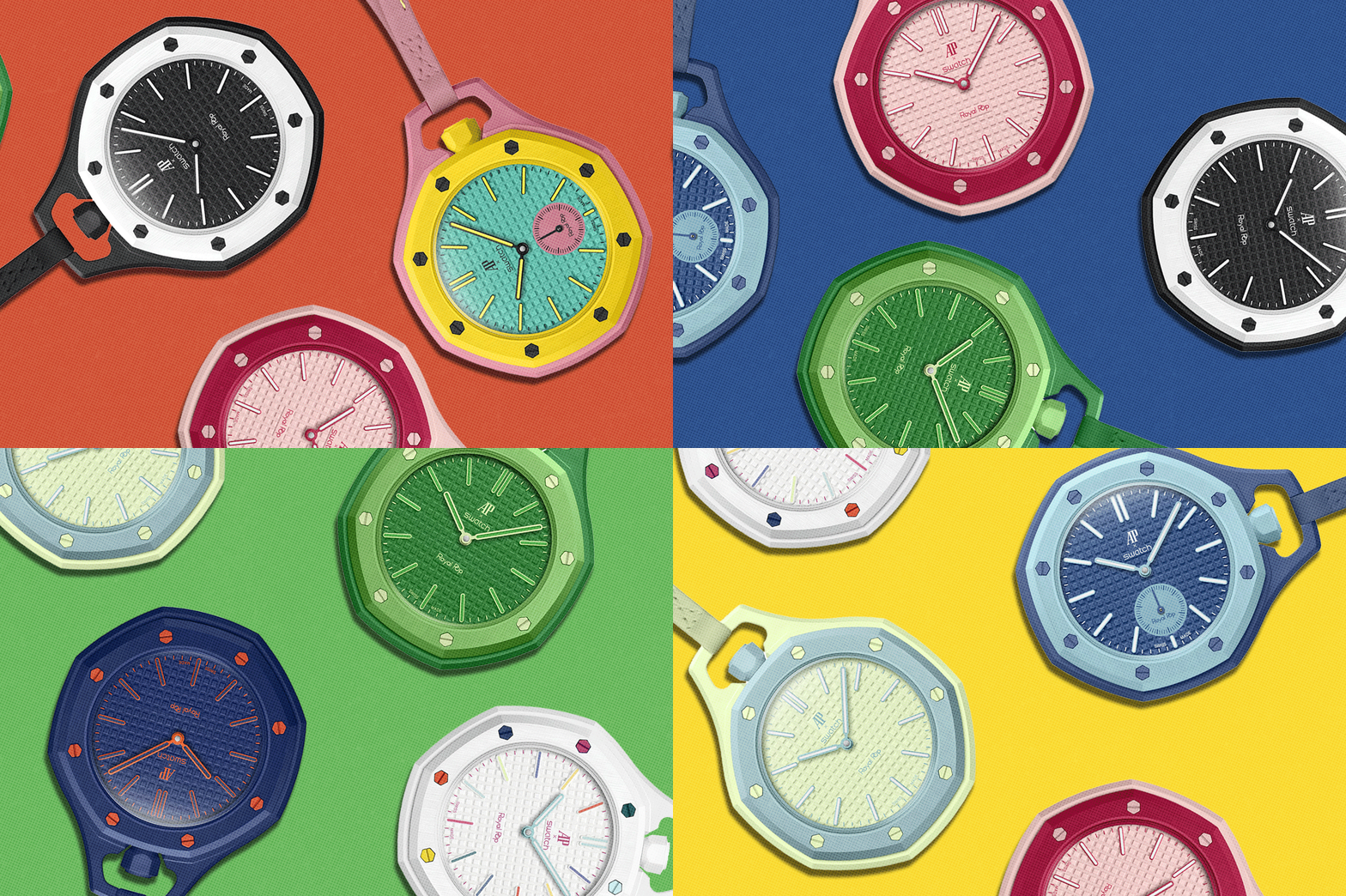
On 16 May 2026, Swatch and Audemars Piguet launched the Royal Pop: a bioceramic pocket watch inspired by the iconic Royal Oak, available in eight colourways, priced between $400 and $420, and designed to be worn around the neck, clipped to a bag, slipped into a pocket, or displayed as a desk clock.
In Singapore, the watches sold out in under two hours at the ION Orchard boutique. In Hong Kong, consumers began queuing outside the Causeway Bay outlet four days before the drop.
On the secondary market, the Royal Pop hit an average of $905 on StockX, $2,820 in Hong Kong, and $1,350 to $5,550 on Singaporean resale platforms.
That is not a watch sale. That is a cultural event.
The Labubu comparison is not casual
Some have compared the Royal Pop to “Labubu for the wrist” – a playful, hype-driven accessory designed more for flex culture and fashion collectors than traditional watch enthusiasts.
The comparison holds. Both objects operate on the same logic: scarcity, visual identity, social signalling, and the pleasure of ownership that has nothing to do with utility. You do not buy a Labubu to play with it. You do not buy a Royal Pop to tell the time. You buy both to say something about yourself.
Gustaf Wick, Business Director at Mahlab ASEAN, put it plainly: the Royal Pop is “a collectible, wearable, attach-it-to-your-Birkin piece of cultural shorthand that sits at the intersection of horology, streetwear, and the kind of quiet luxury signalling that Hermès has built a religion around”. He called it “an identity purchase”.
That framing is precise. The Royal Pop is not competing with the Royal Oak. It is competing with Labubu, Stanley cups, and Miu Miu bag charms. Different category. Same consumer psychology.
The drop mechanics were deliberate
This was not an accidental frenzy. The hype was engineered.
The collaboration was confirmed on 9 May, following a weeks-long teaser campaign that began at Watches and Wonders in Geneva in April, where Swatch placed print ads reading, “The real wonders are happening in May.” On 3 May, Swatch’s Instagram posted a video showing only the words “Royal Pop x Swatch” with no product imagery.
No product. Only anticipation. That is the Labubu playbook: withhold the reveal, let the imagination run, and let the queue form before the doors open.
Lucila Lannes, social strategist at Bread Agency, described how the blind-box model that Labubu popularised transformed a product into an experience: “It transformed a product into an experience, an ‘unboxing’ show to broadcast to an audience.”
The Royal Pop used the same mechanic without the blind box. The uncertainty was which colourway you would find in stock. The broadcast was the queue photograph on Instagram.
The generational shift underneath it all
This is not just about one watch. It is about how Gen Z consumes luxury differently.
Research by Kantar describes a generational shift in how luxury is consumed: while millennials purchased luxury as a status marker, Gen Z treats it as a tool for self-expression and identity curation.
The Royal Pop is priced to fit that logic. At $400, it sits below the aspiration threshold of a real AP but above fast fashion. It is accessible enough to manufacture desire and exclusive enough to feel earned. That is a precise calculation, not an accident.
Randy Wong, General Manager (SEA & TR) at Tumi, noted that the lanyard format resonated with younger consumers more strongly than a wristwatch would have: “Lanyards, pendants, and chain-worn accessories are not alien to a generation raised on streetwear and festival culture. Wearing a timepiece around your neck rather than your wrist is, in that context, a statement of style fluency rather than an oddity.”
Style fluency: that is the operating currency of this consumer. Not heritage. Not mechanical complexity. Fluency.
The backlash is part of the strategy
According to Carma Asia data, AP’s negative sentiment rose from 15.4% to 28.1% at launch, while Swatch’s flipped from 16.1% pre-launch to 43% negative, driven by luxury collectors citing brand dilution and backlash against hype and reseller culture.
And yet the watches sold out in hours. The secondary market tripled the retail price overnight. The backlash drove the conversation, and the conversation drove the demand.
Controversy, it turns out, may just be the best luxury marketing tool of all.
Oliver Ellerton of Ellerton & Co said the quiet part out loud: “For such a storied, serious brand, the ability to let its hair down and have a bit of fun can add a lot of brand value.”
Audemars Piguet is not abandoning its $300,000 complications. It is creating a new entry point: one that does not require a waiting list or a relationship with a dealer. It requires only a queue, a lanyard, and the confidence to wear a watch around your neck.
What brand builders should take from this
The Royal Pop is a case study in repositioning without dilution — or at least, in attempting it. A few things are worth noting for anyone building brands today.
- First: the object is secondary to the identity it signals. The Royal Pop is not selling timekeeping. It is selling membership in a cultural moment. That is a lesson that applies well beyond watches.
- Second: the drop model is a brand strategy, not just a retail tactic. Scarcity, anticipation, and the social spectacle of the queue create desire that advertising cannot replicate.
- Third: the backlash from the core audience is a feature, not a bug. It signals that the brand has crossed into new territory. Heritage brands that want younger consumers must accept that the older audience will protest. The question is whether the commercial upside justifies the tension. In this case, the answer appears to be yes.
- Fourth: Gen Z does not want a watch. Gen Z wants a mirror. The Royal Pop reflects their identity back at them — bold, modular, worn their way, photographed their way, shared their way.
The final word
The Royal Oak was designed in 1972 to break the rules of fine watchmaking. A steel sports watch at a luxury price point was considered commercial suicide at the time.
The Royal Pop is doing something similar: taking the icon and asking a new generation to reimagine what it means to wear it.
Horology purists will not forgive it. They are not the target.
The Royal Pop is not a watch. It is a collectable with an inner movement. And in 2026, that distinction is everything.