The Paradox of Modern Brands: When What Spreads Freely Isn’t What You Charge For
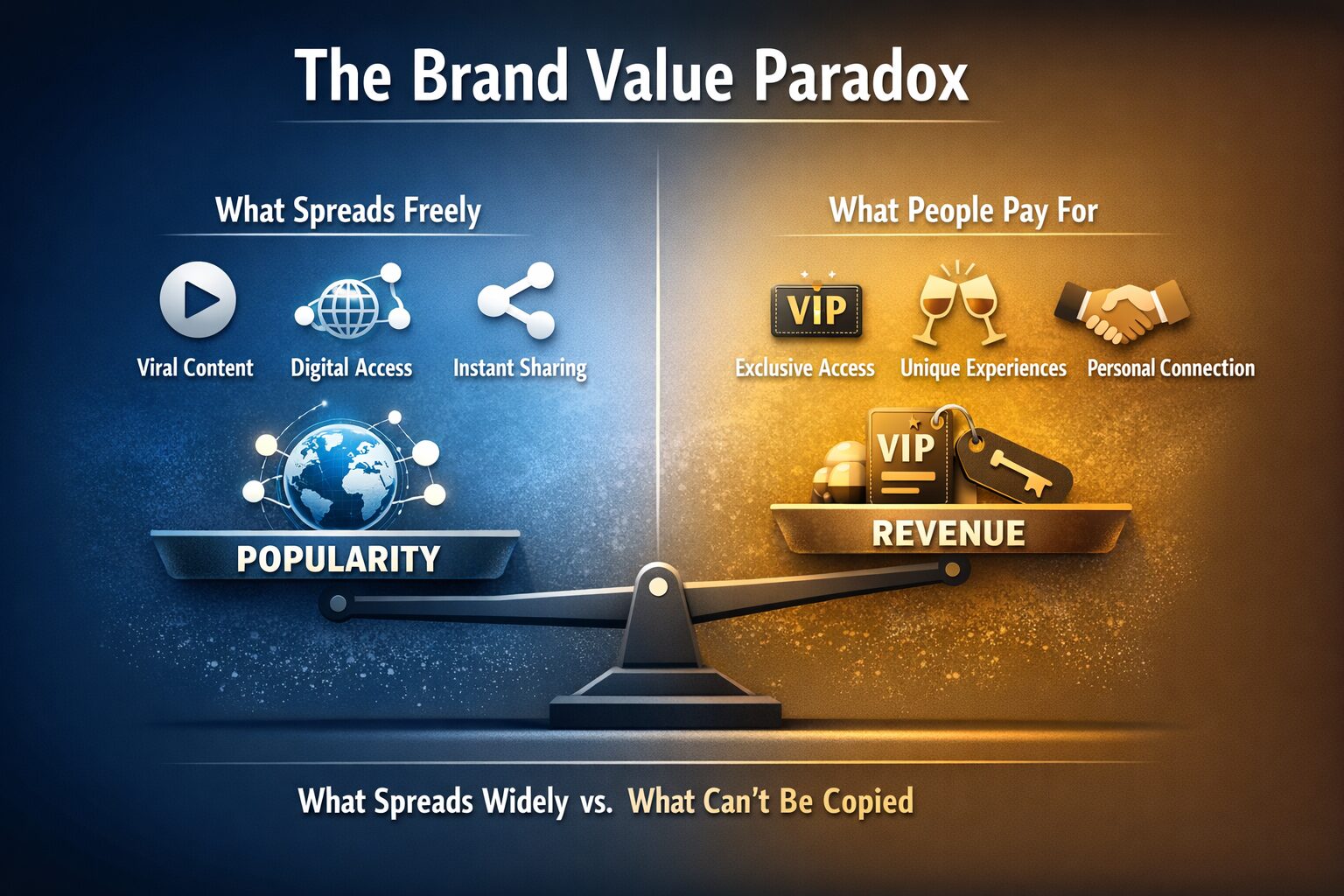
Every era of commerce has had its version of the same puzzle: what makes something valuable when identical things are freely available?
In the physical world, this was straightforward. Scarcity was imposed by nature. A diamond was rare because the earth produced few of them. A handwoven silk sari commanded a premium because the labour could not be industrialised beyond a point. The relationship between scarcity and price was direct and intuitive.
The digital economy has upended this relationship in ways that most brand builders are still catching up with. It has not eliminated scarcity. It has moved it. And the brands that have not noticed the move are the ones struggling to charge for what they offer.
The core shift is this: digital technology has created extraordinary abundance in content, information, and media – while simultaneously creating new forms of scarcity in experiences, access, and participation.
And the brands that understand where abundance ends and scarcity begins are the ones building durable pricing power.
The Collapse of Information Scarcity
Consider how information moved before the Internet. A recipe was something you inherited from your grandmother or found in a cookbook you purchased. A music album required a physical object – a vinyl record, a cassette, or a CD. A university lecture was available only to those who enrolled and attended in person.
Distribution required effort, money, and physical infrastructure. This imposed natural limits on supply, which in turn supported pricing.
Digital distribution dissolved all of these constraints. Today, a recipe is a search query away. An album streams for free on ad-supported platforms. A lecture from a Nobel laureate is available on YouTube to anyone with a phone and a data connection. The marginal cost of reproducing and distributing digital content has fallen to effectively zero.
When supply becomes infinite, the price the market will bear for the content alone drops accordingly. This is not a failure of the market. It is the market working precisely as it should. Abundance drives prices down.
Which is why industries built on selling information – journalism, music, publishing, and education – have spent two decades reinventing their revenue models. The product they once sold (the content) is now the thing they give away. The thing they charge for has shifted elsewhere.
Where Scarcity Has Migrated
If content has become abundant, what remains scarce?
The answer, consistently across industries, is the same: things that cannot be digitally reproduced.
A concert recording can be shared. The experience of being in the arena when A. R. Rahman plays ‘Jai Ho’ live cannot. Millions can watch a TED talk. The experience of being at the TED conference – the hallway conversations, the introductions, the community – is limited to those in the room.
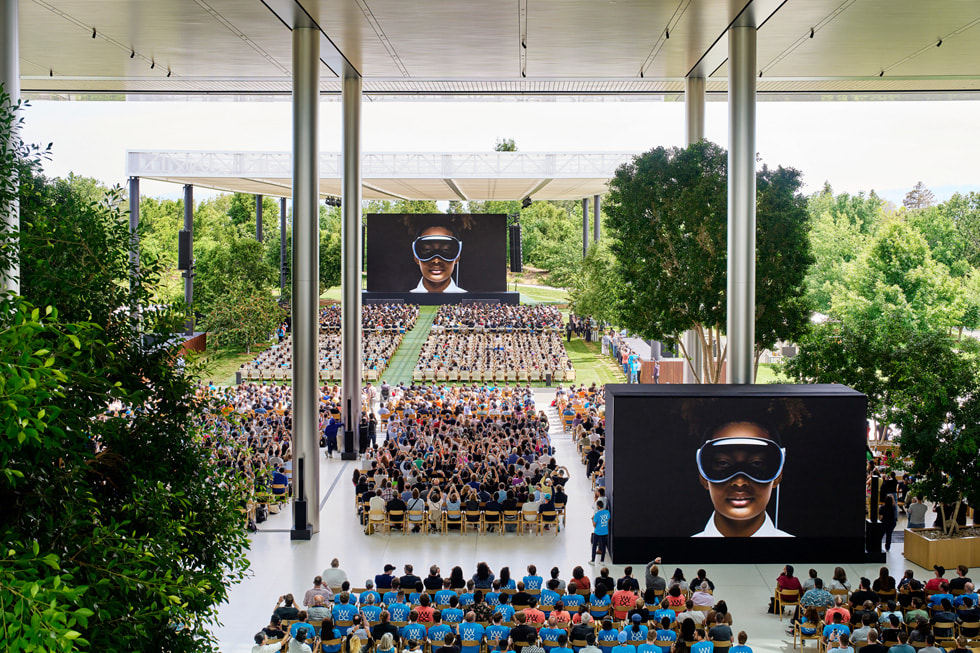
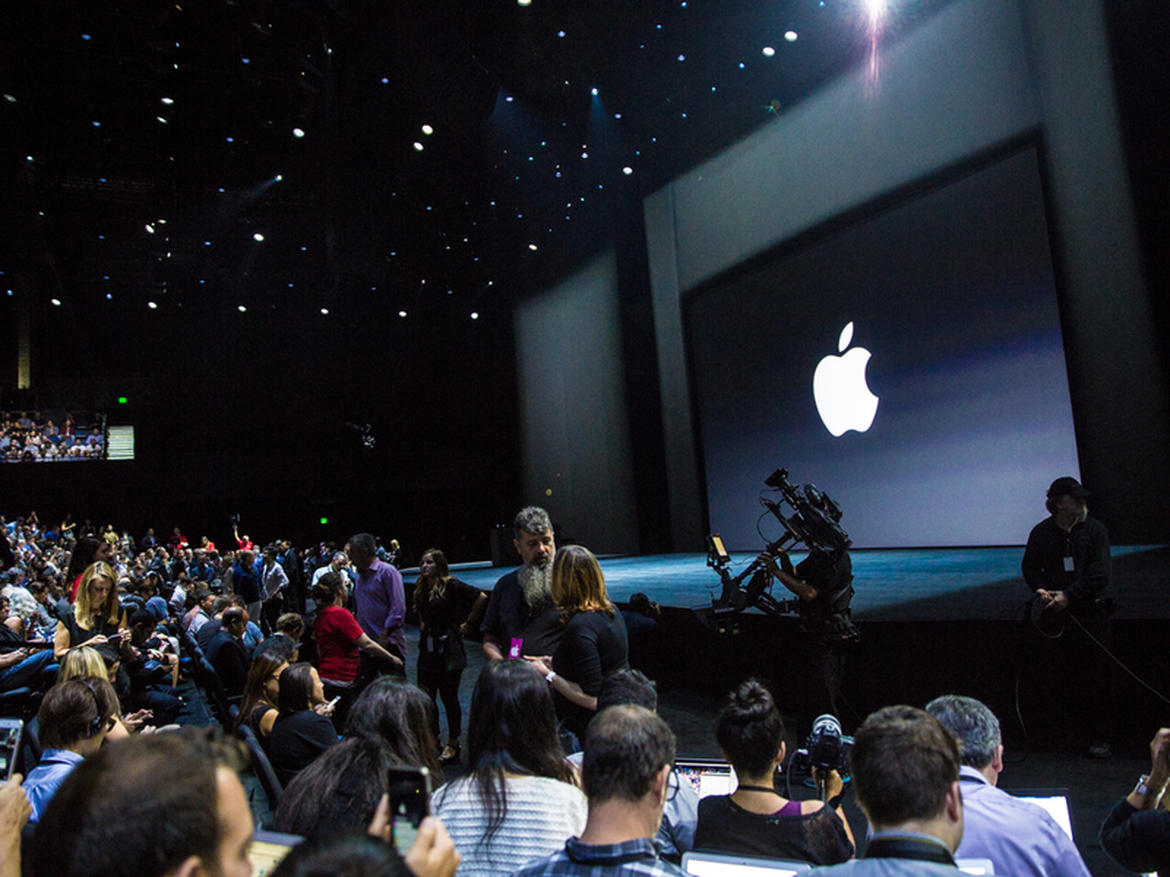
Apple streams its product launches to hundreds of millions of viewers. But the experience of being inside the auditorium, handling the device before the world sees it, and meeting the engineering team – that access is restricted to a few hundred people. The broadcast builds influence. The experience preserves exclusivity.


Fashion weeks in Paris, Milan, and Mumbai are streamed globally. Yet brands invest enormous resources in the physical event because the real currency is not the runway show itself. It is the access, the networking, and the industry relationships that form around the show. The spectacle is shareable. The access is not.
In each case, the same principle holds: the freely distributed layer builds reach and relevance, while the scarce layer captures value.

How This Plays Out Across Industries
- Music. Streaming platforms have made individual songs nearly free to access. Revenue per stream is fractions of a paisa. Yet the concert industry is booming globally. Coldplay’s recent India tour, Arijit Singh’s live performances, and Diljit Dosanjh’s arena shows – tickets sell out within minutes at premium prices. The music spreads freely. The live experience commands the premium.
- Sport. Highlights of the IPL or the FIFA World Cup are available instantly on every social platform. Yet stadium tickets remain in fierce demand. Fans are not paying to see the match – they can see it for free on a screen. They are paying for atmosphere, community, emotional intensity, and the irreplaceable feeling of being part of the moment.
- Hospitality. Photographs of the Taj Lake Palace, Aman Resorts, or a Maldives overwater villa circulate endlessly on Instagram. Travel influencers share these images daily. But the actual experience of being there – the service, the silence, the sensory immersion – cannot be downloaded. The images spread aspiration. The experience carries the price tag.


- Education. Entire courses from Harvard, MIT, and IIM Ahmedabad are available free on SWAYAM, Coursera, and edX. Yet these institutions continue to command premium fees. Because the value lies not in the lecture content but in the peer networks, faculty access, collaborative learning, and career signalling that come with physical enrolment. The knowledge is accessible to anyone with a browser. The experience, the relationships, and the credentials are scarce. That distinction is worth lakhs in tuition.



The Indian Brand Landscape
This principle is increasingly evident in the way Indian consumer brands structure their business models.
- Zomato and Swiggy distribute restaurant information freely – menus, ratings, reviews, and photographs. The entire content layer is open and shareable. But they monetise the service layer: delivery speed, subscription convenience, and curated dining experiences. The information builds a habit. The service generates revenue.
- Tanishq’s jewellery catalogues are widely available online. Every design, every price point, every collection is browsable from a phone. But the premium lies in the in-store experience – the consultation with a trained associate, the trust embedded in the Tata name, and the tactile ritual of trying on a piece under careful lighting. A customer who has seen the catalogue online still walks into the store to make a purchase. Digital exposure creates consideration. The physical environment converts it into a sale and, more importantly, into a relationship.
- Even boAt, operating in a commodity category of audio accessories, understood this. The headphones are visible everywhere online. But the brand invested in experiential touchpoints – music festival sponsorships, cricket partnerships, and a community identity around being a ‘boAthead’. The product is replicable. Identity and belonging are not.
In each case, the brand gives away the shareable layer generously and designs its revenue model around the layer that cannot be forwarded.
The Strategic Principle
For brand builders, the implication is not to restrict the spread of content or information. That battle was lost the moment distribution became free. And it was a battle not worth fighting, because the spread of content is precisely what builds the reach and cultural relevance that brands need.
The implication is to design the business model with a clear-eyed understanding of which layer generates fame and which layer generates revenue. These are rarely the same layer. And the brands that conflate them – that try to monetise the content layer directly or that neglect the experience layer entirely – find themselves famous but unprofitable, or profitable but invisible.
Let the content travel freely. It builds awareness, trust, and cultural presence.
But invest disproportionately in the layer that cannot be replicated – the experience, the access, the personalisation, the community, the physical environment.
These are the elements that remain scarce in an abundant world. And therefore, these are the elements that sustain pricing power.
The Brands That Will Win
As digital networks expand further, content will only become more abundant. AI will generate more media. Distribution barriers will keep falling. Every brand will have access to the same visibility tools.
Which means visibility itself will cease to be a differentiator.
The brands that win will be the ones that understand a simple yet easy-to-forget truth: the things that spread the farthest are not the things people pay for. And the things people willingly pay for are often the ones that cannot be shared at all.
This is not an argument against digital content. Content is the engine of discovery, and without it, no brand reaches the people it needs to reach. But discovery is the beginning of the journey, not the destination. The destination is the moment when a customer encounters something that feels irreplaceable – an experience, a relationship, a sense of belonging – and decides it is worth paying for precisely because it cannot be forwarded to someone else.
Presence over content. Participation over impressions. Belonging overreach.
That is where brand value lives now. And that is where it will increasingly live in the years ahead.
Bibliography
[1] Rifkin, J. (2014). The Zero Marginal Cost Society: The Internet of Things, the Collaborative Commons, and the Eclipse of Capitalism. Palgrave Macmillan. https://us.macmillan.com/books/9781137280114/thezeromarginalcostsociety/
[2] Anderson, C. (2009). Free: The Future of a Radical Price. Hyperion. https://www.harpercollins.com/products/free-chris-anderson
[3] Pine, B.J. & Gilmore, J.H. (1998). ‘Welcome to the Experience Economy.’ Harvard Business Review, July–August 1998. https://hbr.org/1998/07/welcome-to-the-experience-economy
[4] Wenger, A. (2016). ‘Digital Technology.’ The World After Capital. https://worldaftercapital.gitbook.io/worldaftercapital/digital
[5] Goldman Sachs (2024). ‘Live Music Industry Revenue Worldwide from 2022 to 2030.’ via Statista. https://www.statista.com/statistics/1096424/live-music-industry-revenue-worldwide/
[6] MarketsandMarkets (2025). ‘Live Entertainment Industry Worth $270.29 Billion by 2030.’ https://www.marketsandmarkets.com/PressReleases/live-entertainment.asp
[7] Custom Market Insights (2025). ‘Global Live Music Market Size, Trends, Share 2025–2034.’ https://www.custommarketinsights.com/report/live-music-market/
[8] TED Conferences. ‘About TED Conferences.’ https://www.ted.com/attend/conferences
[9] TED Conferences. ‘TED2026: All of Us — Membership and Attendance.’ https://conferences.ted.com/ted2026/attend
[10] IFPI (2025). ‘Global Recorded Music Revenues Grew 4.8% in 2024.’ https://www.ifpi.org/ifpi-amidst-highly-competitive-market-global-recorded-music-revenues-grew/
[11] Sisario, B. (2024). ‘Taylor Swift’s Eras Tour Made a Record $2 Billion of Ticket Sales.’ The New York Times. https://www.nytimes.com/2024/12/09/arts/music/taylor-swift-eras-tour-ticket-sales.html
[12] Techdirt (2006). ‘The Importance of Zero in Destroying the Scarcity Myth of Economics.’ https://www.techdirt.com/2006/11/08/the-importance-of-zero-in-destroying-the-scarcity-myth-of-economics/
[13] Coursera. ‘Free Online Courses from World’s Leading Universities.’ https://www.coursera.org/
[14] SWAYAM (Study Webs of Active-Learning for Young Aspiring Minds). Government of India. https://swayam.gov.in/
[15] Zomato Limited. Annual Report 2023–24. https://www.zomato.com/investor-relations
[16] Titan Company Limited (Tanishq). Annual Report 2023–24. https://www.titancompany.in/investors
[17] boAt (Imagine Marketing Pvt. Ltd.). ‘About boAt.’ https://www.boat-lifestyle.com/pages/about-us
[18] Apple Inc. ‘Apple Events.’ https://www.apple.com/apple-events/
[19] Pawlowski, A.M. (2025). ‘When Zero Marginal Cost Isn’t Free: The Hidden Costs of Digital Abundance.’ Medium / Bootcamp. https://medium.com/design-bootcamp/when-zero-marginal-cost-isnt-free-the-hidden-costs-of-digital-abundance-1160474dc8ed
[20] Outpile (2025). ‘Zero Marginal Cost Didn’t Kill Capitalism — It Put It on Steroids.’ https://www.outpile.com/en/articles/zero-marginal-cost-capitalism-digital-economy


