The Brand-Driven Enterprise Defined
There is a particular kind of confusion that plagues boardrooms when the word “brand” comes up. Finance teams interpret it as a discussion about advertising budgets. Operations leaders assume it belongs exclusively to the marketing department. Sales professionals reduce it to taglines and colour palettes. And senior leadership, caught somewhere between these definitions, nods along while privately wondering whether any of it moves the bottom line.
This confusion is not trivial. It reflects a fundamental misunderstanding of what a brand actually is – and, more importantly, what it can do when an organisation fully commits to it. The brand-driven enterprise represents a fundamentally different approach, one in which brand is not a department, not a campaign, and not a visual system. It is the organising logic of the entire business. And it begins, critically, not in the communications suite, but at the very core of the enterprise – in its beliefs, its behaviours, and its honest relationship with the people it serves.
Starting from the Inside Out
Here is the question that separates genuinely brand-driven enterprises from those that merely aspire to be: Does your brand begin within the organisation, or is it primarily constructed for external consumption?
Many companies still default to the latter. They build elaborate brand architectures – positioning statements, visual identities, campaign platforms – designed to project an image outward toward the market. The assumption is that brand is fundamentally a communication exercise: craft the right message, deliver it consistently, and the market will respond accordingly.
How Powerful Brands Actually Function
But the most powerful brands in the world don’t operate this way. They understand, almost instinctively, that brand is first an internal reality before it becomes an external one. The brand lives in the convictions, practices, and daily decisions of the people who make up the enterprise. It travels from the heart of the organisation directly to the heart of the customer – not through advertising alone, but through every point of genuine contact between the two. When that internal reality is coherent and deeply felt, the brand’s external expression becomes credible in a way no communications budget can manufacture.
This is why so many well-funded brand campaigns fail to build lasting equity. They project an identity that the organisation hasn’t actually earned internally. Customers encounter the promise in a commercial and then experience something quite different when they interact with the product, the service, or the people behind it. The gap between the two is what erodes trust – slowly, quietly, and at considerable cost.
The brand-driven enterprise closes that gap not by managing communications more carefully, but by becoming more genuinely itself.
The Problem with How We Currently Think About Brand
For most of the twentieth century, brand was understood primarily as a signalling device. You created a name, applied a visual identity to your product, invested in advertising, and hoped that consumers would associate your offering with desirable qualities. This was, broadly speaking, a mass-market model – designed for a world where consumers had limited information, limited choices, and limited ability to talk back.
That world no longer exists.
Today’s consumer is extraordinarily well-informed, deeply sceptical, and extraordinarily vocal. A brand promise made in a television commercial can be dismantled in hours by a single viral customer experience. A company’s stated values are instantly comparable to its actual behaviour across thousands of channels that didn’t exist two decades ago. The gap between what a company says it stands for and what it actually does has never been more visible, or more consequential.
This is precisely why the old model of brand – brand as message, brand as aesthetics, brand as campaign – has become not just insufficient but actively risky. Organisations that continue to treat brand as a communication layer applied on top of their operations are essentially building on an unstable foundation. The communications say one thing; the experience delivers another. Consumers notice. trust erodes. And the investment made in brand building quietly destroys value rather than creates it.
Defining the Brand-Driven Enterprise
The brand-driven enterprise operates from a fundamentally different premise: that brand is a strategic asset and an organisational philosophy, not a marketing tool. In this model, the brand is not something the company communicates – it is something the company is.
And at the heart of that identity are answers to a small set of profoundly difficult questions that every enterprise, if it is serious about brand, must be willing to sit with honestly: Why are we here? How are we genuinely unique? How do we make a real difference to the people we serve? Who truly cares about what we do, and why should they?
These are not rhetorical exercises. They are the architectural foundations upon which a brand-driven enterprise is built. Organisations that can answer these questions with clarity, authenticity, and conviction – and that build their operations accordingly – are the ones that create brands with real gravitational pull. Those who cannot, or who respond with polished language that masks a lack of genuine conviction, build brands that are structurally fragile.
A brand, understood this way, is a dynamic, living promise constantly renewed through action. It is not a tagline revisited every three years in a positioning workshop. It is an ongoing expression of the values the organisation cares most deeply about – and it demands the courage to let those values define the business, rather than allowing competitors, market pressures, or short-term convenience to define it instead.
Purpose as the North Star
Purpose has become something of a buzzword in strategic circles, which is unfortunate, because when it operates meaningfully, it is genuinely powerful. In the brand-driven enterprise, purpose is not a statement drafted by a communications agency and posted on the website. It is the answer to a deceptively simple question: why does this organisation exist beyond the generation of profit?
The importance of this question is not ideological. It is strategic. Purpose provides the enterprise with a durable point of differentiation in a world where product and price advantages are increasingly temporary. Technology can be copied. Distribution can be replicated. But a deeply authentic organisational purpose – one that is expressed through every touchpoint, decision, and interaction – is significantly harder to imitate, because it is embedded in culture rather than capability.
Patagonia’s commitment to environmental responsibility, for instance, is not merely a marketing position. It has shaped the company’s business model, its supply chain decisions, its approach to product design and longevity, and its unusual practice of encouraging customers to buy less. These are not communications choices – they are operational and strategic decisions driven by a sense of purpose that permeates the organisation. In this case, the brand is indistinguishable from the business itself.
Values as Behavioural Architecture
If purpose defines why the organisation exists, values define how it operates. In the brand-driven enterprise, values are not a list of admirable adjectives displayed in the lobby. They are behavioural standards – concrete, observable, and consequential.
Brand leadership is the lived expression of these values. It is not a communication strategy or a set of talking points for the executive team. It is the continuous delivery of a profound and consistent experience to an audience that cares with equal passion – an audience that is not merely purchasing a product or service, but recognising itself in what the brand stands for. This is how brand advocates are created: not through loyalty programs or referral incentives, but through a shared emotional resonance so genuine that customers begin to define their own aspirations through the brand’s values.
When values are truly embedded in organisational behaviour, the customer experience becomes coherent across every interaction – whether with a frontline employee, a digital interface, a product, or a piece of communication. That coherence is what creates trust. And trust, across a wide body of research, remains one of the most powerful predictors of loyalty, premium tolerance, and advocacy behaviour.
The Question of Measurement – and Its Limits
One of the persistent debates in brand thinking is the extent to which brand equity can and should be quantified. The instinct to measure everything is understandable – it provides comfort, justification, and the appearance of control. And meaningful metrics certainly exist: brand awareness, association strength, price premium tolerance, Net Promoter Scores, and share of wallet all provide useful data points.
But there is a harder truth here that brand-driven enterprises are willing to acknowledge. How do you quantify a person’s feelings? How do you assign a precise number to someone’s aspirations, passions, beliefs, or devotion to a brand they love? The science of branding, as a means for determining purely quantitative metrics, can become an oversold idea – one that mistakes the map for the territory. Metrics illuminate, but they do not capture the full territory of brand value.
And yet the rewards for connecting these so-called soft emotional attributes are anything but soft in their financial consequences. The enterprises that cultivate genuine emotional resonance – that speak honestly to customer aspirations rather than simply to functional needs – consistently add billions of dollars in hard market value to their equity. Brand equity, in this sense, is the accumulated financial expression of emotional connection, built over time through consistent, authentic delivery of a promise that matters.
The lesson for brand-driven enterprises is not to abandon measurement, but to hold it with appropriate humility. Use metrics to track direction and identify gaps. But never mistake the metrics for the thing itself.
Design as Meaning, Not Decoration
In a new economy where products and services are increasingly functionally similar and where the noise of marketing and message clutter makes differentiation harder to perceive, design is one of the most critical tools available to a brand-driven enterprise. But not design in the narrow sense of aesthetics or visual identity. Design, at its deepest level, is the discipline through which meaning is made tangible.
Brand design in the new economy is fundamentally about meaning rather than marketing. It is the translation of the enterprise’s deepest values and purpose into forms that customers can see, touch, feel, and understand – often before a single word is spoken. The colour of a package, the texture of a material, the sound of a notification, the architecture of a digital experience: these are not decorative choices. They are acts of communication that operate at an emotional register that language rarely reaches.
As categories mature and competitors converge on similar functionality, the enterprises that maintain distinctiveness are overwhelmingly those that have invested in design as a meaning-making discipline. They understand that customers, navigating an increasingly cluttered world, rely on design to help them distinguish between good and great, between common and remarkable. A brand that fails to invest in this dimension of expression is, in effect, choosing to become invisible in precisely the moment when visibility matters most.
There is nothing superficial about this. Brand design, executed with integrity and aligned with genuine organisational values, is one of the most powerful instruments of differentiation available to any enterprise. It is the bridge between the organisation’s internal conviction and the customer’s emotional experience – form in the service of feeling, and feeling in the service of relationship.
Brand Belongs to the Whole Enterprise
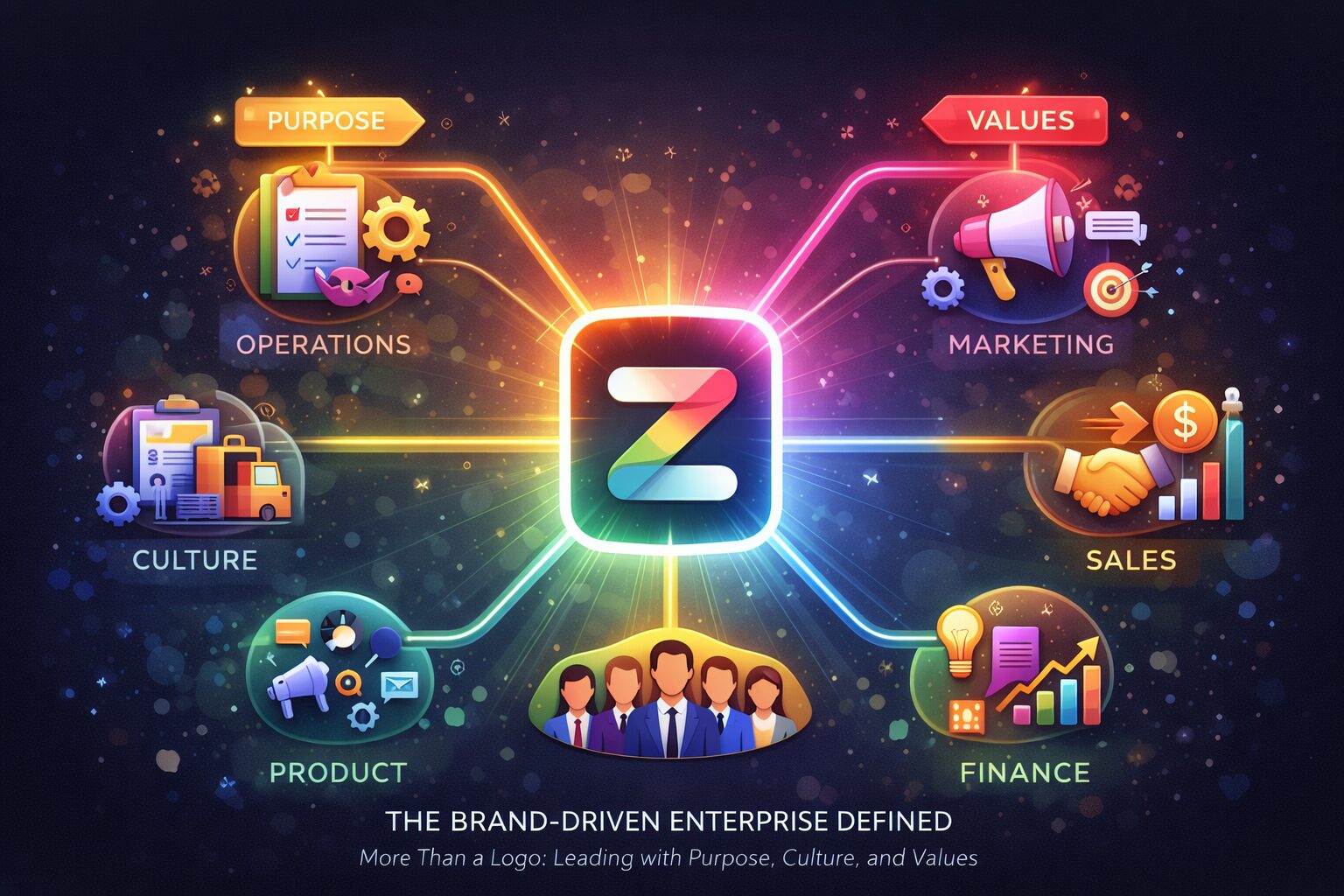
The most important structural insight of the brand-driven enterprise is this: brand does not belong to marketing. It does not belong to product development, the communications team, or any single function within the organisation. A brand belongs to every discipline within the enterprise, and its integrity depends on all those disciplines coming together around a unified, honest set of answers to the questions at the core of the organisation’s existence.
This is why branding, properly understood, is not marketing shtick. It is not a campaign that runs for a quarter and then is replaced by the next. It is a discipline of organisational coherence – a commitment to ensuring that finance, operations, talent, product, service, design, and communication are all pulling in the same direction, shaped by the same underlying values, and delivering the same fundamental promise to the people the enterprise serves.
When this alignment exists, something remarkable happens. The brand stops being a layer applied to the business and becomes indistinguishable from it. Customers feel it. Employees live it. And the relationship that emerges between the enterprise and its audience becomes genuinely two-way – an honest, open conversation in which value flows in both directions, and in which trust becomes the medium of exchange.
Culture as Brand’s Internal Dimension
Culture is what a brand looks like from the inside. Brand is what culture looks like from the outside. In the brand-driven enterprise, this relationship is understood and actively managed- not in the sense of controlling employees, but in creating the conditions for people to genuinely embody the brand’s purpose and values in their daily work.
The most powerful brand ambassadors in any organisation are not celebrities or influencers. They are the people who work within the enterprise and who, through their daily actions, either confirm or contradict the brand’s promise. Organisations that understand this invest in cultural alignment with the same seriousness they bring to product development or financial planning. They know that brand is ultimately the aggregate of a thousand daily decisions made by people throughout the organisation – and that those decisions will either build or erode the equity that all the external communications are working to create.
Brand Development and Design as Two Sides of the Same Coin
The new economy has clarified something that has always been true but often misunderstood: brand development and brand design are not sequential activities or the purview of different functions at different stages of a product’s life. They are twin disciplines – two sides of the same coin – that work in concert to connect the passion and emotion at the heart of the enterprise with the aspirations and desires at the heart of the customer.
Brand development asks the deep internal questions: who are we, what do we believe, what experience do we exist to create? Brand design translates those answers into forms that customers can encounter, feel, and remember. When the two are aligned – when the design is a genuine expression of the development work rather than a cosmetic overlay – the result is a brand in harmonious resonance with its audience’s emotional world. Not because it has engineered that resonance artificially, but because it has earned it through the integrity of what it has actually built.
This is the defining characteristic of the brand-driven enterprise in the new economy. Not a company that has a beautiful logo or a memorable campaign, but one that has built something real – a coherent identity, a living promise, and a genuine relationship with the people it serves. In a world of relentless commoditisation and deepening consumer scepticism, that relationship is not merely a competitive advantage. It is the enterprise itself.
Reference
Aaker, D.A. (1991). Managing Brand Equity: Capitalising on the Value of a Brand Name. Free Press. https://www.simonandschuster.com/books/Managing-Brand-Equity/David-A-Aaker/9781439188385
Kapferer, J.N. (2012). The New Strategic Brand Management: Advanced Insights and Strategic Thinking. Kogan Page. https://www.koganpage.com/product/the-new-strategic-brand-management-9780749465155
Keller, K.L. (2013). Strategic Brand Management: Building, Measuring, and Managing Brand Equity. Pearson. https://www.pearson.com/en-us/subject-catalog/p/strategic-brand-management/P200000005845
Hatch, M.J. & Schultz, M. (2008). Taking Brand Initiative: How Companies Can Align Strategy, Culture, and Identity Through Corporate Branding. Jossey-Bass. https://www.wiley.com/en-us/Taking+Brand+Initiative-p-9780787996789
Sinek, S. (2009). Start With Why: How Great Leaders Inspire Everyone to Take Action. Portfolio/Penguin. https://simonsinek.com/books/start-with-why/
Neumeier, M. (2006). The Brand Gap: How to Bridge the Distance Between Business Strategy and Design. New Riders. https://www.amazon.com/Brand-Gap-Distance-Business-Strategy/dp/0321348109
Peters, T. (1999). The Circle of Innovation: You Can’t Shrink Your Way to Greatness. Vintage. https://www.penguinrandomhouse.com/books/330338/the-circle-of-innovation-by-tom-peters/
Interbrand (2023). Best Global Brands Report. https://interbrand.com/best-global-brands/
Brand Finance (2024). Global 500 Report. https://brandfinance.com/rankings/global-500/
Harvard Business Review – Brand Strategy Collection. https://hbr.org/topic/subject/branding
McKinsey & Company – Branding and Marketing Insights. https://www.mckinsey.com/capabilities/growth-marketing-and-sales/our-insights
Kantar BrandZ Global Reports. https://www.kantar.com/campaigns/brandz/global
Deloitte Insights – Global Marketing Trends. https://www2.deloitte.com/us/en/insights/topics/marketing-and-sales-operations/global-marketing-trends.html