Beyond Attention: The Age of Meaningful Recognition
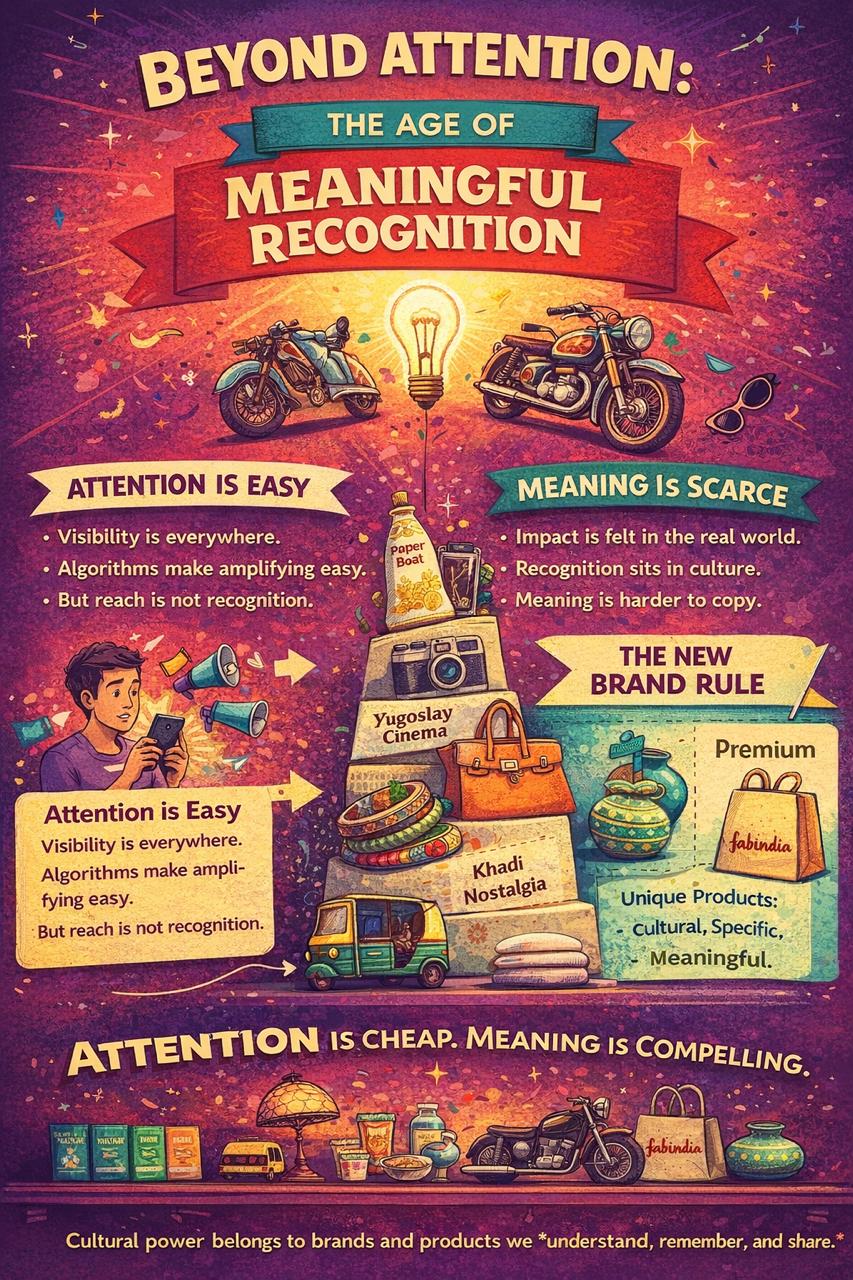
In an age of abundance, attention is cheap. Discover why meaning, recognition, and cultural clarity are becoming the true sources of brand value.
For a long time, attention was treated as the ultimate prize. If something could go viral, dominate feeds, or trend for a moment, it was assumed to have value. That assumption is weakening. Attention today is abundant, algorithmically inflated, and fleeting. What is becoming scarce is recognition with meaning.
We are moving into a Meaning-&-Recognition Economy, one where brands are valued less for how loudly they appear and more for how clearly they are understood.
From Attention to Meaning
Attention can be forced. Algorithms can amplify it.
Meaning cannot.
People now see thousands of products, posts, and brands every week. Most are noticed. Very few are decoded. Even fewer are remembered. The cultural shift is simple but profound:
Visibility without meaning depreciates fast.
What endures is a product’s ability to be immediately placed within a cultural frame—to be recognised for what it stands for, not just what it looks like.
Cultural Capital: What Separates Brands from Commodities
Companies influence culture primarily through the products they put into the world. Some products become cultural shorthand; others experience brief hype; and many remain invisible.
What separates meaningful products from commodities is cultural capital.
Cultural capital is an intangible asset-identity, symbolism, memory, emotion, and social meaning. It is what makes a product referenceable, aspirational, and defensible beyond price.
In India, this distinction is especially visible:
- Royal Enfield is not just a motorcycle; it represents brotherhood, endurance, and the romance of long-distance riding.
- Tata Tea’s “Jaago Re” campaigns turned a daily beverage into a symbol of civic awareness.
- Amul transformed butter into a cultural commentator, embedding itself into India’s collective memory through topical humour.
None of these compete purely on functional superiority. They compete on meaning.
Why Attention Alone Is Losing Power
Digital platforms reward reach rather than depth. They push what is clickable, not what is culturally durable.
A trending reel may capture millions of views, but that does not guarantee comprehension, trust, or attachment. As a result, attention has become cheap. Meaning has become premium.
Brands that rely only on virality often fade quickly. Brands that are recognised—not just seen—compound value over time.
Recognition as the New Cultural Currency
Recognition is the ease with which people can interpret a product’s cultural signal. It answers the question: “What does this stand for?”
A recognisable product:
- carries a narrative beyond function
- signals identity or belonging
- fits into a social or cultural story
Indian examples make this clear:
- Fabindia is legible as heritage, craft, and ethical consumption.
- Raymond still stands for “The Complete Man”, a specific idea of masculine responsibility and aspiration.
- Khadi signals nationalism, simplicity, and moral consumption—regardless of how fashionable it is at any given moment.
These products do not require explanation. Their meaning is already embedded in culture.
Products as Stories You Can Use
The strongest brands turn products into portable narratives.
- Nike is not just about shoes; it represents ambition and self-belief across class and geography.
- Bira 91 positioned itself as urban, youthful, and globally Indian—distinct from legacy beer brands.
- Paper Boat sells nostalgia, memory, and childhood emotions disguised as beverages.
These brands succeed because their products are not neutral objects. They are stories people participate in.
Why Recognition Is Anchored in Real Life
Deep recognition is rarely born online alone. It is reinforced through real-world rituals, habits, and social use.
Brands achieve this by linking themselves to:
- identity (Indian-ness, youth, regional pride)
- emotion (nostalgia, joy, aspiration)
- behaviour (travelling, gifting, celebrating)
- collective memory (festivals, childhood, milestones)
For example:
- Titan is inseparable from life milestones—first job, marriage, anniversaries.
- Tanishq is associated with trust and emotional security in jewellery, not just design.
- Haldiram’s represents familiarity and pan-Indian comfort food, transcending regional boundaries.
Niche Recognition and Subcultural Value
At the extreme end of recognition lie niche brands that are legible only to a few—but intensely so.
In India:
- Raw Mango speaks to those who understand handloom, craft revival, and slow fashion.
- Good Earth is legible as quiet luxury rooted in Indian aesthetics and restraint.
- Independent music festivals, regional cinema, or artisanal coffee roasters thrive not on mass appeal, but on shared understanding.
Here, value comes not from scale but from depth of recognition.
How Recognition Shapes Value and Pricing
The clearer a product’s meaning, the stronger its:
- pricing power
- customer loyalty
- resistance to competition
- cultural longevity
This is cultural currency—the ability to shape taste, behaviour, and aspiration.
Brands with cultural currency do not need to discount aggressively. Their customers are not just buying products; they are affirming identity.
What Used to Create Cultural Currency—and What Comes Next
In the attention-driven era, brands relied on:
- timeliness
- shareability
- instant clarity
- social proof
These still generate reach. But reach without resonance no longer builds brands.
What builds brands now is recognition with depth—products that do not pass through culture but settle into it.
The New Brand Mandate
The role of modern brands is no longer to endlessly chase attention.
It is to create products that are understood without explanation.
In a world where everything is visible, what matters is what is meaningful.
And in a market flooded with noise, recognition—not attention—is the true form of power.