From Water to Coffee: How Brands Make the Ordinary Worth More

How can bottled water and coffee command different prices despite serving the same basic need? Discover how brand differentiation transforms ordinary products into distinctive experiences, creates perceived value and helps businesses grow beyond price competition.
When products are almost identical, the brand can change everything.
Water is one of the most abundant commodities on the planet. You can drink it from a tap, fill a bottle at home or buy it at a neighbourhood store. Yet consumers willingly pay a premium for brands such as Bisleri, Himalayan, Evian, Veen, VOSS, smartwater and Liquid Death.

Each brand offers a different interpretation of the same basic product. Himalayan builds on its natural-origin story and distinctive packaging. Veen & VOSS use minimalist design to convey sophistication. smartwater emphasises its purification process and wellness associations. Liquid Death takes an unconventional route, using edgy packaging and irreverent communication to challenge traditional bottled-water marketing.
The fundamental need is identical: hydration. Yet the brands give consumers different reasons to choose them.
- Bisleri & Himalayan appeal to premium sensibilities.
- VOSS & Veen use design to create a sophisticated image.
- smartwater connects with wellness-oriented consumers.
- Liquid Death attracts people who appreciate an unconventional, rebellious personality.
The water has a job to do. The brand gives people a reason to prefer one version over another.
This makes bottled water a fascinating branding lesson. It demonstrates how a product with limited inherent differentiation can become a vehicle for identity, aspiration, lifestyle and commercial value.
Now consider another everyday product that has undergone a similar transformation: coffee.
One Product, Many Reasons to Buy
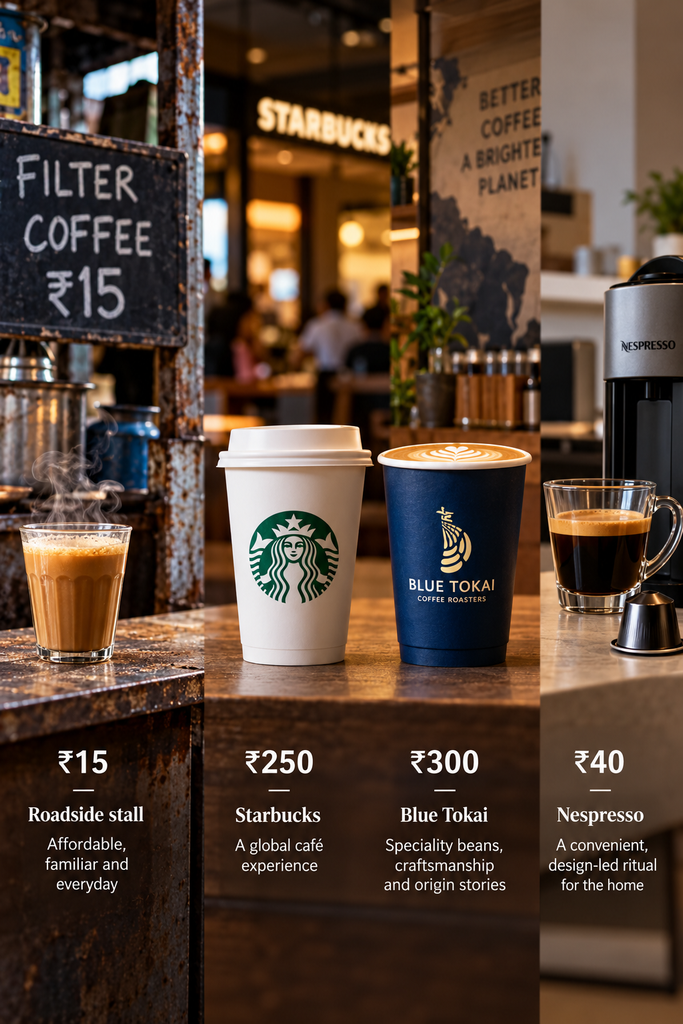
A cup of coffee can cost ₹15 at a roadside stall, ₹100 at a neighbourhood café or several hundred rupees at a premium establishment. Ingredients, preparation, location, and service contribute to these differences, but so does the experience the product creates.
Different coffee businesses have developed distinct propositions within the same category.
- Starbucks: A personalised café experience, a familiar environment and a place to meet, work or take a break.
- Blue Tokai: Speciality beans, roasting expertise, origin stories and brewing craftsmanship.
- Nespresso: A convenient, design-led coffee ritual for the home.
- The neighbourhood coffee stall: An affordable, familiar and convenient part of everyday life.
These businesses do not need to convince consumers that coffee is valuable. Their challenge is to show why their offering deserves attention, preference, and, where appropriate, a premium.
Just as bottled-water brands sell more than hydration, coffee brands sell more than caffeine.
When customers perceive meaningful differences, they stop comparing products on function and price alone.
The Brand Changes the Value Equation
Imagine two bottles of water placed side by side in a supermarket. Both meet the customer’s basic need for hydration. One may be chosen for its price, another for its packaging, and a third because the consumer recognises and trusts the name.
Now imagine two coffee shops on the same street. One attracts customers seeking a quick, inexpensive drink. The other draws people who value its ambience, menu, service and atmosphere.
The product is only one component of the value customers perceive. Other factors influence their decisions:
- Quality: Taste, performance, ingredients and reliability.
- Design: Packaging, aesthetics and shelf appeal.
- Experience: Service, convenience and the environment surrounding the purchase.
- Identity: What choosing the brand communicates about the consumer’s preferences and lifestyle.
- Emotion: Familiarity, confidence, memories and pleasure associated with the brand.
A premium-priced product does not necessarily need to deliver a proportionately greater functional benefit. It needs to offer a combination of benefits that its target customers consider worth paying for.
A consumer buying Veen may appreciate its distinctive bottle and premium presentation. Someone choosing Liquid Death may enjoy its irreverent personality. A customer visiting Starbucks may value the environment as much as the beverage.
The commercial opportunity lies in understanding which benefits matter to which customers and building a credible brand around them.
When Every Brand Looks the Same
The problem begins when every business communicates essentially the same promise.
Imagine ten coffee brands claiming premium quality, exceptional taste, carefully selected ingredients and great value. Their logos and packaging may differ, but their propositions are interchangeable.
Customers then have little reason to prefer one brand over another. Price promotions become more influential, margins come under pressure, and businesses struggle to establish lasting customer preference.
The same problem affects bottled water. If every brand promises clean, refreshing hydration, consumers have few meaningful reasons to pay more for one rather than another.
This is the difference between having a brand identity and building a brand.
A logo creates recognition. A distinctive colour palette improves recall. Attractive packaging captures attention. But a commercially valuable brand establishes a clear promise, gives reasons to believe it, and consistently delivers.
Businesses without meaningful differentiation often end up competing on:
- Price discounts and promotional offers.
- Distribution reach and product availability.
- Packaging changes that competitors can easily imitate.
- Advertising claims that sound similar to those of rival brands.
- Short-term sales incentives rather than lasting customer preference.
Branding is not about making an ordinary product look extraordinary. It is about identifying and communicating the value that makes an offering relevant to a particular customer.
The Same Principle Applies to Professional Services

The water and coffee examples apply just as well to businesses that believe branding matters only to consumer products.
Consider a law firm, accounting practice, financial advisory business, recruitment agency or management consultancy. These businesses sell expertise and service rather than physical products. Yet prospective customers still need a reason to choose them over alternatives.
Many professional services firms depend heavily on referrals. This is a positive signal: existing customers trust the firm enough to recommend it.
But there is a limitation. A firm that relies almost entirely on referrals may have a strong reputation within its existing network while remaining relatively unknown to the wider market. Its growth depends on the size of its partners’ networks and their ability to generate new opportunities.
Imagine two consulting firms with comparable capabilities.
The first relies on personal relationships and word of mouth. Prospective clients generally encounter it through an introduction.
The second has developed a clear market position. It is known for helping mid-market businesses improve profitability, publishing practical insights, showcasing relevant case studies, and consistently communicating its approach.
When a business owner encounters the second firm, its brand has already established some familiarity and credibility. The prospective client has a clearer understanding of what the firm does and why it might be relevant.
The firm becomes easier to discover, understand, and consider.
Professional services businesses can strengthen their market position by:
- Defining a specific area of expertise rather than claiming to do everything.
- Publishing useful insights that demonstrate practical knowledge.
- Showcasing client outcomes and credible performance evidence.
- Maintaining consistent messaging across their website and professional networks.
- Building recognition among prospective customers who have never met their partners.
This does not make referrals less valuable. It makes the business less dependent on them.
Referrals transfer trust. Branding builds recognition and preference beyond existing relationships.
From Being Known to Being Chosen
Branding can influence several dimensions of business performance.
First, a clear proposition helps prospective customers understand the business more quickly. They do not have to work as hard to determine what it stands for or whether it meets their needs.
Second, distinctive positioning can reduce direct price comparisons. Customers who perceive meaningful differences in expertise, experience or service are more likely to evaluate total value rather than compare quotations.
Third, consistent communication builds familiarity. When a need arises, a recognisable brand is more likely to enter the customer’s consideration set.
Finally, a credible brand can support customer retention. When the experience consistently matches the promise, customers have more reasons to return and recommend the business.
These outcomes are not automatic. Product quality, operational capability, distribution, and effective sales execution must support branding. However, it can create an asset that makes growth more sustainable.
Businesses can evaluate their progress through several indicators:
- Brand awareness: Do prospective customers recognise or recall the business?
- Consideration: Does the brand make it onto customers’ shortlists?
- Qualified enquiries: Is it attracting relevant prospects beyond its existing network?
- Conversion: Are prospects more likely to choose the business?
- Price realisation: Can it maintain pricing without excessive discounting?
- Retention: Do customers return and recommend the business?
- Acquisition economics: Is it developing sustainable sources of new demand?
The objective is not merely to attract attention. It is to become a meaningful choice.
Three Questions Every Business Should Ask
The lesson from water and coffee is not that every business should charge a premium. It is that every business should understand the value it wants to represent.
1. What do we want to be known for?
Avoid describing the business through a long list of capabilities. Identify the distinctive association you want customers to make.
A coffee brand might stand for speciality craftsmanship or everyday affordability. A pet wellness company might focus on evidence-led formulations and ingredient transparency. A consulting firm might specialise in growth strategy for family-owned businesses.
A clear position makes the brand easier to understand and remember.
2. Why should customers believe us?
A brand promise requires evidence. This could include transparent ingredients, demonstrable product quality, customer outcomes, relevant experience or technical expertise.
Claims without proof create expectations that the business may struggle to fulfil.
3. How will potential customers discover us?
A strong brand cannot influence people who never encounter it. Consider the channels through which your target audience searches, evaluates alternatives and makes decisions.
These may include retail presence, search, content, professional networks, partnerships, public relations or paid advertising. The objective is to reach the right audience rather than attempt to be visible everywhere.
Measure whether these activities improve awareness, qualified enquiries, consideration, conversion and customer retention. For professional services, also examine the proportion of new business generated beyond personal referrals.
The aim is to connect branding with measurable business outcomes rather than treat it as a cosmetic exercise.
The Real Lesson of Water
Water reminds us that commercial value is not determined by the physical product alone. Coffee demonstrates how the same principle extends to everyday habits, experiences and rituals.
In both categories, brands give customers reasons to choose them beyond their basic function. Some build on quality and craftsmanship. Others focus on convenience, identity, design or experience.
The same opportunity exists in almost every industry, including categories where businesses assume that expertise, price or personal relationships should speak for themselves.
Your customers are already forming opinions about your business. They decide what it stands for, whether it is different, and whether it deserves their attention. The question is whether you are deliberately shaping those perceptions.
You do not need the advertising budget of a global water brand or the outlets of an international coffee chain. You need clarity on your value, consistent communication, and the discipline to deliver on your promises.
Remember three principles:
- The product fulfils a need.
- The brand creates a reason to prefer it.
- The experience determines whether the promise is credible.
The product gets you into the market. The brand gives customers a reason to choose your solution over someone else’s.
When that reason is clear, credible, and relevant, the business is more likely to grow beyond price competition and personal networks.