Oatly: How Creativity Turned Oat Milk Into a Cultural Brand
Oatly’s transformation from a relatively obscure oat milk producer into a globally recognised cultural brand offers an important lesson in creativity, branding and business strategy. By changing how creativity worked inside the organisation, Oatly developed a distinctive brand voice, turned packaging into media, built trial through coffee shops and helped reshape how consumers perceived oat milk.


We spend a lot of time arguing that creativity is a business tool. Oatly is a rather remarkable demonstration of what that can actually mean. The company did not invent oats. It did not invent plant-based food. And it did not suddenly discover the technology that could turn oats into a milk alternative. The underlying science had existed for years. What changed was the way people thought about the product.
For years, oat milk was largely a specialist solution. It appealed to people who were vegan, lactose-intolerant or particularly health-conscious. It was a product solving a dietary problem. Oatly helped turn it into something much bigger: a lifestyle choice, a cultural statement and eventually a mainstream consumer category. And at the centre of that transformation was an unusually radical decision.
Oatly didn’t just change its advertising. It changed who was responsible for creativity inside the company.
The Product Wasn’t the Problem
Oatly’s origins go back to Sweden in the 1990s, when researchers developed technology to turn oats into a milk alternative. The science worked. The product worked. But for years, Oatly remained relatively obscure.
That is a problem many businesses face. A company can have a technically superior product, better ingredients, proprietary technology and genuine consumer benefits, yet still struggle to get noticed. Because consumers don’t experience products as technical specifications. They experience them through associations, habits, emotions, culture and identity. A technically innovative product can therefore remain commercially ordinary.
Oatly had spent years explaining what its product was. The opportunity was to make people care about what it meant.


Then Toni Petersson Arrived
Toni Petersson became CEO of Oatly in 2012. One of the people he brought into the transformation was John Schoolcraft, an American creative who became Oatly’s global creative director and one of the most influential figures in the company’s brand transformation.
Schoolcraft came from the world of advertising. But he had a very different view of how advertising and creativity should work. According to Schoolcraft, he asked Petersson a deliberately provocative question: Could he kill the marketing department?
Petersson agreed. The traditional marketing structure was dismantled and replaced by a creative organisation that became known as the Oatly Department of Mind Control, or ODMC.
This was not simply a dramatic PR story. It reflected a genuine organisational philosophy. Oatly wanted creatives to work much closer to the centre of the business rather than receiving a traditional marketing brief after the strategic decisions had already been made. Schoolcraft and his team were given much greater access to the business itself: product, innovation, packaging, sales, sustainability and consumer behaviour.
The creative function was no longer simply being asked to make the company look interesting. It was being asked to help the company think differently.


What Happened to the Marketing Team?
This part of the story is often simplified into “Oatly fired its marketing department.” The reality was more nuanced. The existing marketing organisation reportedly consisted of around 40 people, many of whom had food-industry and scientific backgrounds.
Rather than simply eliminating everyone, Oatly moved people into other roles within the organisation while creating a new creative structure around Schoolcraft. The significance was not that marketers had suddenly become unnecessary. It was that creativity was no longer treated as something owned exclusively by marketing.
That distinction matters. Marketing remains responsible for understanding markets, consumers, channels, pricing, distribution and commercial performance. Creativity, however, can influence all of those things. The Oatly experiment was essentially asking:
What happens when creative thinking is embedded across the business rather than being brought in at the end?
From “Alternative Milk” to “A Different Point of View”
The plant-based category had another problem. It was usually defined in relation to dairy. Milk was the established product. Plant-based milk was the alternative. That language itself created a hierarchy.
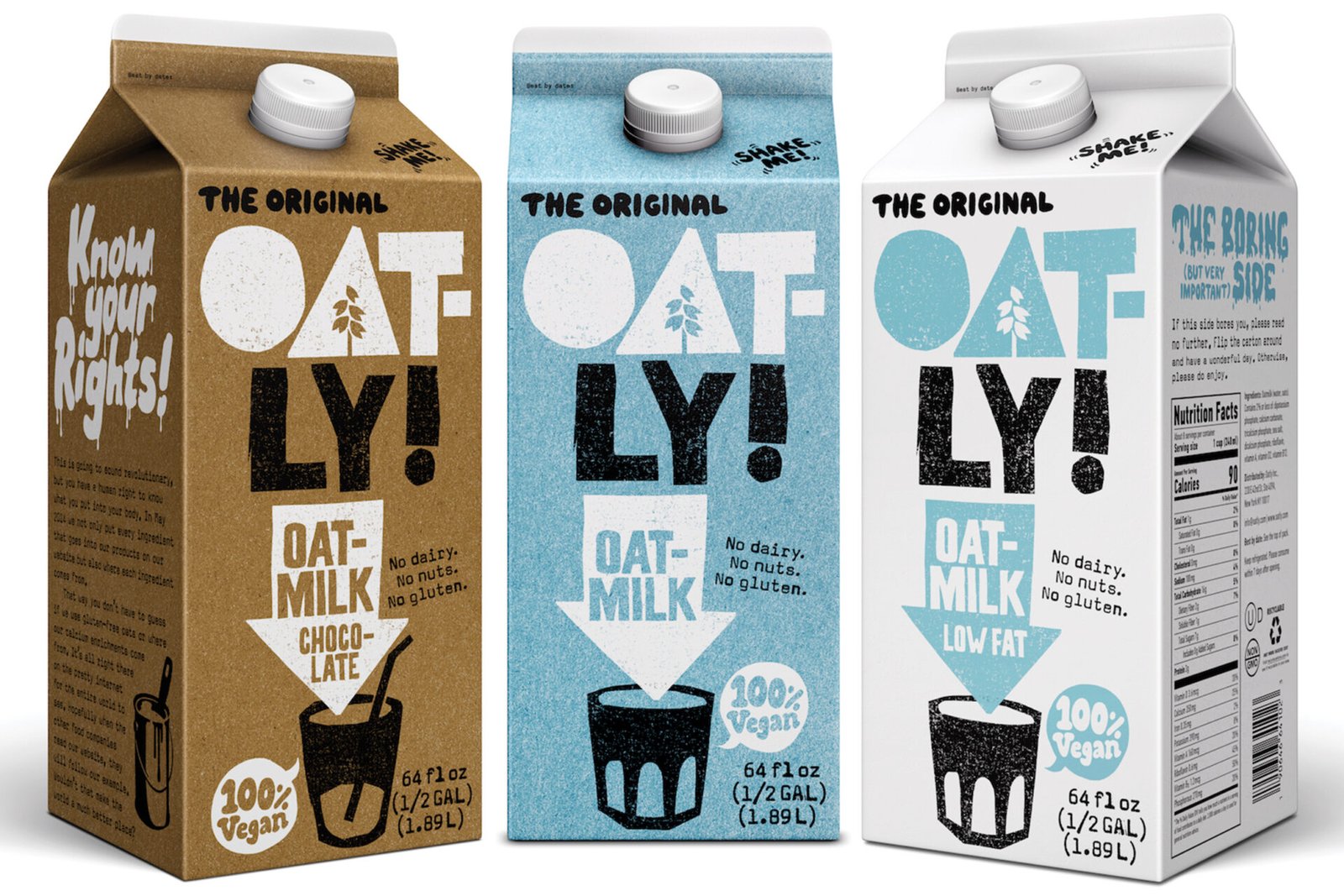
Oatly increasingly refused to behave like an alternative. Its communication was conversational, irreverent and deliberately different from the polished conventions of FMCG advertising. The brand developed an unmistakable voice. Its packaging became part of the communication.
Instead of simply listing product benefits, it often made statements that sounded like something a person might actually say. One of its most recognisable expressions was:
“It’s like milk, but made for humans.”
That was not a conventional product claim. It was a provocation. And it encouraged people to think about the category differently.


When the Packaging Became Media
One of Oatly’s smartest creative decisions was treating packaging as a communication platform. Most FMCG packaging is designed to answer a few functional questions quickly: What is it? What does it taste like? What does it contain? Why should I buy it?
Oatly added another question:
Who are we?
The packaging became distinctive through its typography, tone, copy and visual language. It often looked less like conventional FMCG packaging and more like a conversation.
That mattered because packaging is one of the few communication channels that travels with the product. It appears:
- On supermarket shelves
- In refrigerators
- On café counters
- In consumers’ kitchens
- In photographs
- On social media
- In people’s hands
The pack was no longer simply protecting the product. It was advertising without buying another media impression.


Oatly Wasn’t Trying to Look Like Everyone Else
There is another lesson here. Most brands try to minimise risk. They test advertising. They test language. They test packaging. They identify what consumers dislike. Then they remove the things that might create resistance.
The result can be communication that nobody hates. Unfortunately, it can also be communication that nobody remembers.
Oatly took the opposite route. Its work was designed to be distinctive. Some people loved it. Some people disliked it. Some thought the tone was brilliant. Others found it irritating. But the brand was difficult to ignore.
For a challenger brand, that can be valuable.
Being liked and being noticed are not the same thing.
The Dairy Industry Helped Too
Oatly’s aggressive communication eventually attracted a response from the Swedish dairy industry. The dispute over Oatly’s communications resulted in legal action, and Oatly was required to change or withdraw certain claims.
But something interesting happened. The conflict generated attention far beyond what a conventional advertising campaign might have achieved.
This illustrates an important principle of challenger branding:
When a small brand enters a category dominated by established players, difference itself can become a media strategy.
Oatly did not need to outspend the dairy industry. It needed to become interesting enough that people would pay attention. The controversy helped make the brand part of a much bigger conversation about dairy, sustainability and consumer choice.


Then Oatly Went After the Coffee Shop
The next part of the strategy was less theatrical but arguably just as important. When Oatly expanded in the United States, it invested heavily in independent coffee shops and baristas.
This was a brilliant place to build the category. Why? Because consumers could try oat milk without having to make a major decision. They could simply order a latte. The barista could suggest oat milk. The consumer could taste it. If they liked it, they might order it again. And eventually they might start looking for oat milk in supermarkets.
The café became a product trial environment. The barista became an advocate. And the consumer became the next link in the distribution chain.


From Trial to Demand
The conventional FMCG model often works like this:
Distribution → awareness → trial → repeat purchase.
Oatly’s early coffee-shop strategy created another possible route:
Trial → preference → recommendation → consumer demand → distribution.
That distinction is strategically important. A retailer can decide to stock a product because the brand has a large advertising budget. Or the retailer can decide to stock it because consumers are already asking for it. The second kind of demand can be considerably more powerful.
Oatly was not simply trying to persuade retailers to give it shelf space. It was trying to create a situation where consumers would expect to find the product there.
The Category Took Off
The broader oat-milk category subsequently experienced extraordinary growth. In the US, oat milk moved from a niche plant-based product into mainstream coffee culture and retail. Oatly became one of the brands most strongly associated with that shift.
The company subsequently achieved substantial global scale. Oatly reported revenue of approximately $823.7 million in 2024, compared with approximately $783 million in 2023. In the fourth quarter of 2024, the company sold approximately 153.2 million litres, compared with 139.4 million litres in the same quarter of 2023, representing volume growth of approximately 10%. Its products are now sold across more than 40 countries.
These figures matter because they demonstrate that the story was not simply about a clever advertising campaign. The creativity contributed to a much broader commercial system involving product trial, distribution, consumer demand and category growth.


But Creativity Didn’t Solve Everything
This is where the Oatly story becomes more useful than the usual case study. It would be easy to conclude:
Great creativity equals great business.
It doesn’t.
Oatly generated significant revenue but also experienced substantial losses and operational challenges. In 2024, the company reported a loss before tax of approximately $198.6 million.
At the same time, there were signs of improving operating performance. Fourth-quarter gross margin reached 28.8%, up 5.4 percentage points year-on-year, while the adjusted EBITDA loss narrowed significantly.
The lesson is straightforward.
Creativity can create:
- Attention
- Differentiation
- Cultural relevance
- Trial
- Brand preference
- Consumer demand
But creativity cannot automatically create:
- Healthy margins
- Efficient manufacturing
- Strong cash flow
- Supply-chain discipline
- Profitable scale
A great brand can create demand. It still has to build a business capable of serving that demand profitably.
What Oatly Really Changed
It is tempting to describe Oatly’s transformation as an advertising success. That misses the bigger point.
Oatly changed several things simultaneously:
The organisation– Creatives were given a much more central role in the business.
The brand -Oat milk was given a distinctive personality rather than being treated simply as a dairy substitute.
The communication– The company developed a recognisable voice that could be expressed across packaging, advertising and other touchpoints.
The channel strategy – Coffee shops became a critical environment for trial and advocacy.
The category – The conversation moved from dietary substitution towards lifestyle and mainstream consumption.
That is why the case is so interesting. It wasn’t one great campaign. It was a series of connected strategic decisions.


The Oatly Model
The sequence can be simplified into a powerful business model:
Good product
↓
Radical creative repositioning
↓
Creativity embedded in the organisation
↓
Distinctive brand voice
↓
Packaging as media
↓
Cultural attention
↓
Product trial
↓
Barista advocacy
↓
Consumer demand
↓
Distribution expansion
↓
Global scale
This is much more than advertising. It is creativity connected to commercial strategy.
Five Lessons for Marketers
1. Don’t confuse marketing with creativity
Marketing is a business discipline. Creativity is an organisational capability. They overlap, but they are not the same thing.
Oatly’s lesson is not that companies should eliminate marketing departments. It is that creative thinking should not be restricted to the marketing function.
2. Give creatives access to the real business
If creatives only receive the advertising brief, they can solve the advertising problem. If they understand the product, supply chain, consumer behaviour, sales challenge and business model, they can potentially solve much bigger problems.
Creativity becomes more valuable when it has context.
3. Build distinctiveness before persuasion
Consumers cannot choose what they don’t notice or remember. Oatly built a highly recognisable personality before attempting to explain every product benefit.
That is an important lesson in crowded categories.
First become recognisable.
Then become persuasive.
4. Find the people who influence behaviour
Oatly understood the influence of baristas. Every category has equivalent behaviour-shapers. They might be:
- Veterinarians in pet care
- Dermatologists in skincare
- Chefs in food
- Stylists in fashion
- Accountants in financial services
- Architects in building materials
- Fitness professionals in wellness
The question is:
Who can make the product credible at the precise moment a consumer is making a choice?
5. Give consumers something to talk about
Awareness is not the same as conversation. Oatly created a brand with enough personality that people could talk about it. They could agree. They could disagree. They could share it. They could recommend it.
That gave the brand something beyond functional differentiation.
It gave it cultural relevance.
The Bigger Lesson: Innovation Doesn’t Always Mean Invention
This may be the most important lesson in the entire Oatly story.
Companies spend enormous amounts of money trying to invent something new. New technology. New ingredients. New features. New products. New formats.
But sometimes the most valuable innovation is already sitting inside the organisation.
It simply hasn’t been framed correctly.
The underlying oat-milk technology was not suddenly invented when Oatly became famous. The oats hadn’t changed. The fundamental product hadn’t suddenly become revolutionary.
The meaning changed.
Oat milk moved from being primarily understood as a dietary alternative to becoming part of a broader cultural conversation about food, lifestyle and consumption.
That is innovation of a different kind.


Creativity Can Expand the Market
This is where creativity becomes a genuine business tool. If you only compete for existing demand, you are fighting over the same consumers. But if you change the way consumers understand the category, you can potentially make the category relevant to people who previously had no reason to consider it.
Oatly didn’t only have to convince people who couldn’t drink dairy. It had to persuade people who could drink dairy that they might want something else.
That created a much larger opportunity.
Creativity didn’t merely help Oatly compete for the market. It helped redefine the market it was competing in.
The Final Lesson
Oatly’s story is not really about oat milk. It is about what happens when a company decides that creativity is too important to be left at the end of the process.
Toni Petersson gave John Schoolcraft the freedom to challenge the conventional marketing structure. Schoolcraft and the creative team challenged the conventions of branding. The packaging challenged the conventions of FMCG communication. The coffee strategy challenged the conventional route to distribution. And the brand challenged the conventional way consumers thought about plant-based milk.
The result was not simply a better advertisement. It was a different business conversation.
And perhaps that is the real lesson.
Sometimes the breakthrough isn’t a better product.
Sometimes it is a better idea around the product you already have.
Oatly had the oats.
It had the technology.
It had the product.
What it needed was an idea.
And when that idea arrived, the product stopped waiting quietly on the shelf.
Creativity didn’t invent Oatly’s product.
It made the market see it.
:::