From Products to Worlds: The Korean Way of Building Brand Value
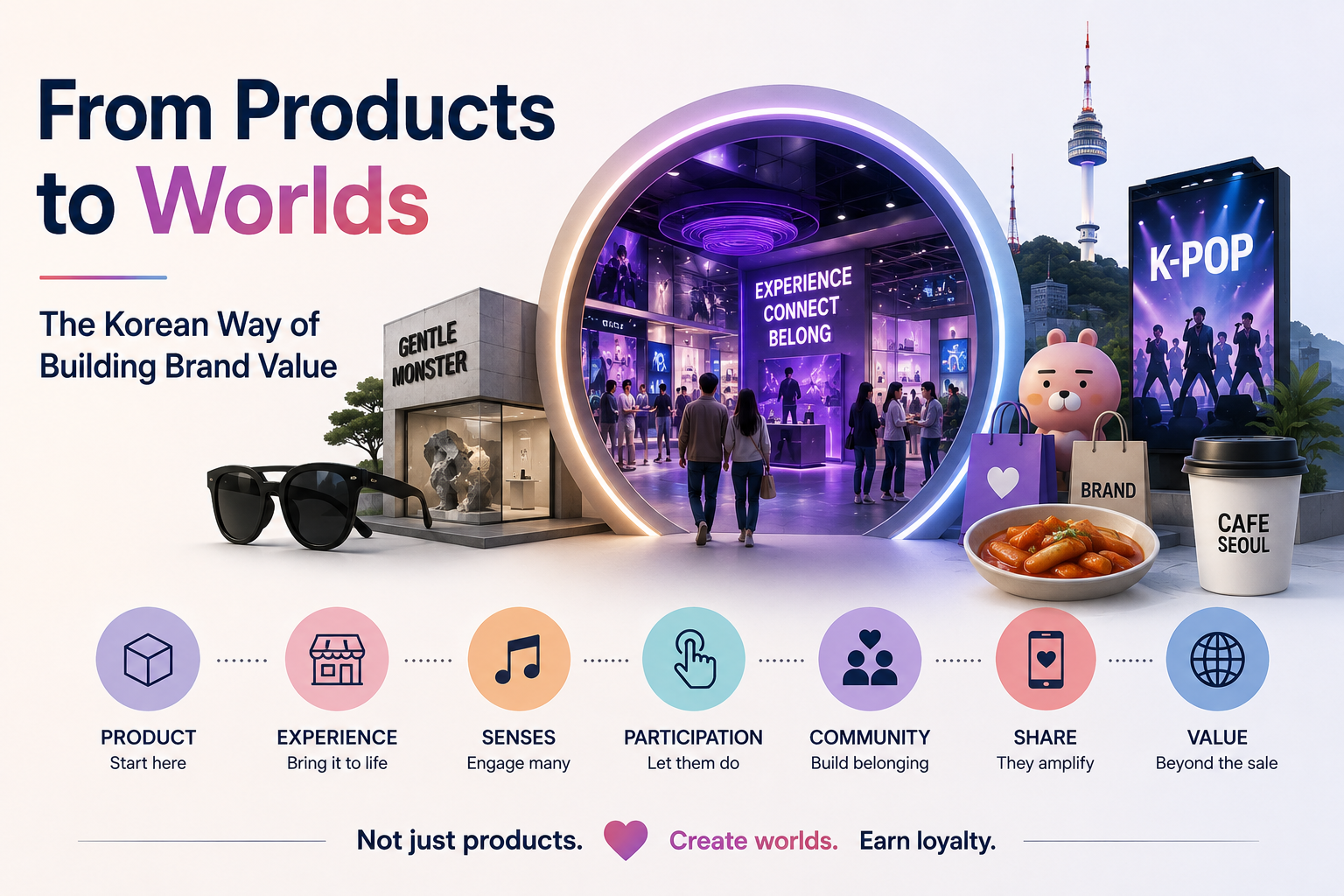
South Korean brands are redefining brand building by turning products into immersive worlds of culture, experience, participation and community. Here is what marketers can learn from the Korean model.
South Korean brands have mastered something that many marketers talk about, but few execute consistently: turning a brand into a world people want to enter.
They do not compete only through product features, functional superiority or advertising. They create cultural, sensory and participatory experiences around the product. Retail becomes entertainment. Packaging becomes a collectable. Music becomes fashion. A character becomes merchandise. A pop-up becomes a destination. A store becomes content.
The result is a fundamental shift in the brand’s role. The brand is no longer something consumers simply recognise. It becomes something they experience, participate in, photograph, share and remember. This is the move from selling products to staging experiences.


1. The product is only the beginning
Traditional brand thinking often starts with the product and asks: What benefit does it provide? Immersive brand thinking asks a different question: What world can we build around this product? A pair of glasses can remain a pair of glasses. Or it can become part of an artistic universe. A song can remain a song. Or it can become a combination of music, choreography, fashion, personalities, collectables, live events and fandom. A food product can remain something you consume. Or it can become a cultural experience involving taste, design, storytelling, ritual and participation.
This distinction is central to the success of South Korean brands. They take a functional proposition and surround it with meaning, emotion, culture and participation. The product remains important. But the product is no longer doing all the work.
The implication for marketers is significant. When the product itself becomes only one component of a larger experience, competition moves away from a narrow battle over features and specifications. The brand begins competing on the richness of the world it creates around those features.
2. They make the brand physically discoverable
One of the most powerful characteristics of Korean branding is the way physical spaces are treated as brand media. A store is not simply a place where a transaction takes place. It is an opportunity to communicate the brand without using conventional advertising.
Gentle Monster is perhaps the clearest example. Its concept stores combine eyewear with art installations, unusual architecture and gallery-like environments. The physical environment sparks curiosity, even among people with no immediate intention of buying glasses. That creates several layers of value: the brand becomes distinctive in a crowded category, premium positioning is communicated through the environment, consumers spend more time with the brand, visitors create photographs and videos that extend the experience online, and the physical space becomes difficult for competitors to imitate.


This is a critical shift in thinking. The store is no longer just a distribution channel. It becomes part of the brand proposition. And once consumers photograph it, post it and talk about it, the store becomes advertising without behaving like advertising.
The physical environment is therefore performing several jobs simultaneously. It is retail space, brand theatre, content studio, social-media trigger and positioning device. That makes the investment in the environment much more than an investment in décor. It becomes an investment in brand building itself.
3. They turn one sensory benefit into a complete sensory world
Immersion becomes powerful when brands stop thinking about products in isolation. Consider K-pop. It is technically music. But its consumption is not limited to listening. Music is combined with choreography, fashion, styling, music videos, personalities, visual identities, live performances, merchandise, fan communities and social media. The consumer therefore experiences the brand through multiple senses and multiple cultural entry points.


The same principle can apply to almost any category. A fashion brand can extend into music, food, architecture and art. A food brand can extend into theatre, design, storytelling and hospitality. A technology brand can extend into gaming, community, events and lifestyle. A beauty brand can extend into rituals, spaces, education and personal identity.
The strategic principle is simple:
Do not ask only what your product does. Ask what else the consumer could experience around it.
This is particularly powerful because sensory expansion increases the number of ways in which consumers can encounter and remember a brand. The product may provide the functional entry point, but the surrounding experience gives the consumer additional memory structures, associations and reasons to engage.
4. They turn retail into entertainment
South Korea’s pop-up culture illustrates this particularly well. The conventional retail model is:
Product → Store → Transaction
The immersive model is:
Story → Experience → Participation → Community → Transaction
That difference is enormous. A conventional store asks the consumer to come because there is something to buy. An immersive store gives the consumer a reason to come even before they have decided to buy.
Korean pop-ups can include interactive zones, demonstrations, themed cafés, photo opportunities, limited products, technology-enabled experiences and performances. The Ministry of Culture, Sports and Tourism has highlighted the growing importance of this content-and-experience-led model.
An important psychological mechanism is also at work: scarcity creates urgency. A permanent store can be visited tomorrow. A pop-up that exists for three weeks cannot. Limited merchandise, exclusive experiences and reservations therefore transform passive interest into immediate action.
The consumer is not merely shopping. They are attending. And attending is psychologically very different from shopping.
The distinction matters because an event creates a different mindset. The consumer arrives expecting discovery, participation and entertainment rather than simply evaluating products and prices. In that environment, the brand has a much greater opportunity to create emotional associations that survive beyond the transaction.
5. They understand that participation creates ownership
The most powerful experiences are not those in which consumers simply look. They are those in which consumers do something.
Korean pop-ups frequently use customisation, games, missions, demonstrations, photo zones and interactive technology to make visitors participants rather than spectators.
This matters because participation creates what can be described as psychological ownership. If I merely see something, I may remember it. If I create something, customise something, discover something, photograph something or share something, the experience becomes partly mine.
That changes the communication equation.
Traditional advertising says:
“Our product is excellent.”
Immersive branding says:
“Come into our world and make something with us.”
The second proposition creates a relationship rather than simply delivering a message.
Participation also changes the consumer’s role. Instead of being the endpoint of communication, the consumer becomes an active component of the experience. They create memories, generate content and potentially bring other people into the brand world. The result is a form of engagement that conventional advertising struggles to replicate.
6. They turn fandom into an economic system
Perhaps the biggest lesson from South Korea is that fandom is not merely an emotional outcome. It can become an economic infrastructure.
A fan does not simply consume content. They may attend an event, visit a pop-up, buy exclusive merchandise, collect products, share photographs, create content, participate in online communities, travel to a location, introduce friends and identify themselves with the brand or property. This transforms a consumer into a participant.
Korean webtoon pop-ups demonstrate this beautifully. Popular characters and stories are brought into physical spaces through interactive experiences, merchandise and fan activities. The intellectual property therefore acquires new commercial life beyond the original content.


The value created is consequently multidimensional:
IP value + retail value + community value + tourism value + merchandise value + data value
This is why successful Korean brands frequently think in terms of ecosystems rather than campaigns.
The deeper implication is that fandom can reduce the distance between marketing and commerce. The same property can generate attention, visits, transactions, content, community and repeat engagement. A strong emotional connection therefore becomes commercially productive across multiple touchpoints rather than being treated simply as a measure of brand affinity.
7. The consumer becomes part of the content
Immersion has another important consequence. The consumer can become a media channel.
Imagine someone visits a remarkable brand space. They take a photograph. They post it. Their friends see it. Someone searches for the brand. Another person visits the store. They create another piece of content. The cycle continues.
The basic mechanism is:
Physical experience → User content → Social discovery → Curiosity → Visit → New content
The physical experience therefore produces digital consequences.
This is why the best immersive spaces are deliberately designed for social transmission. They contain recognisable visual codes, unexpected elements, distinctive architecture, moments of discovery, opportunities for participation, limited-edition elements, strong photographic moments and a coherent relationship between the space and the brand story.
The objective is not simply to make a beautiful store. The objective is to make the experience worth talking about.
This creates a multiplier effect. The brand invests in one physical experience, but the audience can potentially extend that experience through thousands of individual pieces of consumer-generated content. The consumer’s phone becomes an extension of the store, and social platforms become an extension of the physical environment.
8. They understand that culture is part of the product
South Korean brands have another significant advantage: they understand the commercial power of culture.
K-pop, Korean food, fashion, beauty, gaming, webtoons and entertainment do not operate as isolated categories. They reinforce one another. Someone who discovers Korean music may become interested in Korean fashion. Fashion can lead to beauty. Beauty can lead to food. Food can lead to travel. Travel can lead to physical experiences. The consumer gradually enters a larger cultural universe.
This is what makes the Korean model particularly interesting.
Culture becomes a distribution system for brands.
Instead of constantly asking consumers to notice a product, brands become embedded in things consumers already care about. That changes the nature of discovery. Consumers may enter the ecosystem because of music, entertainment or fashion and encounter commercial products almost organically along the way.
Culture, in this model, is not merely a communications device. It becomes an engine that moves consumers from one category to another.
9. They localise without abandoning their identity
Immersion does not mean exporting an identical experience everywhere. Successful Korean brands retain their core identity while adapting the expression to local culture.
The distinction is important.
Standardisation protects identity.
Adaptation creates relevance.
Cultural brokerage creates understanding.
The source material points to examples such as kimchi curry and kimchi pakora in India, where a distinctly Korean product is interpreted through familiar Indian food conventions.
This principle is highly relevant for global brands entering India. A Korean brand does not necessarily need to become Indian. It needs to become meaningful to Indian consumers.
That might mean adapting flavours, language, partnerships, occasions, communication, merchandise, cultural references and retail experiences while preserving its distinctive Korean codes.
The challenge is not choosing between global consistency and local relevance. It is finding the right balance between the two. The strongest global brands are often those that retain a recognisable core while allowing consumers in different markets to see themselves within the brand universe.
10. The bigger lesson for Indian brands
This is where the Korean model becomes particularly relevant to India.
India already has enormous cultural assets. We have festivals, food, cinema, cricket, music, regional cultures, crafts, mythology, fashion, street culture, gaming, creators and communities. Yet many brands still treat these assets primarily as communication opportunities. They use them in advertising.
The Korean approach suggests something more ambitious:
Don’t merely advertise through culture. Build experiences around culture.
Imagine what happens when a brand moves beyond sponsoring a festival and creates an entire world around it. Instead of simply advertising during Diwali, create a Diwali experience. Instead of putting a celebrity in an advertisement, build a participatory universe around the celebrity’s cultural relevance. Instead of sponsoring cricket, create an environment where fans can physically experience the emotion of the game. Instead of merely selling regional food, create a space where consumers can experience its history, preparation, sounds, aromas and stories.
India does not suffer from a shortage of culture.
It suffers from a shortage of brands that know how to turn culture into immersive experiences.
That represents a significant opportunity. India’s cultural diversity means that brands do not have to manufacture meaning from scratch. The raw material already exists. The challenge is to curate, dramatise and translate that cultural material into experiences that consumers can enter, participate in and share.
11. From campaign thinking to ecosystem thinking
Most marketing plans are still structured around campaigns.
A campaign begins.
The campaign runs.
The campaign ends.
Immersive brands operate differently. They build a system in which multiple touchpoints reinforce one another.
A consumer might encounter the same brand through an advertisement, a creator, a streaming platform, a physical store, a pop-up, an event, a collaboration, merchandise, a social community or a tourism destination. Each encounter adds another layer.
The consumer does not have to rediscover the brand every time. They are re-entering a familiar world.
That is a much more powerful form of brand building.
This also changes how marketers should evaluate investment. A pop-up should not necessarily be judged only by sales generated inside the pop-up. Its contribution may include earned media, social content, new visitors, community growth, database acquisition, partnerships, tourism, merchandise sales and future purchase intent.
The same logic applies to collaborations and events. Their value can extend well beyond the immediate transaction because each touchpoint can strengthen the larger ecosystem.
12. The four layers of value
Ultimately, immersive branding works because it creates several kinds of value simultaneously.
| Value | What the consumer receives |
|---|---|
| Functional | A product that performs its basic job |
| Emotional | Excitement, pleasure, aspiration, nostalgia |
| Social | Belonging, status and participation |
| Identity | A way to express who they are or want to become |
The weakest brands tend to compete primarily on functional value. Stronger brands add emotional value. Powerful brands create social value. The most culturally resonant brands reach the level of identity.
At that point, the product becomes a badge.
The consumer is no longer saying:
“I bought this.”
They are saying, consciously or otherwise:
“This is part of who I am.”
The Korean model is powerful precisely because these layers can reinforce one another. A product can perform its functional role while simultaneously delivering pleasure, belonging and identity. The consumer therefore receives considerably more than the physical object itself.
13. The strategic questions marketers should ask
The Korean experience offers marketers a useful checklist. Instead of asking only How do we advertise this product?, ask:
- What is the brand’s strongest sensory or cultural asset?
- Can that asset be experienced physically?
- What can consumers do rather than merely see?
- Can the experience become collectable or scarce?
- What will make people photograph and share it?
- Can the experience create a community rather than just an audience?
- How can the idea be adapted to local culture?
- Which partners can extend the brand into other categories?
- Can the experience live beyond a single campaign?
- What part of the experience can become intellectual property in its own right?
These questions move marketing from communication planning to experience design.
The important point is that immersion should not be treated as a decorative layer added after the marketing strategy has been developed. It should influence the strategy from the beginning. The brand proposition, physical environment, content, partnerships, community mechanics and commercial model should ideally reinforce the same central idea.
The real competitive advantage
The greatest lesson from South Korean brands is not that every brand needs an extravagant store, a pop-up or a celebrity.
It is something deeper.
They understand that attention is not enough.
A consumer may notice a brand because of an advertisement. They remember it because of an experience. They share it because it gives them something to say. They return because it gives them something to discover. They become loyal when it gives them a sense of belonging. And they become advocates when the brand becomes part of their identity.
That is the real power of immersion.
Products can be copied. Advertising formats can be copied. Discounts can be copied. Even visual styles can be copied.
But a deeply constructed brand world, supported by culture, community, participation and accumulated memories, is much harder to replicate.
South Korean brands have therefore moved the conversation:
From brand recognition to brand participation.
From selling to staging.
From audiences to communities.
From campaigns to ecosystems.
And ultimately, from products people buy to worlds people want to belong to.
That is how immersion creates value.



1 Comment