Are Indian Pet Parents Still Demonising Ingredients?
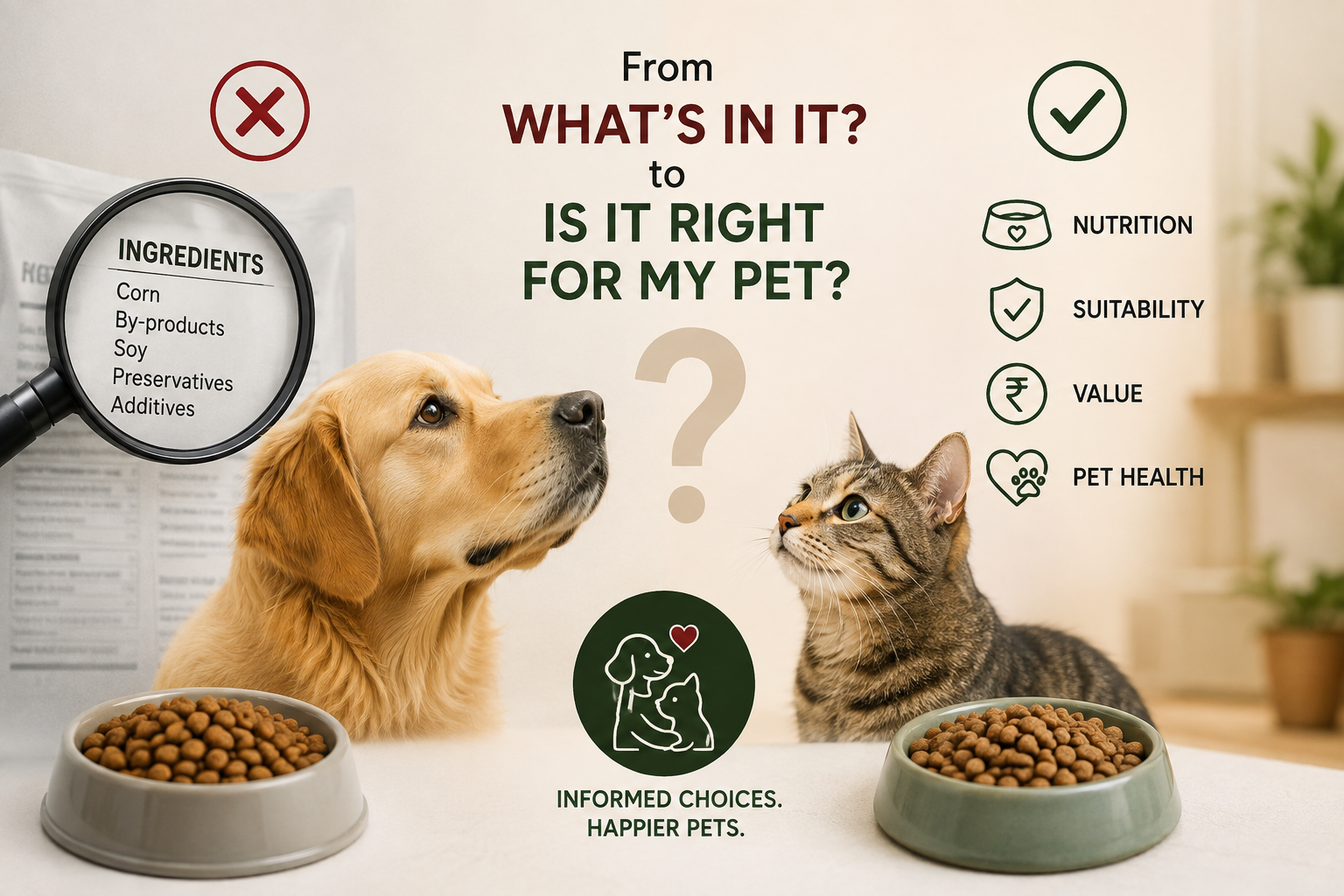
Indian pet parents are becoming more conscious about pet-food ingredients. But is the conversation moving beyond “good” and “bad” ingredients towards what truly matters: nutrition, suitability, value and pet health?
For years, pet food conversations have often revolved around one question: “What is in the food?”
That sounds reasonable. After all, pet parents want to know what they are feeding their dogs and cats. But somewhere along the way, ingredient awareness has sometimes turned into ingredient fear.
Corn is bad. Soy is bad. By-products are bad. Preservatives are bad. Grains are bad. “Fillers” are bad.
Social media has made these messages even more powerful. A short video or an infographic can turn a complicated nutritional issue into a simple list of ingredients to avoid. The problem is that nutrition rarely works in such black-and-white terms.
The more interesting question today is whether pet parents are beginning to move beyond ingredient demonisation.
The ingredient is not the whole story
An ingredient does not exist in isolation.
Its nutritional value depends on its composition, inclusion level, processing, digestibility and how it contributes to the overall formulation. What matters ultimately is whether the complete diet provides appropriate nutrition for the animal and meets its particular needs.
Yet pet-food discussions often reduce this complexity to individual ingredients.
The word “by-product”, for instance, can sound unappealing to a human consumer. But the nutritional value of a particular animal-derived ingredient cannot be judged simply by its name. Similarly, the presence of cereals or plant ingredients does not automatically determine whether a food is appropriate or inappropriate for a dog or cat.
This distinction is becoming increasingly important as Indian pet parents become more informed.
India has a different pet-food conversation
The Indian market cannot simply be treated as a smaller version of the US or European markets.
Pet ownership is evolving rapidly, particularly in urban India. Dogs and cats are increasingly regarded as family members, while spending on nutrition, grooming, preventive healthcare, supplements and veterinary care is becoming more deliberate.
At the same time, affordability remains important.
An Indian pet parent may genuinely want a premium diet but still have to balance that aspiration against household expenses, veterinary bills and the rising cost of pet care.
That creates an interesting tension.
Consumers may say they want the cleanest, most natural or most premium food available. But when it comes to purchasing, they may also consider price, availability, palatability, the animal’s health, veterinary advice and whether the food appears to deliver results.
In other words, the ingredient list may be important, but it may not be the only deciding factor.
Social media has created both awareness and confusion
Instagram, YouTube and other platforms have made pet nutrition far more visible.
That is a positive development. Pet parents today can access information that was difficult to find a decade ago.
But accessibility does not necessarily mean accuracy.
A nutritional claim can be repeated thousands of times without becoming scientifically valid. Terms such as “chemical-free”, “toxin-free”, “grain-free”, “preservative-free” and “human-grade” can create strong emotional associations even when consumers do not fully understand what they mean in the context of pet nutrition.
The result is a peculiar situation: a pet parent may feel highly knowledgeable about pet-food ingredients while understanding only a small part of the science behind them.
This is not unique to India. International consumer research cited in the original discussion found high levels of confidence among pet owners in understanding pet-food labels, even though many could identify only a few ingredients in the foods they purchased.
That gap between confidence and knowledge deserves attention.
“Natural” does not automatically mean better
One of the strongest trends influencing pet-food purchasing is the appeal of naturalness.
For consumers, “natural” intuitively sounds healthier. But naturalness and nutritional adequacy are not interchangeable concepts.
A food can contain familiar-sounding ingredients and still fail to provide an appropriate nutritional balance. Conversely, an ingredient with a technical or unfamiliar name may perform an important nutritional or functional role.
The same applies to the word “premium”.
Premium is primarily a positioning term. It does not, by itself, tell a pet parent whether a particular diet is suitable for a particular animal.
The more useful question is:
What does this food do for my pet?
Does it provide complete and balanced nutrition? Is it appropriate for the animal’s age, size and physiological needs? Does it address a legitimate health requirement when necessary? Is it safe? Is the pet maintaining an appropriate body condition? Is the diet recommended or supported by qualified veterinary professionals when there is a medical need?
These questions are considerably more useful than simply counting the number of ingredients that appear “good” or “bad”.
Price may be quietly changing the debate
Another factor deserves greater attention: inflation.
Pet parents may become more sophisticated about nutrition while simultaneously becoming more conscious of household budgets.
This can change the nature of ingredient conversations.
When budgets are comfortable, consumers may be willing to reject a food because it contains an ingredient they dislike. When budgets tighten, they may evaluate the product more holistically, asking whether the food offers sufficient value for the price.
This does not necessarily mean that Indian pet parents are becoming less concerned about quality.
It may mean that “quality” itself is being redefined.
Quality could increasingly mean a combination of nutritional adequacy, safety, veterinary suitability, palatability, consistency, convenience and affordability.
Veterinarians have an important role
This is where veterinary professionals can make a significant difference.
Pet parents are surrounded by nutrition advice. Some of it is evidence-based. Some of it is anecdotal. Some of it is marketing dressed up as education.
Veterinarians can help bring the conversation back to the animal.
Instead of simply telling an owner that an ingredient is good or bad, the more valuable conversation is about why a particular diet is appropriate for that particular pet.
A healthy young Labrador, an overweight indoor cat, a senior dog and a cat with a diagnosed medical condition do not necessarily have the same nutritional requirements.
The question therefore should not simply be:
“Does this food contain ingredient X?”
It should be:
“Is this diet appropriate for my pet and its nutritional needs?”
That is a much more meaningful conversation.
Are ingredients still being demonised?
Probably. But the nature of the debate may be changing.
The international surveys discussed in the original article suggest that consumers are not necessarily allowing concerns about supposedly undesirable ingredients to dominate their purchasing decisions. Affordability, enjoyment and perceived value can exert a stronger influence.
There is not enough comparable, current public data to make the same statistical claim about Indian pet parents.
But there are signs worth watching.
Indian consumers are becoming more label-conscious. They are asking questions about protein sources, grains, preservatives, additives and processing. At the same time, they are also increasingly interested in outcomes such as digestion, skin and coat health, weight management, immunity and healthy ageing.
That could represent an important evolution.
Instead of asking only, “What does this food NOT contain?”, pet parents may increasingly ask, “What does this food actually provide?”
From ingredient fear to nutritional literacy
The future of pet-food communication in India may therefore depend less on defending individual ingredients and more on improving nutritional literacy.
Brands need to explain their formulations clearly rather than relying on fear-based comparisons.
Veterinarians need accessible ways to explain nutrition to increasingly curious pet parents.
And consumers need to become comfortable with a more nuanced truth: an ingredient cannot always be classified as universally good or universally bad.
Pet nutrition is not a popularity contest between ingredients.
It is about formulation, nutrient requirements, safety, digestibility, suitability and outcomes.
The real opportunity for the Indian pet-care industry is to move the conversation from ingredient demonisation to informed choice.
Because the best pet food is not necessarily the one with the shortest or most fashionable ingredient list.
It is the one that makes nutritional sense for the animal eating it.