Ambush: Paddy Power vs UEFA EURO 2012 – When a Pair of Underpants Stole the Sponsorship Spotlight
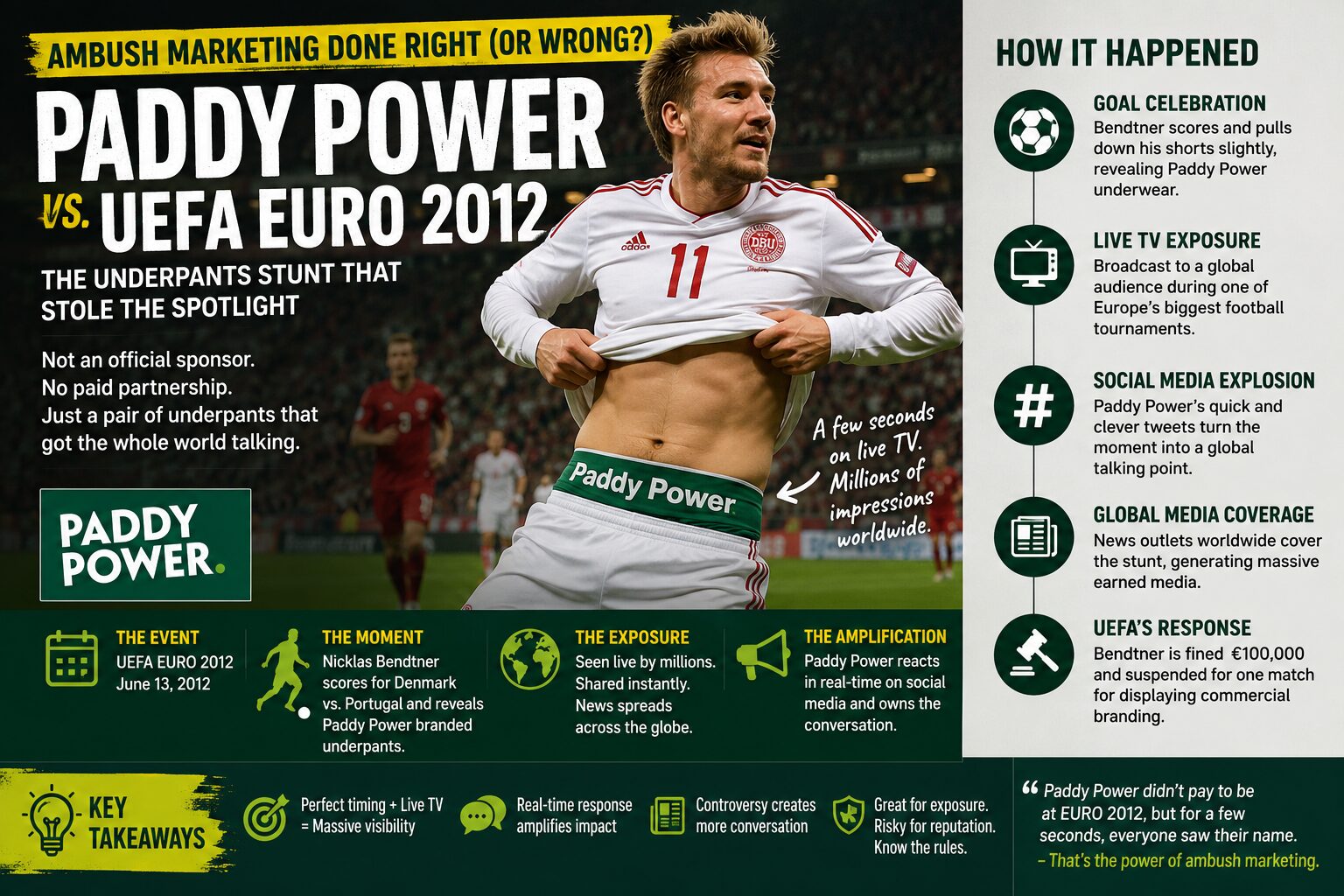
Paddy Power hijacked the UEFA EURO 2012 spotlight when Nicklas Bendtner’s branded underpants created one of sport’s most famous ambush marketing campaigns.
Official sponsorships at global sporting events cost millions of dollars, giving brands exclusive rights to associate themselves with the tournament. Yet, every major event attracts marketers looking for creative ways to gain attention without paying sponsorship fees.
One of the most memorable examples came during UEFA EURO 2012, when Irish bookmaker Paddy Power found itself dominating headlines despite not being an official tournament sponsor. The vehicle for this visibility was neither a television commercial nor a stadium billboard. It was a footballer’s “lucky” pair of branded underpants.
The incident demonstrated how a few seconds of live television exposure can generate worldwide publicity that rivals expensive sponsorship campaigns.


The Background
UEFA EURO 2012 had strict commercial regulations designed to protect official sponsors. Every visible piece of a player’s kit was required to remain free of unauthorized commercial branding during matches. These rules ensured that only paying sponsors benefited from the tournament’s enormous global audience.
Paddy Power, known for its provocative and humorous marketing, had built a reputation for challenging traditional advertising conventions. Rather than competing through sponsorship budgets, the brand consistently relied on publicity-generating stunts that encouraged media discussion.
The Stunt
On 13 June 2012, Denmark striker Nicklas Bendtner scored his second goal against Portugal.
During his celebration, he lifted his jersey and lowered his shorts just enough to reveal the waistband of his green boxer shorts carrying the Paddy Power logo.
The exposure lasted only moments.
Yet millions watching the match on live television instantly saw the bookmaker’s branding.
Within minutes, Paddy Power amplified the moment across social media, referring to them as Bendtner’s “lucky pants” and ensuring that the conversation spread far beyond the football pitch.
Why It Was Ambush Marketing
Paddy Power had no official association with UEFA EURO 2012.
Instead, it leveraged:
- Live television exposure
- An athlete’s celebration
- Instant social media amplification
- Global news coverage
- Public controversy
Rather than buying sponsorship rights, the brand inserted itself directly into the tournament conversation.
This is a classic example of direct ambush marketing, where a non-sponsor gains visibility during an event without purchasing official rights.
UEFA’s Response
UEFA quickly investigated the incident, citing regulations that prohibit sponsor advertising on players’ equipment during tournament activities.
Nicklas Bendtner was later fined €100,000 and suspended for one competitive match for improper conduct related to the branded underwear display.
The Danish Football Association was also unhappy because its own betting sponsor was a competing bookmaker, making the incident commercially awkward on multiple levels.
Ironically, every report about the punishment repeated one name:
Paddy Power.
The Publicity Multiplier
The real success of the campaign came after the match.
Instead of disappearing once UEFA acted, the controversy became the story.
Media outlets across the world debated:
- Whether the stunt was intentional
- If UEFA’s punishment was excessive
- The effectiveness of ambush marketing
- The value of official sponsorships
Paddy Power further fueled the narrative by announcing it would pay Bendtner’s UEFA fine, extending the news cycle and generating another wave of coverage.
The company effectively transformed a regulatory penalty into additional advertising.
Why the Campaign Worked
Several factors made this one of sport’s most memorable ambush marketing examples.
1. Perfect Timing
The exposure happened immediately after a goal, one of football’s highest-attention moments.
2. Live Television
Unlike traditional advertising, the branding appeared organically during the match, making it difficult for broadcasters to avoid.
3. Social Media Speed
Paddy Power responded almost instantly, ensuring the moment spread before UEFA could control the narrative.
4. Controversy
UEFA’s disciplinary action created a second and even larger publicity wave.
5. Brand Consistency
The stunt aligned perfectly with Paddy Power’s mischievous, irreverent brand personality, making it feel authentic rather than forced.
Marketing Lessons
This case illustrates several enduring principles of event marketing.
- Creativity can sometimes outperform sponsorship budgets.
- Real-time marketing amplifies spontaneous moments.
- Controversy often increases earned media.
- Athlete visibility can rival official advertising.
- Strong brand personality makes unconventional campaigns more believable.
However, it also highlights the legal and ethical risks of ambush marketing. Brands may gain attention, but athletes, teams, and organizers can face contractual, regulatory, and reputational consequences.
Final Thoughts
The Paddy Power underpants incident at UEFA EURO 2012 lasted only a few seconds on screen, yet it became one of the defining marketing stories of the tournament.
Without paying for official sponsorship, Paddy Power secured worldwide media attention through timing, humour, and controversy. The incident remains a textbook example of how earned media can sometimes rival paid sponsorship, while also reminding marketers that the most effective ambush campaigns often walk a very fine line between creativity and rule-breaking.