Guiness: Four Pairs of Pint Glasses You Could Actually Look Through
Guinness made just four binoculars for the World Cup. Here’s how extreme scarcity turned a giveaway into one of 2026’s smartest brand activations.
How Guinness turned a stadium seating problem into one of the World Cup’s smartest pieces of marketing
There’s a particular kind of misery known to every fan who has ever paid good money for a “great view” of a football match, only to discover that the great view is actually a great view of the concept of football, taking place somewhere far below, between two clusters of ants in matching shirts.
Guinness looked at that misery and decided to sell it back to people as a gift.
The brief, as nobody wrote it
Picture the conversation. Somewhere inside Diageo, or at its agency, somebody says: “People on the upper deck can’t see anything.” People in pubs can’t see anything either, not really, not past the six heads in front of them. What if we made that the joke, instead of apologising for it?
That’s the entire creative insight behind Guinness Binoculars, a limited-edition giveaway designed to help football fans get a closer view of the action during the 2026 World Cup.
Not a new can design. Not a jersey, though Guinness had already done that too, a few weeks earlier, with Art of Football. This time, an actual optical instrument.
The object itself does the talking
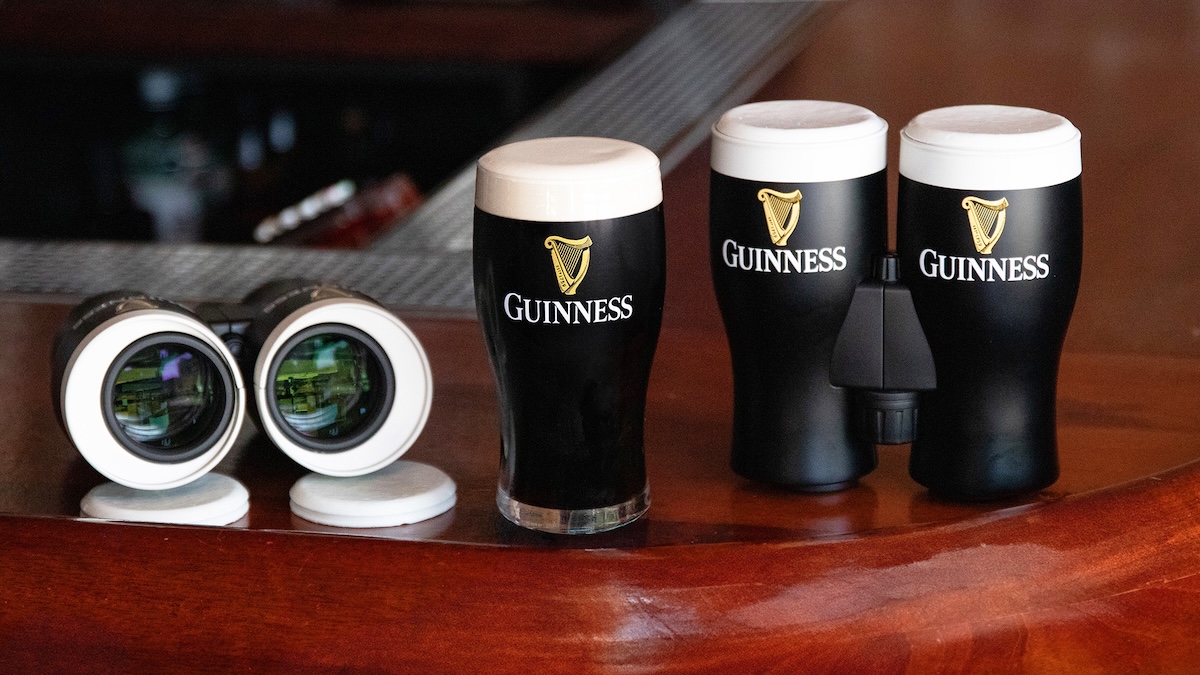
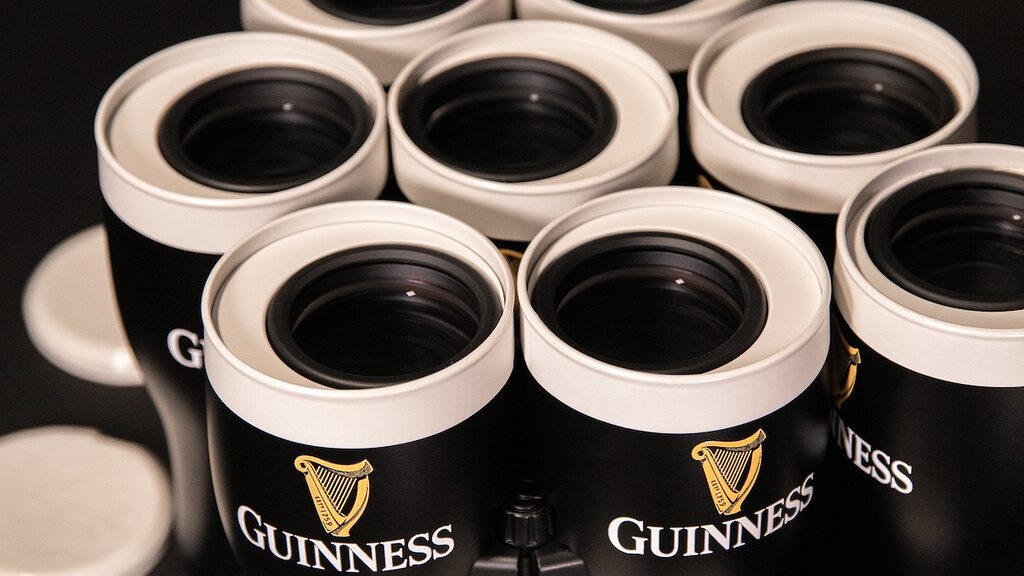
Here’s where it gets properly clever. The binoculars aren’t shaped like binoculars; they just happen to have a Guinness logo stamped on the side, which is what most branded merchandise actually is. They’re shaped like two iconic Guinness glasses side by side, with the silhouette doing the branding rather than a sticker.
Diageo describes them as:
- Designed to help fans get a little closer to the action, wherever they’re watching from
- Fully functional, not a display-only novelty
- Complete with a leather carrying case
Fully functional is the detail that matters most here, and it’s worth sitting with for a second. A lot of brand-novelty objects are novelty-first and object-second. They look the part in a press photo and fall apart the moment someone tries to use them.
Guinness inverted that. These had to actually work as binoculars, because the entire joke collapses the moment they don’t. The inclusion of a dedicated leather case elevates the release into something that resembles a keepsake or heirloom, transforming the object from a simple giveaway into a piece of design-driven memorabilia.
And then comes the line that makes the whole thing sing. Guinness says the binoculars were created for fans who never want to miss a moment of the beautiful game, whether watching from the upper deck, across a crowded pub, or at home with friends, offering a new “pint of view” on the action.
Pint of view. That’s not a tagline bolted onto a product. That’s the product justifying its own existence in three words, which is the kind of copywriting most brands spend entire campaigns failing to find.
The scarcity lever, pulled all the way back
Now for the part that turns a nice idea into a story people actually talk about. Guinness didn’t make a thousand pairs and ship them to influencers. Only four pairs of Guinness binoculars exist, and they are not being sold to the public.
Fans aged 21 and over could enter over an eleven-day window by:
- Following the brand’s account on Instagram
- Commenting on the designated sweepstakes post
- Using a dedicated entry hashtag
Four. Not four thousand, not four hundred. Four pairs, for a tournament being watched by what will likely be billions of people across the world. That ratio is the entire mechanism. It converts a giveaway into a lottery ticket and a lottery ticket into a reason to follow, comment, tag a friend, and keep checking your phone for eleven days straight.
Every mechanic of the entry process is itself a piece of free distribution, built entirely on the promise of an object most entrants will never hold.
This is the bit students of brand strategy should sit up for. The product was never really the four pairs of binoculars. The product was the story about four pairs of binoculars, and the binoculars were simply the artefact that made the story believable.
Why this fits Guinness, and wouldn’t fit just anyone
None of this works if it’s a brand with no standing to make the joke. Guinness has spent this World Cup building an entire platform around the idea that whatever divides fans on the pitch, the pint unites them. The binoculars landed as one beat in a wider sequence:
- A revived 1990s anthem advertisement, reintroduced for a new generation
- A limited-edition can pack designed by a Brooklyn-based illustrator
- A jersey collaboration with a fan creative studio
- The binoculars giveaway, arriving once the audience was already primed for a Guinness moment
The binoculars weren’t a standalone stunt. They were the punchline to a joke the brand had already spent weeks setting up: that watching football, badly, with friends, in a packed pub, holding a pint, is itself the whole point.
The activation plays on Guinness’s long-standing association with shared viewing occasions and aims to add a light-hearted twist to match-day rituals. That’s the brand truth doing the heavy lifting. A sports drink brand making this object would feel opportunistic. A beer brand whose entire equity is built on conviviality and the craic of watching together gets to make this object and have it feel inevitable rather than gimmicky.
The takeaway
Strip away the football and the pint glasses, and there’s a transferable lesson sitting underneath. The most efficient activations don’t try to reach everyone. They make something almost nobody can have, root it in a genuine category truth, and let scarcity do the broadcasting that media usually have to buy.
Four pairs of binoculars. Eleven days. One hashtag. And an entire internet writing about a beer brand’s eyewear, weeks after the giveaway closed.
That’s not a stunt. That’s a masterclass in knowing exactly which constraint to turn into the idea.
Marketing case note
Brand: Guinness (Diageo) Market: Global, anchored in the United States ahead of the 2026 FIFA World Cup Activation: Guinness Binoculars, a sweepstakes giveaway of four fully functional, pint-glass-shaped binoculars with leather cases
Objective
To extend Guinness’s World Cup sponsorship positioning beyond stadium and on-premise advertising, deepening engagement with fans who associate Guinness with communal match-day viewing rather than in-stadium spectating.
Mechanic
- A single physical artefact, designed around brand iconography rather than logo placement
- Extreme manufactured scarcity, with only four units in existence and none for sale
- A low-friction social entry mechanic (follow, comment, tag, hashtag) that converts every entrant into a distribution node
- A finite eleven-day entry window, creating urgency without requiring paid media to sustain it
Why it worked
- Earned media over paid reach. The scarcity made the object newsworthy on its own terms, generating coverage across marketing, lifestyle and pop-culture press without a commensurate media spend.
- Brand-truth alignment. The idea only works because Guinness has long-standing equity in togetherness and shared viewing occasions. The same mechanic on a less culturally rooted brand would have read as a gimmick rather than an extension of identity.
- Object as proof, not prop. Functionality was non-negotiable. A non-working novelty item would have collapsed the credibility of the idea on first use; the leather case pushed it further, into keepsake territory.
- Platform sequencing. The binoculars landed as the third beat in a broader World Cup campaign (anthem revival, limited-edition packaging, jersey collaboration), benefiting from an audience already primed to expect a Guinness moment.
Transferable principle for brand strategists
Scarcity is not a discount mechanic; it is a storytelling mechanic. When a limited-run object is built on a genuine category truth and given just enough functional credibility to be believable, the ratio of media value to production cost can outperform conventional campaign spend by a wide margin. The lesson for category teams with constrained budgets: a single, well-made, severely limited artefact, correctly rooted in brand truth, can do the work of a multi-market paid campaign if the scarcity itself is engineered to travel.