The Indian Cat Is Finally Getting Her Own Aisle. Brands Should Be Paying Attention.
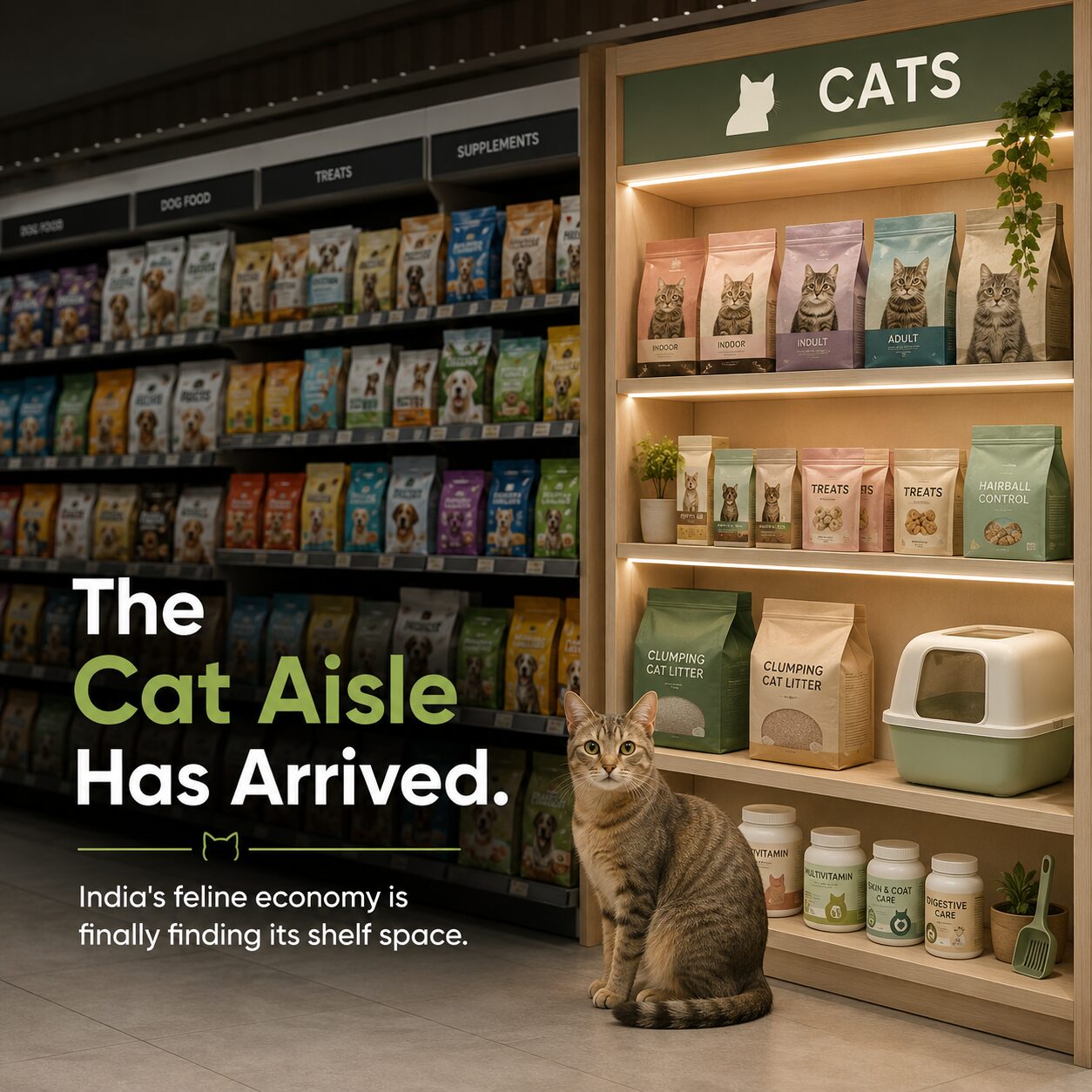
India’s cat supplement market is small but compounding fast. Here’s the white space brands are missing and where the real opportunity sits.
For years, the Indian pet industry has run on one assumption: the dog owns the home, and the cat is an afterthought. Walk into any pet store in Bengaluru, Mumbai or Delhi, and the shelf space tells you everything. Dog food takes up three aisles. Cat products get a corner.
That assumption is starting to look outdated.
In the United States, the cat is quietly overtaking the dog as the category every smart supplement brand wants to be in. New consumer research presented recently at a major industry pet supplement conference made the point bluntly: dog ownership in the US is declining, cat ownership is holding firm, and supplement makers who have spent a decade obsessing over dogs are sitting on an underserved, underpriced opportunity.
India is not the US. But the underlying forces behind that shift, smaller homes, ageing pet parents, and renters who cannot keep a dog are not unique to America. They are playing out here too, just from a very different starting point. And that difference is exactly why this is worth unpacking for an Indian audience.
A quick snapshot of what the US data showed:
- Cat ownership has held steady as a share of households even as overall dog ownership has slipped.
- Renters are far more likely to keep a cat than a dog.
- The ratio of kitten-adopting households to puppy-adopting households has moved from roughly two-to-three a few years ago to almost one-to-one today.
- Cat owners are deeply bonded to their pets, yet a large and growing share feel that the industry treats their cats as an afterthought.
Two markets, two starting points, one direction
In the US, this is a story of substitution. Dogs are declining; cats are filling the gap.
In India, it is a story of late arrival. The Indian pet category has been built almost entirely around the dog. Cats account for roughly a tenth of the country’s pet population, against the dog’s near 90% share, depending on which industry estimate you use. But look at the growth rate, not the base, and the picture changes. Cat ownership in India has been clocking the fastest compound growth of any pet category for several years running, comfortably outpacing dogs. The base is small. The climb is steep.
This is the part Indian brand owners tend to miss. A 10% market growing at double digits will, in a few cycles, matter a great deal more than a 90% market growing slowly. Cats are not catching up to dogs in India. They are compounding past most people’s attention spans.
The reasons read like a localised version of what the American data has been showing:
- Apartment living is now the default, not the exception, for India’s urban middle class. A cat asks for a litter box and a windowsill. A dog asks for a walk twice a day in cities where pavements barely exist.
- Renting is normal, and most Indian landlords are far more relaxed about a cat than a dog. No barking complaints, no muddy paws in the lift, no breed-based prejudice from the residents’ welfare association.
- Nuclear families with two working parents and limited time find a cat a more honest fit for their actual lifestyle, even if the dog remains the more aspirational, more Instagrammed choice.
- South India, in particular, has shown a greater cultural comfort with cats than the north, and that regional skew is itself a market signal that most national brands, built dog-first out of Mumbai or Delhi, have not bothered to read.
None of this means dogs is losing ground in India. They are not. But it does mean the cat segment is the fastest-growing line item on a P&L that most pet brands have chosen not to build.
The same neglect, the same opportunity
The same research surfaced something brand strategists should find familiar: cat owners in the US feel like second-class customers. They believe the products on the shelf are designed for dogs first and adapted for cats as an afterthought.
Ask an Indian cat owner the same question, and you will likely hear the same complaint, just louder. Most Indian pet supplement brands started as dog brands, and it shows:
- Joint care, gut health and coat care formulations built for canine biology, then relabelled for cats with little real reformulation.
- Packaging language and dosing instructions that read as a dog product with the word changed.
- Marketing imagery and brand worlds built around the dog-owner lifestyle, with the cat squeezed into a corner of the same campaign.
- Retail and e-commerce listings where cat products sit as a subcategory of a dog-first catalogue, rather than getting their own shelf logic.
This is the gap. Not a small gap, a structural one. And structural gaps in a fast-growing category are exactly where new brands earn their right to exist.
The emotional investment is not in question either. Indian cat owners are every bit as bonded to their pets as dog owners, arguably more demonstratively so, given how much indoor time cats spend with their humans by necessity of their lifestyle. A cat that lives entirely indoors, shares the bed, and sits on the dining table while the family eats is a cat whose owner notices every change in appetite, coat, litter habits and energy. That noticing is the entire commercial premise of the pet supplement category. You cannot sell wellness to someone who is not watching closely. Indian cat owners are watching very closely indeed.
What the Indian cat owner actually wants
Translate the American purchase-driver data into the Indian context, and three things stand out:
- Health and visible comfort outsell pure pampering as a purchase motivation, and that gap is likely wider in India than in the US.
- Vet endorsement carries more weight in India than any influencer or celebrity tie-up, given how stretched access to vets already is.
- Format and palatability decide repeat purchase more than the ingredient list does, because a fussy cat will simply refuse a badly made product.
Health and comfort, not pampering, will sell first. Indian consumers, even affluent ones, are value-conscious by instinct. A supplement pitched purely as a luxury indulgence will struggle. A supplement pitched as “this keeps your cat’s gut, joints or coat in genuinely better condition” earns its price. The American data showed health and comfort outranking pampering as a purchase driver. In India, given the country’s broader thrift-first consumer psychology, that gap will likely be even wider.
The veterinarian’s word still counts for more than any influencer’s. India has a vet access problem that is, if anything, more acute than the one the US data points to. Fewer vets per pet, more stress around the vet visit itself, and a cat that is, true to its species, extremely good at hiding the fact that something is wrong. Brands that build genuine vet relationships and back their formulation claims with vet-backed evidence will out-trust brands that simply run an influencer campaign.
Format matters more than Indian brands currently credit. The soft chew topped the list of preferred supplement formats in the US study. Indian cat owners face the same basic problem dog owners have solved for years: a fussy, suspicious animal who will reject anything that smells wrong or feels wrong in the mouth. Powder sprinkled on food, often the laziest and cheapest format to manufacture, is usually the first thing a cat learns to eat around. Brands willing to invest in palatability and format, not just formulation, will win disproportionate loyalty.
Where the actual white space sits
A few areas look particularly open for an Indian brand willing to build cat-first rather than cat-adjacent:
- Senior and longevity support, built ahead of the demand curve rather than in response to it.
- Calming and anxiety formulations designed for India’s largely indoor-only cat population.
- Honest value framing that positions the supplement as essential care rather than an indulgence.
- Direct-to-consumer and subscription models designed around cat-buying habits, not retrofitted from a dog playbook.
Senior and longevity care. India’s cat-owning households are young as a category; most Indian house cats are still under seven, which means the wave of ageing cats needing joint, cognitive and metabolic support is a few years out, not already here. That is not a reason to wait. It is a reason to build the brand and the trust now, so the product is already established by the time the demand curve arrives. Waiting for the market to mature before showing up is how you end up competing for shelf space instead of defining the category.
Calming and anxiety support. Anecdotally and in early Indian pet behaviour surveys, indoor-only cats, increasingly the Indian norm given urban living realities, show meaningfully higher rates of stress behaviour than cats with any degree of outdoor access. A genuinely Indian product conversation around this, grounded in local vet input rather than a translated American formulation, has almost no serious competition right now.
Value framing, done honestly. Indian consumers will not pay a premium for a product they perceive as optional. The brand’s job is to make the case, with real ingredient transparency and real efficacy data, that the supplement is part of essential care, not a nice-to-have. This is a positioning problem before it is a formulation problem, and it is exactly the kind of problem brand strategy exists to solve.
Direct-to-consumer and subscription. India’s D2C pet infrastructure is still being built out, largely on the back of dog categories. A cat-first D2C play, subscription-led, vet-recommended, and built around the much smaller but far more habitual basket size a cat household tends to buy, is close to greenfield. The omnichannel blur visible in the US, where quick commerce, vet clinics and retail increasingly overlap, is arriving in India even faster, riding on the back of platforms like Blinkit and the broader q-commerce boom. A brand that designs for that blurred channel from day one, rather than retrofitting a dog-first DTC model, starts with a real advantage.
The real takeaway for Indian pet brands
The instinct in Indian pet care has long been to build for the dog and treat the cat as a smaller, simpler version of the same playbook. That instinct made commercial sense when the dog was 90% plus of the market and growing the fastest. It makes progressively less sense each year; the ‘cat’ category compounds quietly in the background.
The brands that will own the next phase of India’s cat supplement market are unlikely to be the ones that port over a dog formulation with a different label. They will be the ones who start from the cat’s actual physiology, behaviour, and household role and build outward from there.
The American market got there first because its dog category hit a ceiling, forcing the shift. India does not need a ceiling to force the same realisation. The growth numbers are already making the case. The only real question is which brand reads them early enough to matter.