Brands and the New Rules of Value: Why Scarcity Still Wins
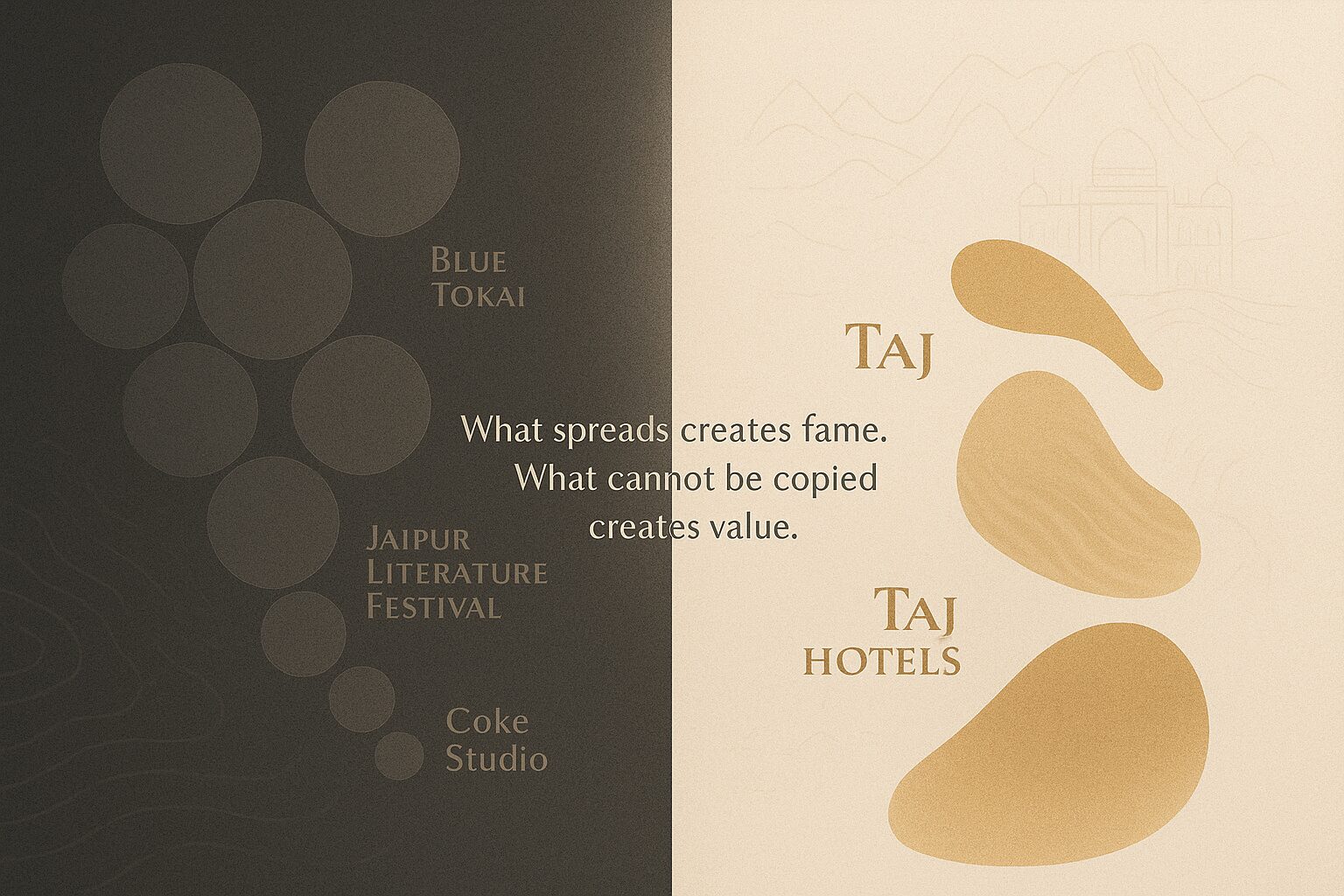
Explore how modern brands thrive by embracing scarcity, uniqueness, and analogue value in a world of mass abundance.
Economists often say that when one thing becomes abundant, another becomes scarce. You see this everywhere: when information became free, attention became valuable. When mass production made goods cheap, craftsmanship became premium. When convenience became universal, effort itself became a signal of value.
This shift is no longer about digital versus analogue. It’s about common versus irreplaceable.
In every category—food, travel, wellness, entertainment, fashion—abundance has pushed consumers to seek out what cannot be mass replicated. The centre of gravity has moved toward experiences, emotions, cultures, rituals, and relationships. You can copy products. You cannot copy meaning.
This is where new market value is being created.
The New Market Rule: Replicable = Cheap. Irreplicable = Premium.
A simple principle now governs modern brand value:
If it can be reproduced instantly and consumed by everyone, it becomes a commodity.
If it requires presence, effort, or cultural depth to experience, it becomes a premium.
Look at Indian examples:
- Coffee Chains vs. Local Roasters
Coffee is everywhere now. But Blue Tokai or Third Wave charge premium prices not for the drink alone, but for the ritual—fresh roasts, handcrafted brewing, and the café as a social space. The beverage is standard; the experience is scarce.
- Ayurveda and Wellness
Basic yoga tutorials are freely available. But retreats at Isha or Ananda in the Himalayas command substantial pricing because the experiential, spiritual immersion cannot be forwarded as a link.
Knowledge is abundant. Transformation is scarce.
- Music: Recorded vs. Live
You can stream any artist anytime. But a Coke Studio live experience, a Zubin Mehta concert, or an AR Rahman stadium show sells at a premium because the atmosphere, acoustics, and collective emotion cannot be reproduced.
Sound is abundant. Presence is scarce.
Products Become Popular. Experiences Become Profitable.
Here lies the irony of modern branding:
The things that give you scale are not the things that generate revenue.
The things that create revenue cannot scale infinitely.
Examples:
- Royal Enfield
Millions watch riding videos online, but the company’s real value lies in the riding brotherhood, the Ladakh journey, and the rituals of motorcycling. The digital content makes the brand popular; the community makes the brand profitable.
- Taj Hotels
Photos of the Taj Lake Palace are everywhere, but the warmth of Taj hospitality—the welcome with jasmine, the handwritten notes, the personalised care—cannot be mass-produced. Digital spreads awareness. The human touch builds pricing power.
- Artisan Brands
Mass fashion is abundant. That’s why Fabindia’s handwoven textiles or Raw Mango’s sarees command premium prices. What you pay for is heritage, craft, and the human hand, all of which are scarce.
- Sports Leagues
Watching IPL clips online is free. But being in the stadium, feeling the roar, the adrenaline, the unpredictability—that exclusivity cannot be copied.
Content is abundant. Emotion is scarce.
Why Scarcity Is Becoming the New Aspiration
Across categories, consumers are showing a preference for:
- Customisation over mass production
- Local flavours over generic globalisation
- Heritage over trend cycles
- Human touch over automation
- Community over anonymous consumption
This is partly driven by fatigue. When everything is available, convenience loses meaning. What rises instead is the desire for:
- stories
- provenance
- authenticity
- identity
- connection
The Jaipur Literature Festival, for example, streams sessions online, but tens of thousands still travel to Jaipur because the charm is not in the talks alone—it is in the ambience, the crowd, the chai breaks, the unexpected conversations.
When society is flooded with abundance, people seek experiences that feel unrepeatable.
The Playbook for Modern Brands
To thrive in this market reality, brands must embrace a dual strategy:
- Use What’s Abundant to Build Fame
Social media, videos, tutorials, content, behind-the-scenes glimpses—use these to create reach, aspiration, and community growth.
- Use What’s Scarce to Build Value
Offer what cannot be copied:
- immersive experiences
- craftsmanship
- limited editions
- personalised service
- physical events
- rituals and communities
Scale gives attention.
Scarcity gives pricing power.
The Future Belongs to Brands That Master Both Worlds
- A yoga studio that teaches online grows followers.
‘A yoga centre that transforms offline grows revenue.’
- A restaurant becomes famous through Instagram.
‘It becomes iconic through the meal that cannot be replicated.’
- A wellness brand becomes known through influencers.
‘It becomes trusted through results that no video can reproduce.’
Brands cannot win on abundance alone anymore.
They win when they create something the world cannot forget.
In a world where everything can be copied, the true luxury is what remains uniquely yours.