The D2C Multiverse: Why Consumer Brands Are Building Businesses Beyond Their Core Categories
Successful D2C brands are moving beyond their original categories. From boAt and Wakefit to Nykaa and Lenskart, discover why consumer businesses are building multi-category portfolios and the challenges that come with expansion.
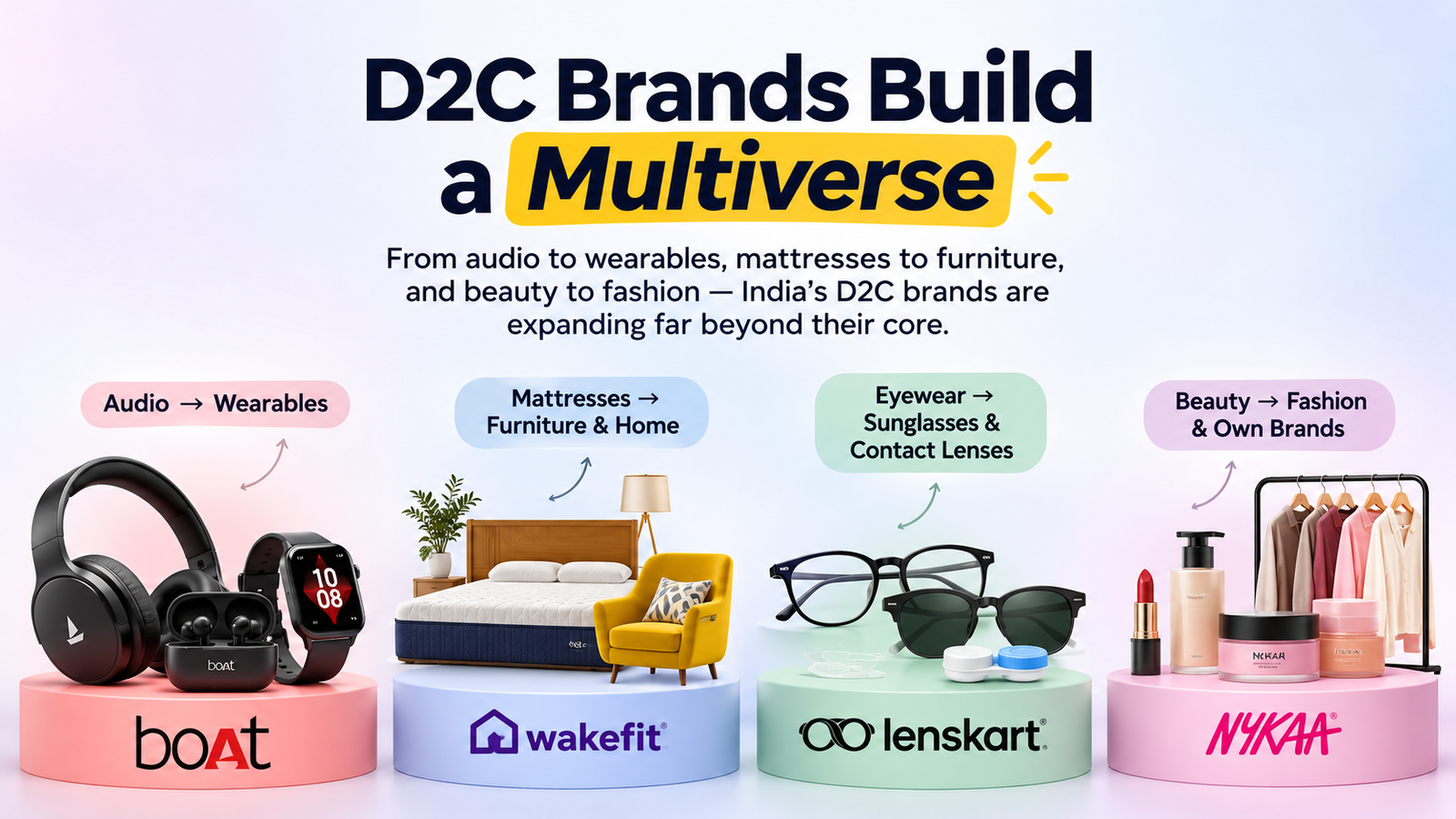
D2C brand expansion is becoming an increasingly important growth strategy as successful consumer businesses look beyond their original categories. A consumer electronics brand moving from audio products into wearables. A mattress company expanding into furniture and home solutions. An eyewear retailer entering sunglasses and contact lenses. A beauty platform developing its own fashion and personal care brands.
These may seem like unrelated business decisions. But they point towards an interesting shift in India’s direct-to-consumer (D2C) landscape. Successful consumer brands are increasingly looking beyond the categories that made them successful and building portfolios that span multiple consumer needs.
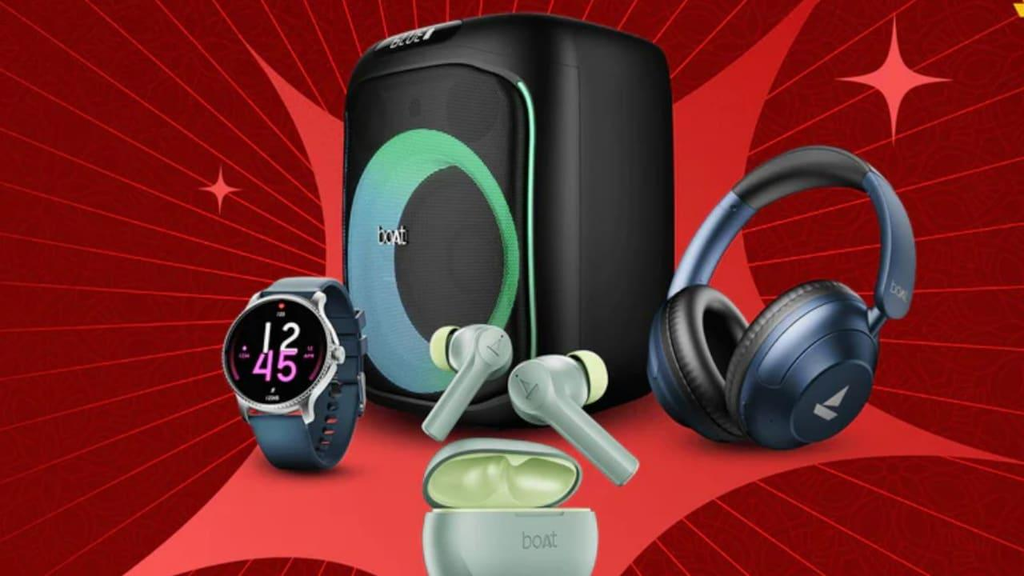
Consider boAt, which built its business around audio products before expanding into smartwatches and wearables. Wakefit, initially known for mattresses, moved into furniture and broader home solutions. Lenskart, which established itself in prescription eyewear, broadened its portfolio into sunglasses and contact lenses. And Nykaa, which began as a beauty retail platform, has expanded into fashion while developing its own portfolio of beauty and fashion brands.
These businesses are no longer content with owning a single consumer category. They are looking to capture a larger share of the consumer’s wallet by participating in multiple consumption occasions.
The phenomenon extends beyond these companies. Wingreens Farms has expanded from dips and spreads into sauces, snacks, breakfast cereals and beverages. Honasa Consumer, the parent of Mamaearth, has developed a portfolio of brands such as The Derma Co, Aqualogica, BBlunt and Dr Sheth’s, each addressing different beauty and personal care needs.

These are not fledgling businesses experimenting with product-market fit. They are established consumer companies with brand recognition, distribution capabilities and existing customer relationships.
The question is: why are they moving beyond their original categories? Is this simply ambition, or is staying within one category becoming a constraint on growth?
1. The Growth Ceiling: When the Core Category Is Not Enough
India’s D2C opportunity continues to expand. According to Inc42’s D2C 3.0 Report 2026, India’s D2C gross merchandise value (GMV) is projected to exceed $310 billion by 2031, growing at approximately 37% CAGR from $65 billion in 2026.
Yet revenue growth does not automatically translate into profitability. Several consumer businesses still face pressure from customer acquisition costs, discounting, marketing spend, and expansion investments.
This creates a fundamental challenge. Once a brand establishes itself in its original category, how does it continue growing without endlessly spending to acquire new customers?
One answer is to increase the value derived from existing customers.
A consumer who buys grooming products may also spend on personal wellness. Someone who purchases athleisure may be interested in footwear, hydration products or recovery accessories. A mattress customer may also need bedroom furniture and home comfort items. An eyewear customer may also need sunglasses and contact lenses.
The opportunity lies in identifying these overlapping consumption occasions.
It is similar to how wealth management firms operate. Once a customer is acquired, the same institution can offer fixed deposits, broking services, insurance and pension products. The relationship creates opportunities to serve multiple needs.
For consumer brands, the logic is similar: why acquire an entirely new customer when an existing customer could potentially buy from another category?
However, customer overlap should not be confused with automatic brand acceptance. A consumer who trusts a brand for one product will not necessarily trust it for everything else.
The challenge is to identify categories where the parent company’s capabilities and consumer relationships provide a genuine advantage.
2. The Adjacency Advantage: Finding the Right New Market
Successful category expansion is rarely about entering a market simply because it is growing. It is about finding an intersection between consumer needs, existing capabilities and commercial opportunity.
Consider the different approaches.
boAt has leveraged its association with affordable, lifestyle-oriented technology products to enter adjacent electronics categories. Wakefit has extended its association with sleep and comfort into furniture and home solutions. Lenskart has used its eyewear credentials to deepen its presence in the broader vision-care market.

These are examples of businesses building around a consumer need rather than merely adding unrelated products to their catalogues.
Then there are businesses such as Wingreens Farms, where category expansion is driven by opportunities within a broader consumption territory. A consumer who buys dips and spreads could also be interested in sauces, snacks and other food products.

Varun Gupta, co-founder of rE and CMO of Bombay Shaving Company, identified three factors influencing the company’s expansion decisions: consumer understanding, storytelling capabilities, and sourcing and product development strengths.
These are important because a new category requires more than a product launch. It requires understanding consumer behaviour, establishing credibility, and having the operational capability to deliver consistently.
But adjacency is not merely about related products. It is also about whether the brand has permission to participate in the new category.
A consumer may readily accept a fitness brand selling everyday sportswear. The same consumer may question its credibility if it suddenly starts selling skincare or financial products.
Category attractiveness alone does not establish brand legitimacy.
3. Three Routes to Building a Consumer Multiverse
Not all category expansions follow the same strategy. At least three distinct approaches exist.
Brand extension: Taking the existing brand into new categories
Here, the company uses its existing brand identity to enter adjacent product categories. boAt moving from audio products into wearables and Wakefit moving from mattresses into furniture illustrate this approach.
The advantage is leveraging existing brand recognition, distribution, and customer relationships. The risk is that an extension into an unsuitable category can dilute the original brand proposition.
Category deepening: Capturing more of the same customer’s spending
This approach focuses on offering additional solutions to existing customers. Lenskart’s expansion into sunglasses and contact lenses is an example.
The objective is to increase customer lifetime value by serving more needs within an established consumption territory.
House of brands: Building multiple identities under one organisation

Honasa Consumer illustrates this model. Instead of positioning Mamaearth as a universal beauty and personal care brand, the company has developed distinct brands to address different consumer needs and segments.
Similarly, Nykaa has developed its House of Nykaa portfolio across beauty and fashion, including brands such as Kay Beauty, Dot & Key, Nykd and Nykaa Cosmetics.
This offers greater flexibility in positioning and pricing, but requires investment in multiple brand identities, marketing teams and consumer propositions.
The choice between these models depends on the nature of the category, the strength of the existing brand and the company’s long-term ambitions.
4. The New Economics of Experimentation
Until a few years ago, entering a new category involved significant investments in distribution, marketing, inventory and consumer education. Testing a new proposition could take months, sometimes years.
Today, the economics of experimentation are changing.
Quick commerce platforms provide brands with access to consumers across multiple cities without necessarily building an extensive physical distribution network. Digital marketplaces make it easier to test product demand, pricing and positioning.
Celebrity partnerships have also evolved. Rather than treating celebrities only as expensive endorsers, some businesses are bringing them on board as co-founders or equity partners.
This creates an opportunity to combine celebrity influence, distribution and brand-building into a longer-term commercial relationship.
These developments have lowered some barriers to entry. They have made it easier to launch, test and scale new propositions.
However, lower entry barriers do not necessarily mean lower business risk.
A product can generate initial curiosity and trial through digital distribution, but sustained demand depends on product performance, repeat purchases, consumer trust and unit economics.
The difference between launching a brand and building a business remains substantial.
5. One Company, Multiple Brands: The Architecture Dilemma
An interesting aspect of this expansion is that multiple brands do not necessarily require multiple independent organisations.
A company can create separate consumer-facing identities while retaining common infrastructure.
According to Varun Gupta, functions such as HR, finance, supply chain, warehousing and e-commerce relationships can remain centralised. The new brand may initially require a separate category marketing team, while much of the operational infrastructure is shared.
This makes the multi-brand model attractive.
Companies can potentially leverage existing investments in technology, distribution relationships, performance marketing, logistics and customer data.
Ujwal Sutaria, founder of TDV Partners, has also highlighted the advantages of transferring customer data, marketing expertise, distribution relationships and backend capabilities across businesses.
However, not every capability can be transferred.
Product expertise, category-specific knowledge and consumer credibility must still be developed. A company that understands grooming cannot automatically assume it understands recovery equipment or luggage.
This creates an important organisational question: what should be shared, and what needs to remain independent?
Sharing infrastructure improves efficiency, but excessive integration can prevent a new brand from developing its own identity.
The ideal architecture allows operational synergies without compromising category-specific expertise.
6. Beware of the Burn: The Hidden Risks of Diversification
The excitement of entering new markets can sometimes overshadow the financial and operational realities.
As Pranav Pai, founding partner of 3One4 Capital, has pointed out, different categories operate with different economic characteristics.
Consider the differences:
- Purchase frequency: Grooming products may be replenished every few weeks, while luggage may be purchased once every few years.
- Average order value: Some categories depend on high-volume, low-ticket transactions; others depend on fewer, higher-value purchases.
- Gross margins: Product economics vary considerably across categories.
- Working capital: Inventory cycles, procurement commitments and cash conversion periods differ.
- After-sales obligations: Electronics and recovery devices may require warranties, replacements and service infrastructure.
- Consumer trust: A new category may demand a different level of product credibility and expertise.
Consequently, sharing the same customer base does not mean sharing the same business economics.
Brand dilution is also a risk.
A brand is built around a specific set of associations and consumer expectations. Extending it too far can weaken the very identity that made it successful.
A grooming brand may have credibility in personal care, but that credibility does not automatically extend to every wellness product. A fitness brand may have authority in exercise, but that does not give it unlimited permission to enter unrelated consumer categories.
The cost of a failed extension therefore isn’t limited to the money invested in the new business. It can also affect the original brand’s reputation and positioning.
For companies already struggling to turn growing revenues into profits, one wrong bet could make the burn even worse.
7. From D2C Brands to Consumer Platforms

The larger shift is that some D2C businesses are beginning to think less like product companies and more like consumer platforms.
Their ambition is to build a portfolio of brands and categories around identifiable consumer needs.
This approach offers several potential advantages:
- Higher customer lifetime value through cross-category purchases.
- Better utilisation of existing marketing and distribution investments.
- Reduced dependence on a single product category.
- Opportunities to develop new revenue streams.
- Greater economies of scale across procurement, logistics and technology.
But diversification should not replace fixing the core business’s economics.
A company struggling with customer retention, contribution margins or cash flow cannot necessarily solve those problems by launching another brand.
The most successful multi-category businesses will be those that understand where their existing capabilities create a competitive advantage, where consumers genuinely want them to participate and where the financial returns justify the investment.
Ultimately, the objective should not be to own more brands or sell more products. It should be to build stronger consumer relationships and create more value from them.
The next generation of successful D2C companies may not be remembered for the category they started in. They may be remembered for how intelligently they expanded beyond it.
The real question is no longer how many categories a D2C brand can enter. It is how many categories it has the right to win.