There Is More to Loyalty Than Behaviour
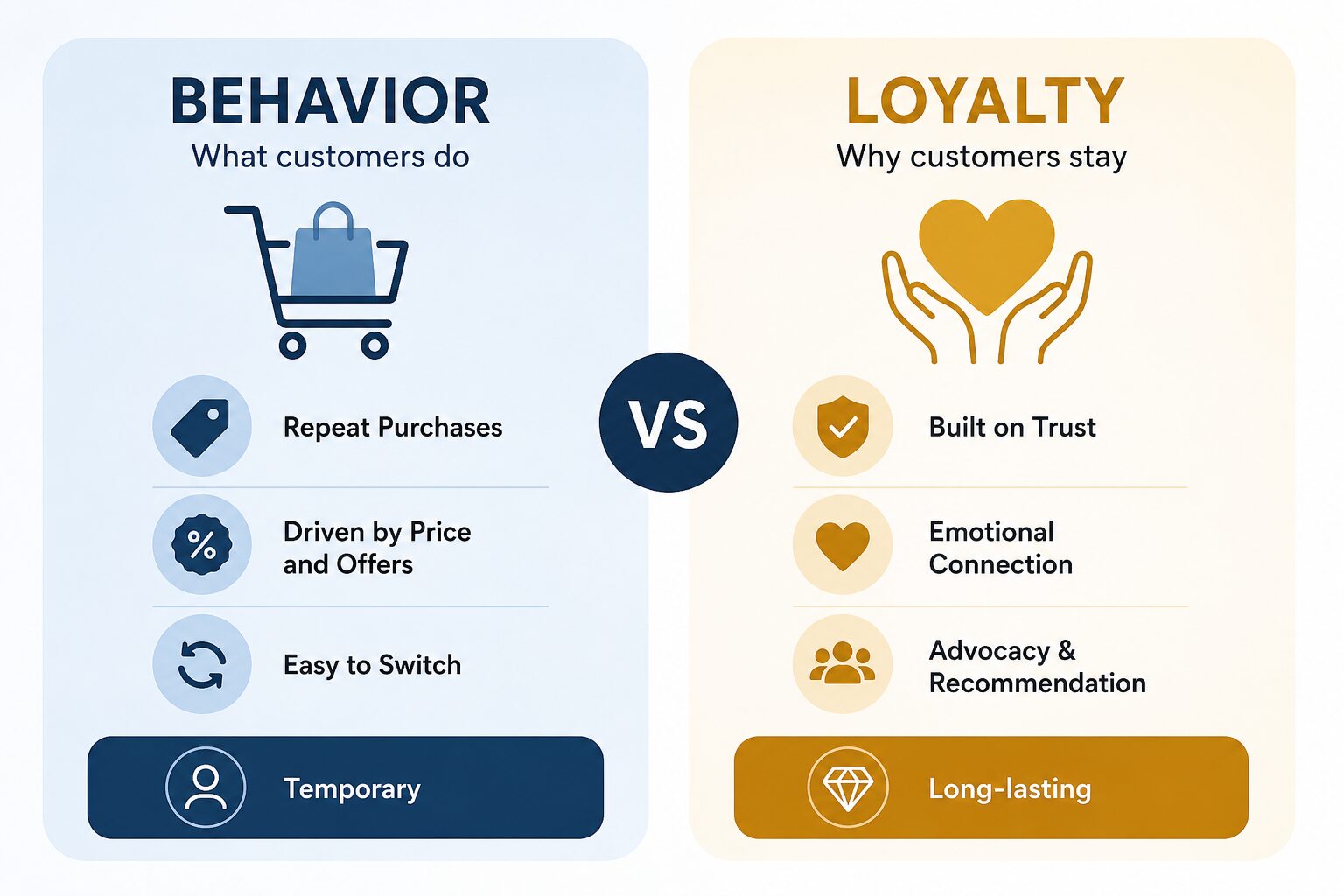
Most businesses mistake repeat purchases for loyalty. True customer loyalty is built on trust, emotional connection, and consistent experiences-not just behavior.
Most businesses measure loyalty through customer behaviour. They track repeat purchases, renewal rates, frequency of visits, customer lifetime value, and purchase frequency. These metrics are important because they reveal what customers are doing. However, they do not explain why customers continue choosing a brand.
Behaviour is only the visible outcome of loyalty. It is not loyalty itself.
A customer may buy from the same brand repeatedly because it is convenient, affordable, or simply the only option available. Genuine loyalty exists when customers continue choosing a brand despite having attractive alternatives. It is driven by trust, emotional connection, and confidence rather than mere repetition.
Repeat Buying Is Not Always Loyalty
Imagine someone who visits the same neighbourhood coffee shop every morning because it is located on the way to work. From the business’s perspective, this customer appears highly loyal. The purchase history certainly suggests so.
But what happens if another café opens next door with better coffee, quicker service, and lower prices? If the customer switches immediately, it becomes clear that the repeated purchases were driven by convenience rather than commitment.
This is one of the biggest misconceptions in marketing. Businesses often mistake repeat behaviour for genuine loyalty.
Behaviour tells us what happened.
Loyalty explains why it happened.
Customers Return for Different Reasons
Not every returning customer is loyal. People continue buying from brands for many reasons that have little to do with emotional attachment.
Some of the most common reasons include:
- Convenience
- Habit
- Competitive pricing
- Attractive promotions
- Limited alternatives
- Long-term contracts
- High switching costs
These factors certainly influence purchasing decisions, but they do not create lasting relationships. The moment a better option becomes available, these customers are often willing to move.
True loyalty exists only when customers choose to stay because they genuinely believe in the brand.
Loyalty Begins in the Mind
Every purchase starts with a decision, and previous experiences influence every decision.
Customers gradually develop confidence in brands that consistently deliver on their promises. Over time, they begin to think:
- “I trust this brand.”
- “They always deliver quality.”
- “They understand my needs.”
- “I never have to worry when I buy from them.”
These thoughts are invisible to dashboards and reports, yet they shape future buying behaviour far more than discounts or promotions.
In other words, behaviour is an outcome. Belief is the cause.
Why Behaviour Can Be Easily Influenced
Behaviour is surprisingly easy to change.
Competitors can quickly attract customers by offering:
- Bigger discounts
- Lower prices
- Faster delivery
- Cashback offers
- Free trials
- Additional services
Many customers respond immediately because these incentives reduce the cost or increase the perceived value of switching.
What competitors cannot easily replicate is the trust a brand has earned over years of consistently delivering positive experiences. Emotional loyalty acts as a protective barrier against competitive offers.
Trust Is the Real Foundation of Loyalty
Every interaction with a customer either strengthens trust or weakens it.
Customers notice whether brands:
- Deliver on their promises.
- Resolve complaints fairly.
- Maintain consistent quality.
- Communicate honestly.
- Admit mistakes when necessary.
Trust is not built through a single advertising campaign or one exceptional experience. It grows slowly through hundreds of positive interactions.
Interestingly, brands that have earned deep trust are often forgiven when occasional mistakes happen. Customers recognise that perfection is impossible, but honesty and consistency matter.
Emotion Creates Stronger Relationships
Although customers often believe they make rational decisions, emotions influence far more purchases than they realise.
People remain loyal because certain brands make them feel:
- Understood
- Appreciated
- Confident
- Comfortable
- Safe
- Proud
These emotional benefits are much harder for competitors to copy than product features or pricing.
This explains why some brands retain customers even when they are not the cheapest option in the market.
When Brands Become Part of Identity
The strongest brands eventually become part of a customer’s identity.
People do not simply use these brands; they associate them with who they are.
For many Apple users, owning an iPhone or MacBook represents more than technology. It reflects simplicity, design, creativity, and belonging to a trusted ecosystem. Customers often remain within the ecosystem despite premium pricing because they value the overall experience, not just the product.
Similarly, Amul has earned remarkable loyalty across generations in India. Families continue purchasing its products because decades of consistent quality have created deep trust. The decision is often automatic, not because consumers have compared every alternative, but because confidence has already been established.
Another excellent example is Tata. Across automobiles, jewellery, hotels, and consumer products, the Tata name represents integrity and reliability. Consumers frequently extend their trust from one Tata business to another because the corporate reputation itself inspires confidence.
These brands demonstrate that loyalty is built through trust and meaning rather than repeated transactions alone.
Looking Beyond Behavioural Metrics
Businesses should continue measuring customer behaviour, but they should also evaluate the strength of customer relationships.
Useful questions include:
- Would customers recommend the brand to others without being rewarded?
- Would they remain after a modest price increase?
- Do they speak positively about the brand in conversations?
- Do they actively defend the brand when others criticise it?
- Would customers genuinely miss the brand if it disappeared?
These questions reveal emotional commitment rather than simple purchasing patterns.
Building Loyalty That Lasts
Creating loyal customers requires much more than offering rewards or discounts. It requires delivering value consistently over time.
Brands that build lasting loyalty typically focus on:
- Delivering reliable quality every time.
- Listening carefully to customer feedback.
- Solving problems quickly and fairly.
- Being transparent in communication.
- Creating memorable customer experiences.
- Standing for values customers admire.
- Making customers feel recognised rather than merely targeted.
Loyalty is earned through thousands of consistent experiences rather than a single marketing campaign.
The Competitive Advantage That Cannot Be Copied
Products can be copied.
Technology can be replicated.
Prices can be matched.
Even innovation eventually attracts competition.
What remains difficult to imitate is a relationship built over years of trust, consistency, and emotional connection.
Brands with genuinely loyal customers enjoy lower acquisition costs, stronger advocacy, higher customer lifetime value, and greater resilience during economic uncertainty. Their customers remain not because they have to, but because they want to.
Final Thoughts
There is far more to loyalty than behaviour.
Repeat purchases, frequent visits, and high spending are valuable indicators, but they represent only the visible outcome of a much deeper relationship. Genuine loyalty begins with trust, grows through consistently positive experiences, and strengthens when customers feel emotionally connected to a brand.
The most successful brands understand that customers do not remain loyal simply because they buy repeatedly. They remain loyal because they believe the brand consistently delivers value, understands their needs, and deserves their trust.
Behaviour may appear on a dashboard, but belief is what builds enduring brands.