Five Beers, One Ketchup, and 150 Years of Pretending Not to Know Each Other
Heinz and Heineken swapped one beer for ketchup in a World Cup six-pack. Here’s the story behind a simple idea that got the whole internet talking.
How Heinz and Heineken turned a fridge habit into a World Cup talking point
Some brand collaborations need a brief, a deck, and six months of legal review before anyone agrees on a single creative idea.
This one needed a fridge.
Heinz and Heineken looked at how people actually stock up before a match; noticed that ketchup and lager have been sitting side by side at dinner tables for over a century; and decided that was the entire campaign. No new product. No elaborate mechanic. Just an admission of something everyone already knew.
The pack, as simple as it sounds
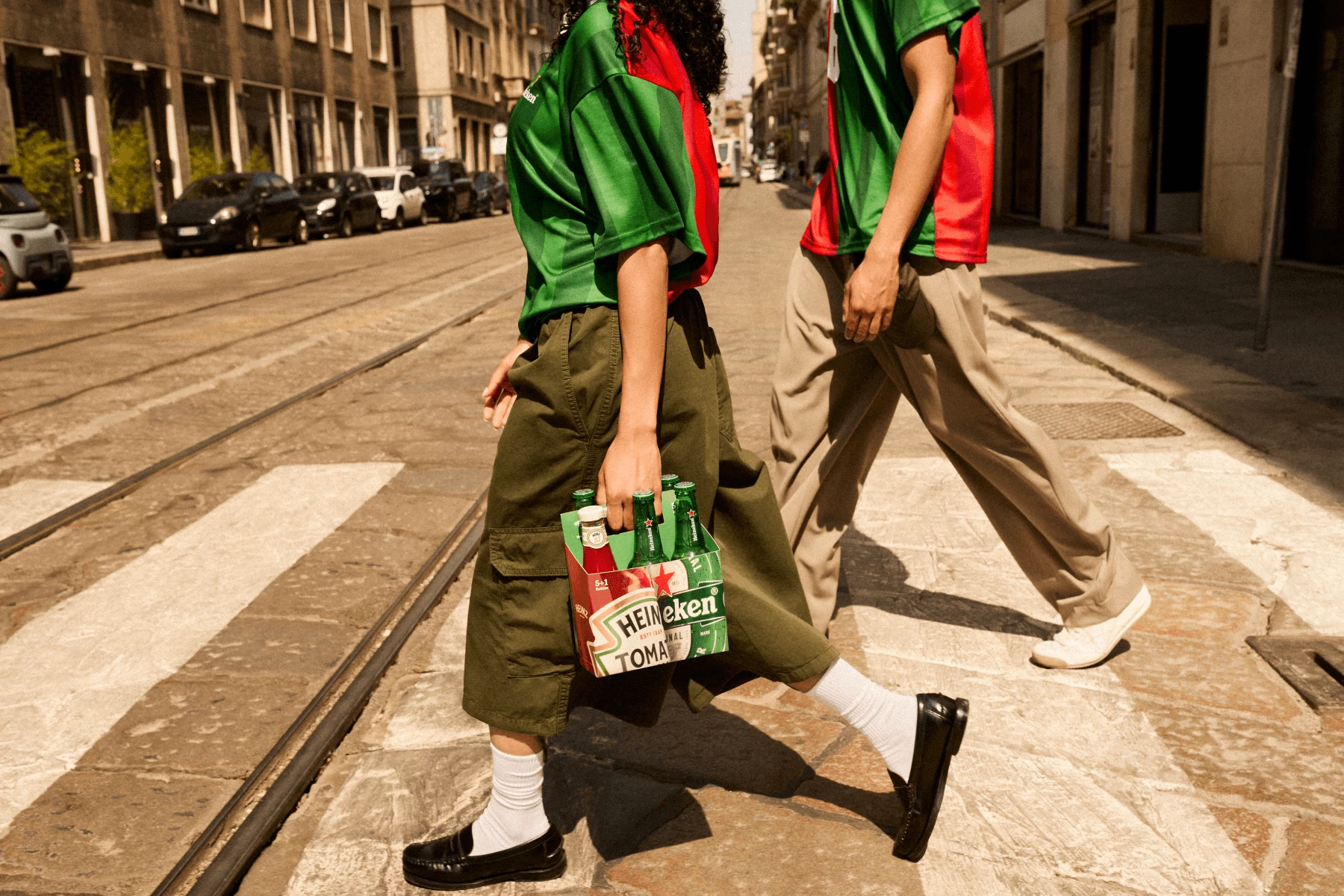
The idea is almost insultingly straightforward. They have called it “the match we’ve all been waiting for”: a six-pack of Heineken with the sixth bottle quietly swapped for a Heinz. Five lagers, one condiment, shelved and priced like a regular six-pack.
The design does the rest of the talking:
- A close-up of each bottle is printed on the bottle carrier, arranged so it spells out the Heineken brand name using both companies’ logos and colour schemes
- The carrier blends Heineken’s green palette with Heinz’s red-and-white identity, making the pack recognisable from both brand perspectives
- The accompanying campaign photography features football jerseys split between the two brands’ colours, a nod to the tournament without either brand claiming sponsorship
It went live as a collaborative post on both brands’ Instagram accounts at once, with the same image appearing on Heinz’s and Heineken’s grids simultaneously. No staggered reveal, no teaser campaign. Both brands simply said, at the same moment, that this was happening.
The line that makes it work
Every good collaboration needs one sentence that justifies the whole idea, and both brands clearly knew it.
Heineken has always been about sparking fresh connections, and the collaboration is a reminder that even the most unlikely pairings can feel completely natural when they’re part of shared moments.
For 150 years, Heinz and Heineken have been part of the moments that bring people together, and this summer, the brands were making it official.
That’s the entire pitch, delivered twice, from both sides of the partnership. Not a new occasion. Not a new audience. Just an old habit, finally given a name.
Built by people, not just algorithms
This wasn’t a quick social stunt knocked out by an intern with Canva. The collaboration was created by The Kitchen, EPDM at Kraft Heinz, in partnership with LePub Milan and PR agency The Romans, with additional work from art director Jack Parker and design lead Dan Howarth. The launch film was produced by LittleBig, and the photo series was shot by Paolo Zerbini.
That’s a proper campaign machinery behind what looks, on the surface, like a single funny idea. Which is exactly the point. The best simple ideas are rarely simple to produce. Getting two heritage brands, two creative agencies, a PR partner, and a director aligned on one image, launched in lockstep, takes more coordination than most multi-channel campaigns ever see.
A crowded World Cup, and a quieter way to stand out
This pack didn’t land in a vacuum. It arrived in the middle of one of the most heavily marketed World Cups in recent memory, where every beverage and snack brand was fighting for the same eyeballs.
The numbers explain why the fight was worth having:
- Numerator found that nearly a third of US consumers planned to watch the 2026 FIFA World Cup, and 89% of intended viewers expected to make a purchase tied to watching the games
- Numerator projected the tournament could drive $7.5 billion in consumer spending, with an average spend of $74 per shopper
- The top planned purchase categories were snacks, chips and dips at 51%, alcoholic beverages at 38%, and prepared foods or appetisers at 35%
Put plainly, beer and ketchup were already going into the same shopping basket before a single ball was kicked. Heinz and Heineken didn’t need to convince anyone to buy both. They just needed to be the brand people remembered reaching for.
Not everyone was convinced, and that was sort of the point
Here’s where the story gets honest. The pack split opinion almost immediately, and the brands didn’t appear to mind.
- Consumers responded positively to the launch on the Kraft Heinz and Heineken Instagram accounts, but opinions differed elsewhere
- Some social media users objected to a multipack containing one fewer beer bottle and questioned whether adding a bottle of ketchup would inflate the price
- One commenter wrote that nobody was waiting for this, while another argued that just because you can doesn’t mean you should
The idea may seem ‘stunty’ and won’t see wide distribution, but it was generating real attention amid all the World Cup marketing clutter, which is a win in itself.
It has been observed that many brands treat partnerships as shortcuts to relevance, but this collaboration avoided that trap by pairing two established brands without leaning on trendy startups or complicated promotions. The strongest ideas often come from observing existing behaviour rather than inventing something entirely new.
That tension is worth sitting with. A campaign that some fans actively disliked, that critics called gimmicky, and that almost nobody outside a limited run will ever hold in their hands, still generated exactly the kind of debate that gets a brand talked about for free.
The takeaway
Strip away the football shirts and the bottle carrier, and the lesson is almost uncomfortably simple. Heinz and Heineken didn’t invent a new occasion, a new flavour, or a new product. They noticed an old one, gave it a name, and let the pairing’s existing familiarity do the convincing.
Beer and ketchup have both earned their place as the backbone of sports watch-party rituals, and this collaboration simply made that fact official, marketed as something fans could easily recreate at home with everyday purchases.
The cleverest part isn’t the pack. It’s the restraint. No new mechanic, no app, no QR code. Just two logos, side by side, finally admitting what was always true.
Marketing case note
Brands: Heinz (Kraft Heinz) and Heineken Market: Global, with a strong US and European push timed to the 2026 FIFA World Cup Activation: A limited-edition co-branded six-pack — five Heineken beers and one bottle of Heinz Tomato Ketchup — supported by a launch film, photo series, and split-colour football jerseys
Objective
To position both brands inside an existing, unclaimed consumer ritual (watch-party shopping) rather than competing for World Cup sponsorship attention directly, while generating high-visibility earned media through novelty and debate.
Mechanic
- A co-branded product built entirely from existing SKUs, requiring no new manufacturing or formulation
- Packaging designed to do the explaining, with bottle imagery spelling out the partner brand’s name using both colour identities
- Simultaneous, synchronised launch across both brands’ owned social channels rather than a staggered media rollout
- Senior leadership quotes from both companies used to frame the partnership as a 150-year-overdue formalisation rather than an opportunistic stunt
- Supporting assets (launch film, photography, jerseys) that reinforced the “shared occasion” narrative without referencing the World Cup as an official sponsor would
Why it worked
- Borrowed familiarity, not invented demand. The brands didn’t try to create a new reason to buy together. They formalised a purchase pattern that already existed at barbecues and watch parties, which made the idea instantly believable.
- Packaging as the entire media plan. The visual pun, one ketchup bottle standing in for a beer, communicated the whole concept without requiring an explainer film or a complex campaign mechanic.
- Two-sided credibility. Quotes from senior leaders on both sides gave the partnership equal weight from each brand’s perspective, avoiding the common collaboration pitfall where one partner looks like the headline act and the other a guest feature.
- Comfortable with imperfect reception. The brands did not appear to chase universal approval. Mixed social commentary and gimmick accusations were absorbed as part of the attention mechanism rather than treated as a failure signal.
Transferable principle for brand strategists
The most efficient collaborations are often the ones that require the least explanation, because they are simply naming something the audience already does. When two brands already coexist in a consumer’s basket, cart, or fridge, formalising that coexistence through packaging and timing can generate disproportionate earned media relative to production effort. The risk to manage is not whether the idea will be liked, but whether it will be talked about; for an attention-driven activation timed to a single cultural event, talkability is often the more relevant success metric than universal approval.