What Kishore Biyani Got Right: Building the Future Group
What Kishore Biyani got right with Future Group: private labels, festival pricing, local merchandising, etc. A practical playbook for strategists.
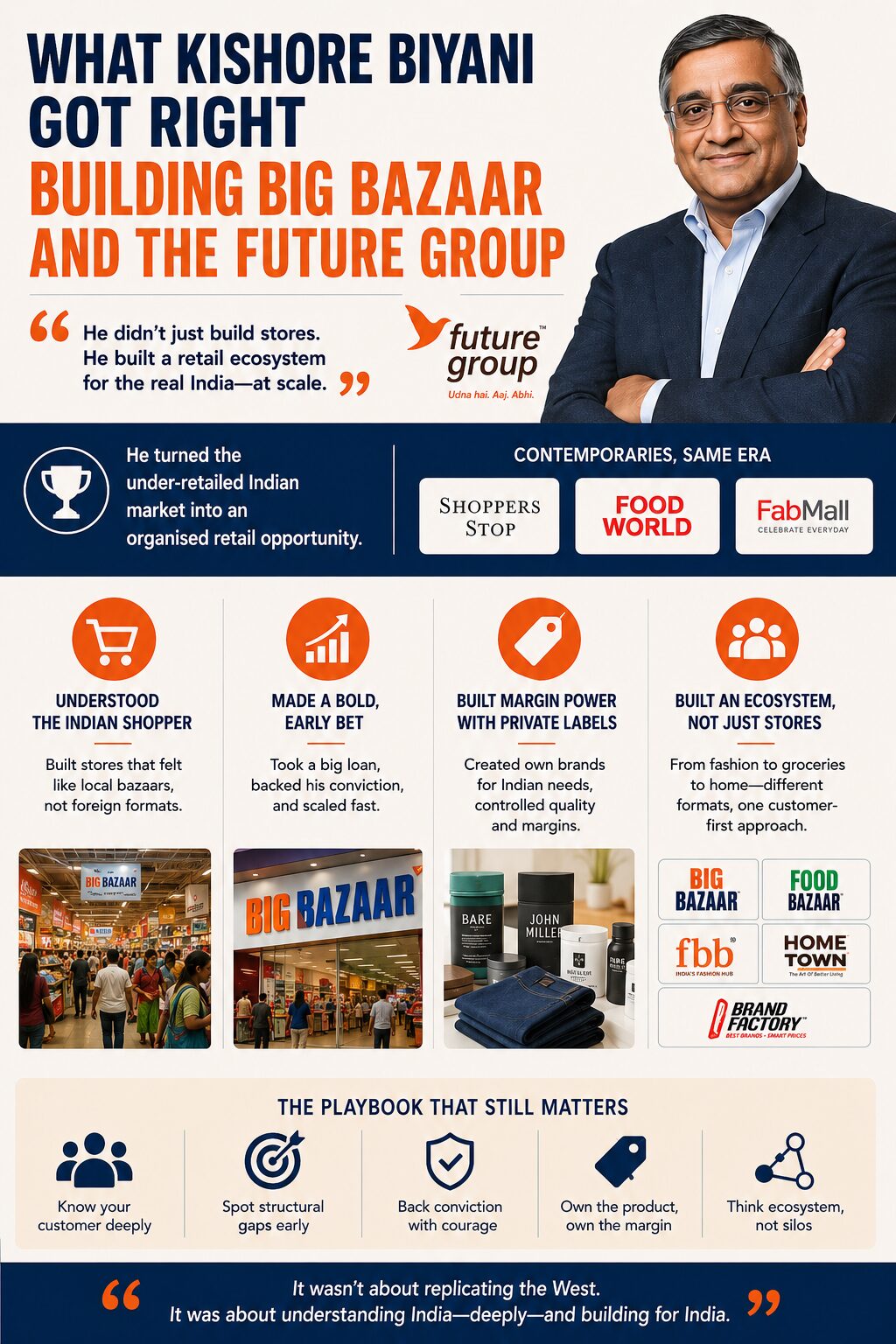
Kishore Biyani did not invent retail in India, and he did not need to. What he did was something harder: he took organised, large-format retail and made it work for the Indian mass-market consumer at a scale nobody else had attempted. That distinction matters, and it is the real reason his playbook is still worth studying.
He read the Indian shopper instead of importing a foreign one
The most consequential decision Biyani made was also the simplest to state. Rather than copying the Western retail format, he focused on making the store authentically Indian. His approach was intuitive and consumer-centric, blending the energy of traditional Indian bazaars with the scale of contemporary retail.
That translated into specific, deliberate choices:
- Big Bazaar was designed to feel like a regular grocery shop rather than an upscale store, with staff dressed in everyday clothes rather than formal retail uniforms, so the mass consumer would feel at home rather than out of place.
- He brought the spirit of everyday Indian street-market shopping into a modern, urban supermarket format, and the cost and variety on offer drew people in immediately.
- The format was designed to be democratic by intent: it welcomed every income segment under one roof, using market-like energy in store design rather than sanitised luxury cues.
He spotted the market gap and moved on it early
In the late 1980s and early 1990s, as India’s economy opened up and consumer aspirations rose, organised retail was almost non-existent; shopping still meant local markets, small shops, and unstructured experiences. Biyani saw an opportunity where others saw chaos.
He didn’t start in retail at all. His entrepreneurial journey began with selling stone-washed denim fabric in the 1980s, before he incorporated Manz Wear Private Limited in 1987 to manufacture and sell men’s apparel. That led to the first Pantaloons store in Kolkata in 1997 and only then to the format that would define him: Big Bazaar, launched in 2001 as one of India’s first large-format hypermarket chains offering a genuine one-stop shop for groceries, clothing, and household essentials.
The sequencing is the lesson here. He built operating experience in manufacturing and single-category retail before scaling into a multi-category format, earning the right to the big bet rather than starting with it.
He turned value into a brand language, not just a price tag
Anyone can discount. Few can make the discount feel like an event. Big Bazaar and the wider Future Group built their offering around discounts, festival sales, and loyalty programmes, anchored by a mechanic that became genuinely iconic: festival-based promotions and localised retail experiences, introduced long before they became standard practice in Indian retail. “Sabse Sasta Din” – Cheapest Day, became a recurring event that pulled in millions of customers each time it ran.
This is the strategist’s takeaway: a price promotion is a tactic, but a named, recurring, calendar-anchored promotion is a brand asset. Future Group built one of the most recognisable of these in Indian retail history.
He scaled fast, and the scale was real
By the numbers, this was not a regional experiment; it became a genuinely national infrastructure play. By 2009, even through the global downturn, there were over 100 Big Bazaar stores serving more than two million customers every week, while Pantaloon Retail employed over 30,000 people across 1,000 stores in 71 cities, with a turnover of 47 billion rupees that year. By 2015, the store count had crossed 1,000, and Big Bazaar had become a household name dominating the retail landscape.
He built an ecosystem, not just a chain
Future Group’s ambition went well beyond a single hypermarket format. It built out into Pantaloons for fashion, Central for premium mall-format retail, Foodhall for gourmet food, and Ezone for electronics, while also moving into financial services through Future Capital, agriculture through Future Agrovet, and even insurance and media. Owning the brands that sat on his own shelves, alongside the retail real estate itself, gave the group margin control that a pure retailer renting out shelf space to others never gets.
The recognition followed the substance
None of this happened quietly. Biyani won the Retail Leadership Award for pioneering the organisation of the Indian retail sector, the India Business Leader Award from CNBC-TV18, and Most Admired Retailer of the Year multiple times for retail innovation and a customer-centric approach. He also received the EY Entrepreneur of the Year Award in 2018 for Business Transformation. The book he co-authored on the journey, “It Happened in India”, sold over 300,000 copies and became one of India’s best-selling business books.
What to take from this
Strip away the company history, and what remains is a usable strategic checklist:
- Earn the big format through smaller bets first. Fabric trading to Pantaloons to Big Bazaar was a deliberate climb, not a leap.
- Design the store, the language, and the staff around the actual customer, not around what looks credible to industry peers.
- Turn your pricing strategy into a named, recurring brand property – a date on the calendar people start to expect, not a one-off sale.
- Build category breadth deliberately, so each new format reinforces the same customer relationship rather than fragmenting it.
- Move early into a gap that structural or market conditions have created because the advantage of being early compounds.
Biyani’s real contribution wasn’t that he reinvented Indian retail. It’s that he proved, at a genuine national scale, that an Indian retail format built on Indian instincts could outperform an imported one. That’s still the most useful idea in the playbook.