When Your Brand Tries to Be Everything to Everyone
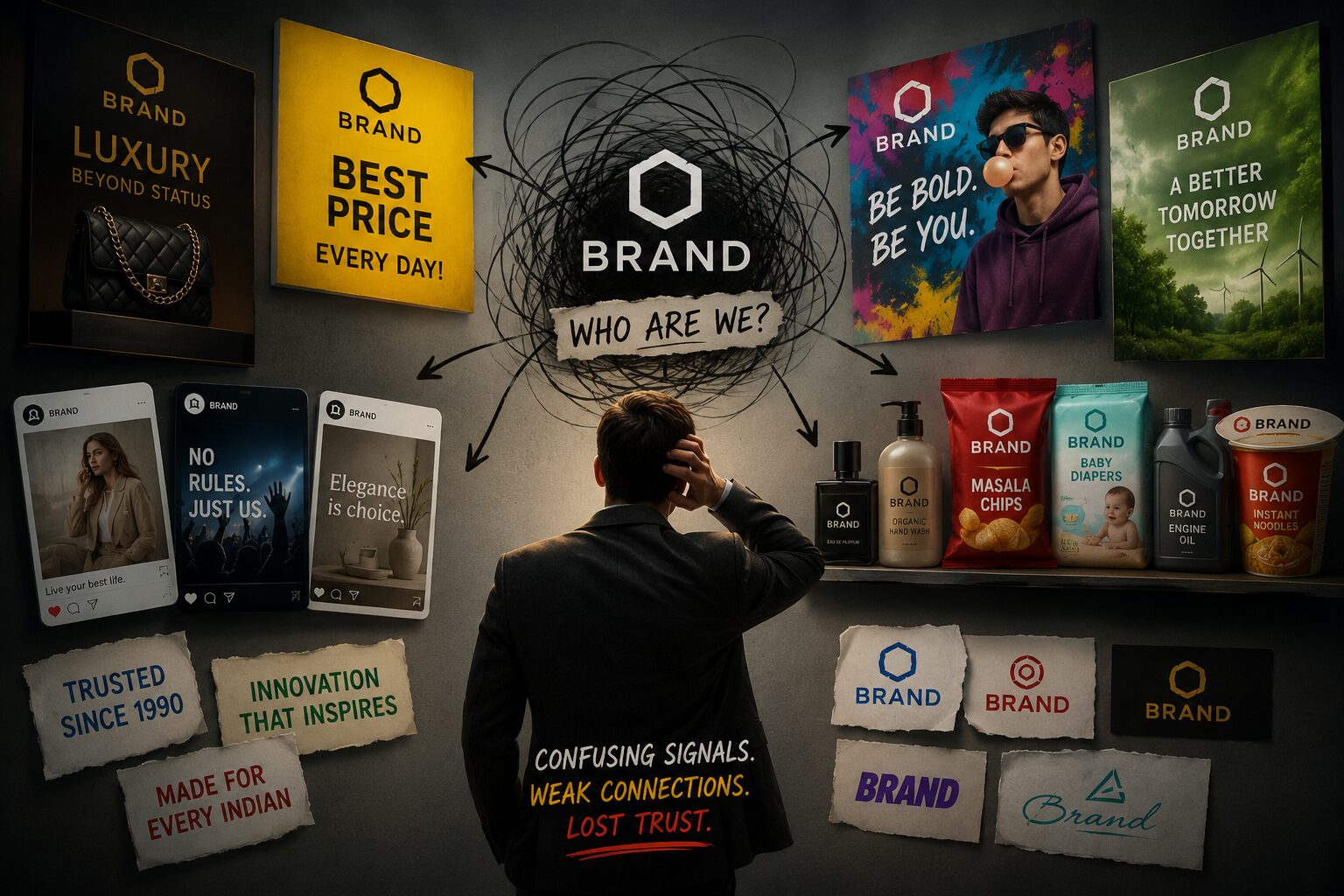
When brands try to be everything to everyone, they lose clarity, trust, and identity. Explore how brand schizophrenia destroys positioning, coherence, and long-term growth.
There is a condition that quietly destroys some of the world’s best-known brands. It does not announce itself. It creeps in slowly, disguised as ambition, growth strategy, and opportunity.
Call it brand schizophrenia. A brand that cannot make up its mind about who it is.
What Does It Actually Look Like?


Brand schizophrenia is not about having multiple products. It is not even about entering new categories.
It is about a brand that sends contradictory signals. Simultaneously. To the same customer.
Here is what it looks like in practice:
- A brand that is “premium” in one segment and “value” in another
- A visual identity that changes every time someone new joins the marketing team
- A tagline that means three different things depending on which channel you see it on
- A product lineup where the original brand promise has quietly been abandoned to chase volume
The consequences are real and measurable: reduced brand equity, customer churn, fragmented brand image, and a breakdown in trust. Customers experience confusion, avoidance, and a reduction in loyalty.
The customer does not know what to expect. And a customer who cannot predict what you stand for stops trusting you.
The Growth Trap


Most brands of schizophrenia do not start as a bad idea. It starts as a growth conversation.
The core business slows. Someone in the room asks, “What adjacencies can we enter?” And suddenly, a brand built on one sharp idea is asked to carry five different directions.
When a company’s path to growth runs its course in its home market, the instinct is to look outside existing boundaries for new sources of growth. The danger is what you might call adjacency addiction.
Every new direction pulls the brand slightly off-centre. The brand starts to mean less. The customer gets confused. And confusion, in branding, is lethal.
The real cost of these moves is often invisible: each new direction distracts the organisation from finding ways to grow the business it already has. Missing growth opportunities in your own backyard is one thing. But a second, even bigger danger is losing your coherence, loosening the fit between what your company does and what it is distinctively good at.
Indian Brands That Lost the Plot


India has produced some of the most vivid examples of brand schizophrenia. Partly because growth ambition here runs at a different speed. And partly because the temptation to be all things to all consumers, across Tier 1 to Tier 3 markets, is almost irresistible.
Videocon is the sharpest example. It started brilliantly, bringing colour television to Indian homes in the 1980s. By the 1990s it had become a household name for consumer electronics and home appliances. But the brand never stood for anything deeper than a price advantage.
The brand went through a slew of positioning changes, from “Bring home the leader” to “New improved life” to “Eco logic for sustainable life”, none of which had the ring of a winner. Constant changes in positioning did not help. Consumers tended to buy Videocon for its price discount rather than for any genuine brand attraction.
Then came the extensions. Videocon rapidly expanded into oil and gas, telecom, DTH entertainment, and retail. Its foray into mobile telephony caused a Rs 7,000 crore loss. A brand that consumers associated with affordable televisions was now trying to be an oil explorer and a telecom player. It could not explain itself anymore. From a rank of 26 in the Brand Finance Report of India’s top 100 brands in 2014, Videocon slid to no. 59 in 2017. The company eventually went into insolvency.
Bisleri is another instructive case. In India, Bisleri is not a brand; it is a category. Ask for water anywhere in the country, and you will hear the word ‘Bisleri’.
Bisleri had built its reputation entirely on trust and purity. Consumers associated the brand with clean, healthy drinking water. When it launched sugary sodas under the same brand name, it created immediate confusion. Why would a company known for its commitment to pure water be making sugary drinks?
The extension failed and was withdrawn. The brand’s entire equity was rooted in one idea: purity. Carbonated drinks sat on the wrong side of that idea.
Tata Nano is a slightly different flavour of the same problem. The brand positioning was self-contradictory from launch. The relentless focus on being the cheapest car in the world created an unintended image. Indian consumers, with their growing aspirations, began to associate the Nano with being a symbol of poverty rather than progress. This perception significantly dented the car’s appeal.
The product was affordable. But the brand message made buyers feel they were compromising, not choosing smartly. A brand that cannot decide whether it is aspirational or utilitarian will struggle to be either.
Global Brands With the Same Problem


This is not an Indian affliction. Some of the most iconic global brands have wrestled with the same confusion.
Gap is a textbook case. Through the 2000s and into the 2010s, Gap could not decide what it was: a basics brand? Fashion brand? Mass market? Accessible premium? It tried redesigns, resets, and repositioning, none of which stuck. The brand kept oscillating. Customers drifted to Old Navy on one end and Banana Republic on the other, both owned by the same parent company. Gap itself became the brand in the middle that stood for nothing in particular.
Harley-Davidson attempted extensions into perfume, wine, and home decor. A brand built on rebellion, freedom, and the open road was now selling cologne and cake plates. These extensions fell down on almost every failure factor imaginable. They confused loyal customers and attracted no new ones. The brand had to retract and refocus.
Crystal Pepsi tried to ride the health and purity wave. It broke the brand’s memory structure. Pepsi Cola is associated with a dark black colour, so a clear version created confusion. Most people still expected a cola taste, but it was actually citrus-flavoured. The product was killed within a year.
Colgate Ready Meals remains the extreme end of the spectrum. A toothpaste brand entering the food aisle. It falls down on almost every failure factor. It is so plain wrong that there are even questions about whether it ever actually got launched at all. The mere association between oral hygiene and a ready meal was enough to make the brand incoherent.
In stark contrast to disciplined brand extension, Hershey’s explored plans to extend its Reese’s and Kisses brands into cosmetics for teen girls, essentially trying to capitalise on brand recognition in a category where it had no relevance or credibility.
The Identity Gets Blurred in Three Places
Brand schizophrenia shows up most visibly here:
1. The product portfolio
Growth pressures force a brand into new products or services that blur its meaning. Brand extensions reposition the core brand in a negative light. The organisation proliferates sub-brands with no clear differentiation or consumer targeting.
2. The messaging
Different things get said to different audiences. The brand stands for something on Instagram and something completely different in a retail aisle or a B2B pitch deck. Over time there is no consistent thread and no single story a customer can hold onto.
3. The brand identity itself
The brand’s identity is presented inconsistently across different contexts, media, and situations. And every time a new brand manager arrives, changes are made whether changes are needed or not.
The “Averaging Down” Problem

There is a particularly insidious version that does not even require a failed extension. It happens in the core business.
When a company tries to be distinctive across formats or categories simultaneously, the risk is “averaging down”. You may end up competent at both, but you will not be the best at either. Entering a new space very likely dilutes the brand’s coherence.
Coherence is the word that matters here. A brand has coherence when everything it does fits together. Product, price, communication, retail experience, customer service. When one goes off-script, the customer notices. When all of them go off-script in different directions, the brand loses its identity entirely.
Why It Keeps Happening

Brand schizophrenia is persistent because the incentives that create it are real.
- Short-term revenue pressure encourages extensions and adjacencies
- New leadership brings new visions, often contradicting the previous one
- Agencies pitch campaigns that are creative but disconnected from one another
- Digital channels reward platform-specific behaviour, pulling the brand in multiple directions at once
When the CEO and leadership team do not understand brand management and do not support it, and when marketing budgets are slashed every time the economy slows, the brand is left vulnerable.
In the Indian context, there is an additional layer. The pressure to serve multiple income segments, multiple geographies, and multiple cultural contexts simultaneously makes schizophrenia almost structurally inevitable unless there is very deliberate brand architecture in place.
What Coherent Brands Do Differently

The brands that avoid schizophrenia are not necessarily more creative. They are more disciplined.
They do a few things consistently:
- They protect the core promise even when expanding the portfolio
- They define what the brand will not do, not just what it will do
- They evaluate every new product and communication against the same central idea
- They use sub-brand architecture to stretch without contaminating the master brand
Trust is category-specific, not universal. Brand extension fails spectacularly when brands forget this. One bad experience in a new category poisons the well for everything else. A brand that stretches into too many categories too fast loses clarity about what it actually stands for.
Key to any brand stretch is entering a market where the brand can bring relevant added value. It is not enough to have awareness. The brand needs to bring something to the party that competitors do not currently offer.
A Diagnostic You Can Use Right Now

If you run a brand, here is a quick test.
Ask five people in your own organisation to describe your brand in one sentence. If you get five different answers, you have a problem.
Then ask five customers. If their answers do not match yours, you have a bigger problem.
If your marketing materials look like they came from ten different companies, if your employees give different answers about the company’s mission, and if you can no longer describe your business’s value in a single clear sentence, you have a fundamental, painful disconnect between your brand’s promise and its performance.
The Uncomfortable Truth

Brand schizophrenia is almost always a leadership problem before it is a marketing problem.
When leaders treat the brand as a flexible container that can hold any idea, any product, any message, it stops being a brand. It becomes a label. Labels get switched. Brands, if built right, do not.
The brands that endure are not the ones that said yes to the most opportunities. They are the ones who had the discipline to say no to the wrong ones.
That is not caution. That is clarity. And clarity, in a noisy market, is the rarest competitive advantage.