Beyond Silos: Why Integrated Thinking Is the New Imperative for Business and Society
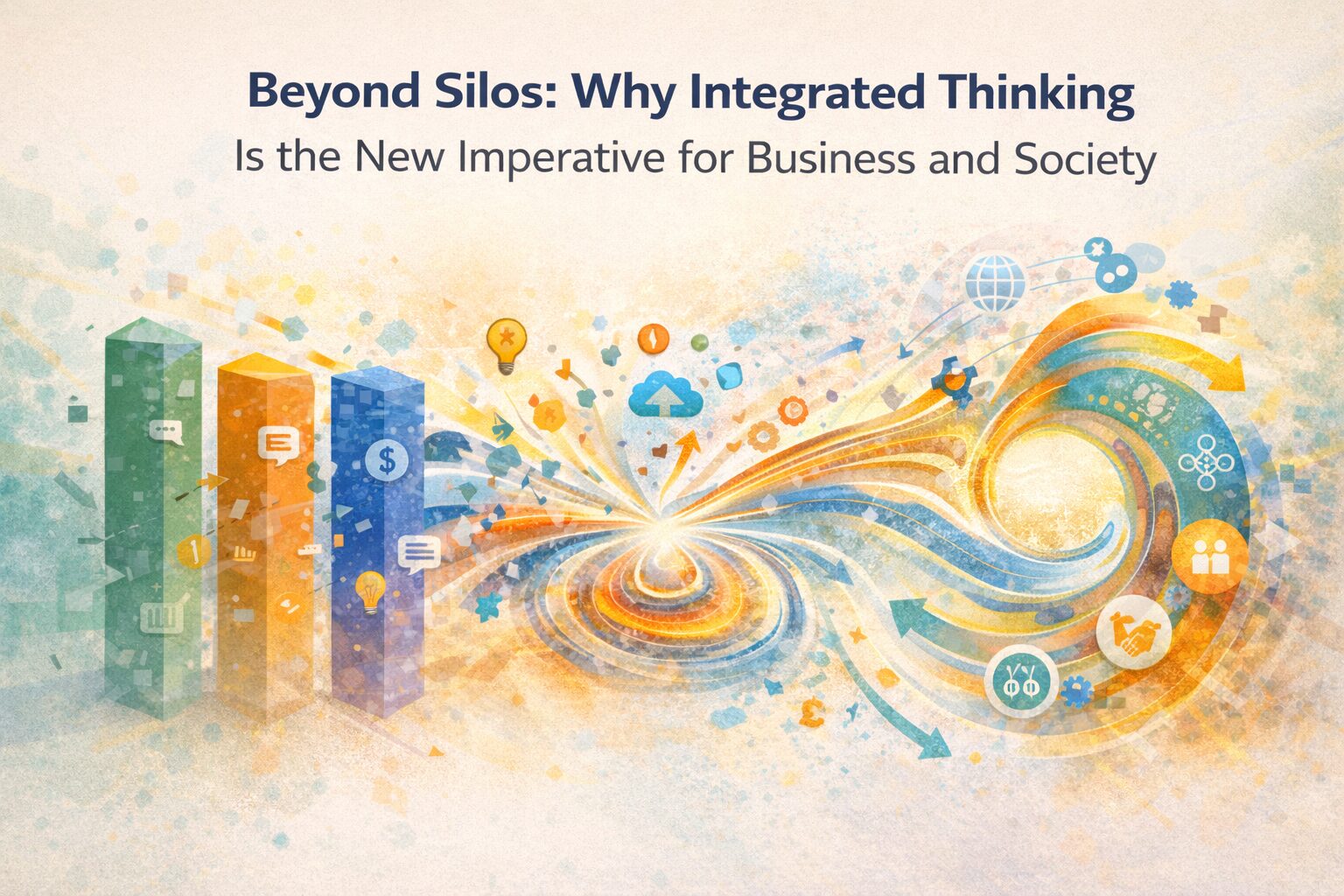
Capturing the shift from siloed thinking to integrated collaboration in business and society. Ideal for articles on strategy, innovation, and systems thinking.
In an age when complexity is the defining characteristic of markets, organisations and societal challenges, the traditional model of siloed thinking – where departments, disciplines and expertise operate in isolation – is proving increasingly ineffective. The need for integrated understanding is overshadowing the value of isolated insight: a way of thinking that connects people, information, systems and strategy across boundaries to produce cohesive outcomes. Integrated thinking transcends outdated hierarchical mental models and offers a holistic perspective better suited to the interconnected challenges of the 21st century.
Why Siloed Thinking Is No Longer Fit for Purpose
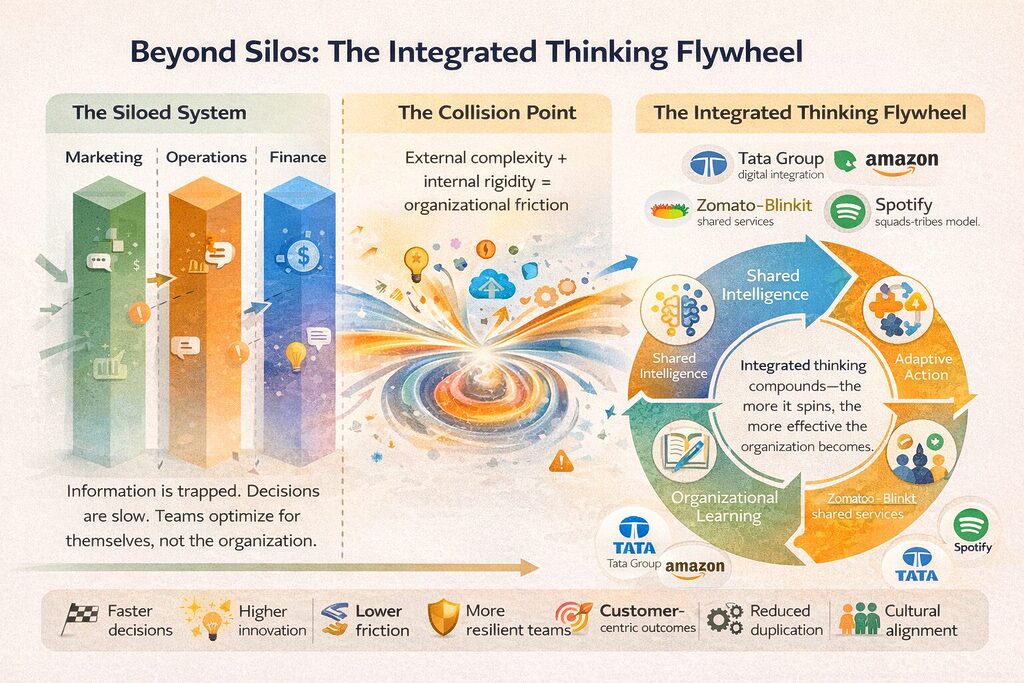
Historically, organisations have structured themselves into functions – finance, marketing, operations, HR, and R&D – each with its own goals, metrics, and priorities. While specialisation has delivered efficiency and technical expertise, it has also entrenched narrow thinking. Silos often lead to disconnected data, fragmented decision-making, and behavioural norms that prioritise local optimisation over organisational success. In this environment, information gets “stuck”, collaboration stalls, and strategic agility suffers.
This problem is not simply organisational but cognitive. Siloed thinking reflects cognitive inertia-the persistence of familiar thought patterns that resist change – which slows responses to emerging trends and inhibits creative solutions. When teams focus only on their individual parts, they lose sight of the whole.
A New Mental Model: Integrated Thinking
Integrated thinking is a deliberate shift away from functional compartmentalisation. It emphasises seeing relationships among internal and external variables that shape outcomes. In organisational practice, this means:
- Aligning strategy with operations and culture
- Sharing information across functions in real time
- Designing collaborative decision-making processes
- Embedding accountability that spans units
- Focusing on enterprise-wide value creation rather than local performance metrics
At its heart, integrated thinking turns fragmented insights into systemic understanding – a prerequisite for sound judgement in uncertain environments.
What Integrated Thinking Looks Like in Practice
1. Cross-Functional Collaboration
Integrated thinking encourages teams to work across boundaries rather than within silos. For example, a product launch will succeed not just because of engineering excellence but because marketing understands customer behaviour, finance assesses long-term value, and operations ensures deliverability. Companies like Unilever and Procter & Gamble have increasingly adopted cross-functional “brand teams” that bring diverse expertise together from inception to execution.
In India, firms such as Tata Consultancy Services (TCS) leverage integrated delivery models in which technology, business consulting, and client stakeholders co-create solutions, ensuring alignment from strategy to implementation.
2. Unified Data and Decision Making
Integrated systems and data platforms break down informational barriers. When sales data, customer support feedback, and supply chain performance are visible across the enterprise, leaders can make faster, more informed decisions. Organisations that have invested in integrated CRM, ERP, and analytics – for example, Infosys and global firms such as Siemens – report improved agility and fewer missed opportunities.
Without integration, disconnected data can lead to conflicting interpretations, duplicated efforts, and reactive rather than proactive leadership.
3. Holistic Strategy and Reporting
Integrated thinking also translates into integrated reporting – where financial, environmental, social and governance (ESG) factors are presented not in silos but as interconnected elements of value creation. This approach helps investors, employees and stakeholders see the complete picture of organisational health and long-term sustainability.
Such frameworks are gaining prominence globally; companies reporting under the International Sustainability Standards Board (ISSB) increasingly use integrated thinking to explain how strategy, risk management, and performance link across capitals – financial, human, social, and natural.
4. Innovation at the Intersections
Innovation often emerges where disciplines intersect. Problems like climate change, AI governance, public health, and urban mobility cannot be solved by any single function. They require synthesis: combining science with policy perspective, ethics with technology considerations, and economics with human behaviour.
India’s National Education Policy 2020 explicitly champions breaking disciplinary silos in education to prepare learners with multidisciplinary strengths. This echoes ancient Indian traditions of holistic scholarship and aligns with global moves toward integrative education models.
Integrated Thinking in an AI-Driven World
The rise of artificial intelligence accelerates the need for integrated thinking. AI systems themselves are catalysts for breaking down rigid intellectual barriers by synthesising knowledge across fields. For instance, advanced AI tools enable professionals in design, finance, engineering and healthcare to access broad repositories of knowledge that were previously siloed in domain-specific communities.
Yet AI also highlights what is lost when thinking remains compartmentalised: an AI strategy confined to a technology team without business, ethical and regulatory input can misfire or fail to create strategic value. Organisations that leverage AI for lateral problem-solving and multidisciplinary collaboration gain a competitive advantage.
Challenges to Transitioning from Silos
Moving away from siloed thinking is not simple. It requires cultural change, leadership commitment, structural adjustments, and new performance incentives. Leaders must model integrated behaviour, reward cross-unit collaboration, and build trust across hierarchies. Too often, organisations maintain legacy reporting lines and siloed incentives, which undermine efforts to integrate.
The Payoff: Resilience and Long-Term Value
Organisations that successfully embrace integrated thinking become more resilient, adaptive, and purpose-driven. They are better positioned to respond to disruption, navigate complex stakeholder landscapes, and sustain innovation. More importantly, integrated thinking fosters environments where people see their roles in relation to the organisation’s mission and are motivated to contribute to shared outcomes.
Conclusion
Siloed thinking is no longer an asset; it is a liability in a world defined by complexity and hyperconnectivity. The capacity to understand how parts fit into a whole – whether in business models, strategic planning, or civic policy – is what will separate resilient organisations from those that buckle under volatility. Integrated thinking is not just a management trend; it is a fundamental shift in how we understand problems, make decisions, and create sustainable value in an interconnected world.
Reference
- The Death of Siloed Thinking in Business
Explores why traditional siloed structures fail in complex environments and why businesses need integrated systems.
https://cxotoday.com/expert-opinion/the-death-of-silo-why-integrated-business-systems-will-define-business-agility/ - Integrated Thinking and Reporting – Better Value Creation
Discusses how integrated thinking links financial, non-financial, and strategic information for holistic decision-making.
https://www.icaew.com/technical/corporate-reporting/corporate-reporting-resources/by-all-accounts/articles/2025/integrated-thinking-and-reporting-the-path-to-long-term-value-creation - Cognitive Inertia – Persistence of Familiar Thought Patterns
Defines cognitive inertia and how it limits adaptive thinking – relevant to understanding organisational silos.
https://en.wikipedia.org/wiki/Cognitive_inertia - Multidisciplinary Education as a Strategic Priority
Explains emerging educational approaches to break down siloed learning and foster integrated thinking.
https://sundayguardianlive.com/feature/in-the-age-of-ai-siloed-thinking-is-a-national-liability-161863/ - AI and Cross-Functional Decision Making
Discusses how artificial intelligence is enabling cross-domain knowledge access and reducing dependency on narrow silos.
https://harvardbusinessreview.org/2024/01/ai-and-the-future-of-consumer-decision-making - McKinsey’s Perspective on Integrated Strategy and Agility
Examines how systematic, integrated planning and data utilisation enhance organisational agility.
https://www.mckinsey.com/capabilities/growth-marketing-and-sales/our-insights/the-consumer-decision-journey - Collaborative Platforms and Enterprise Integration
Analyses how digitisation and shared platforms break down silos in modern organisations.
https://www.forrester.com/report/How-To-Build-A-Connected-Customer-Experience-Strategy/-/E-RES176929 - Organisational Silos and Culture Change
Provides insights into cultural barriers that sustain silos and how leadership must respond.
https://www2.deloitte.com/us/en/insights/topics/talent/culture-organizational-change.html