The Challenger Brands Are Eating the Legacy Brands’ Lunch
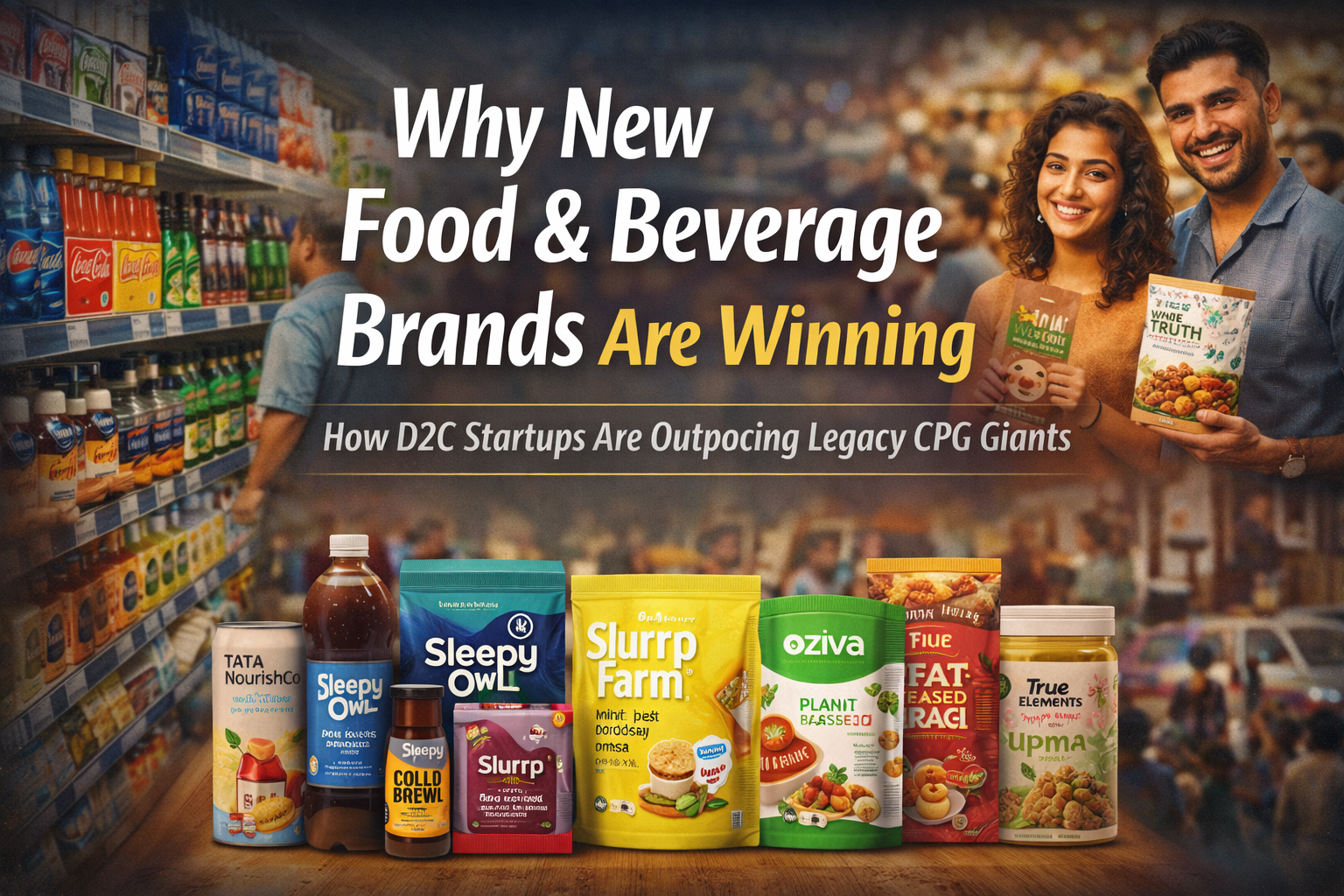
Why emerging food and beverage brands are outpacing legacy CPG players. A sharp look at India’s D2C boom, functional foods, and the power of specificity.

Something is shifting in the food and beverage aisle. Not gradually. Structurally.
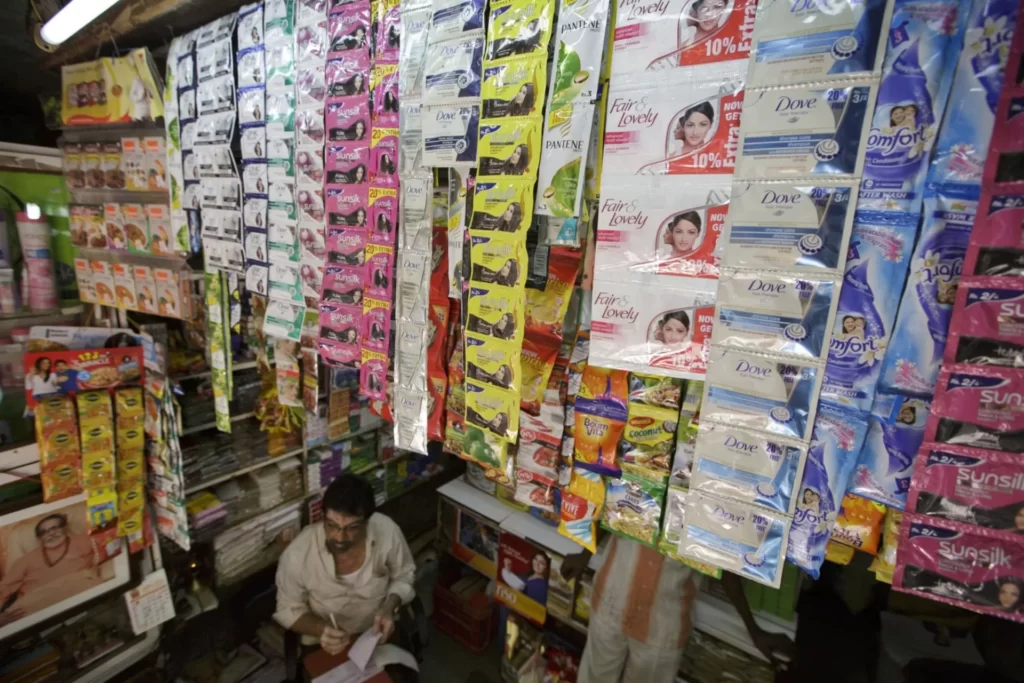
The world’s largest CPG companies spent much of 2025 shrinking. Portfolio rationalisation. Job cuts. Price rollbacks. Margin pressure. The headlines were relentless: giants announcing break-ups, sell-offs, restructuring exercises dressed up as strategy.
Meanwhile, another set of brands was quietly winning.
Smaller. Faster. More focused. Built around a specific consumer insight rather than a broad category play. These are the emerging brands that are rewriting how food and beverage work, not just globally, but right here in India.
What’s driving the disruption globally


Three forces are doing most of the work:
- Health and function. Consumers are no longer buying food. They’re buying outcomes. Gut health, immunity, protein, energy, and cognitive function. The number of health-related eating behaviours the average consumer tracks has crossed seven per person. That is a significant shift. It means a product that does only one thing – hydrates, fills, tastes good – is no longer enough.
- Viral product discovery. A single viral video can now generate enough demand to disrupt an entire category in weeks. The Dubai Chocolate Bar went from regional novelty to global obsession so quickly that it contributed to a worldwide pistachio shortage. The speed at which a product moves from obscure to ubiquitous has collapsed. Brands that can move fast enough to capitalise on that window are winning. Brands built for slow-moving retail cycles are not.
- Acquisition as a signal. Large CPG companies are watching where consumers are going and buying their way there. PepsiCo’s acquisition of the prebiotic soda brand Poppi and Hershey’s deal for the LesserEvil popcorn brand helped the food giants diversify and better reach younger consumers by tapping into emerging trends. When the biggest players are spending billions to acquire what they cannot build, it tells you something important about where the future is being built.
The India parallel: same forces, different terrain


Every one of these global dynamics has an Indian version. The difference is scale and speed.
India’s D2C food and beverage market was valued at approximately $12 billion in 2024, part of a sector growing at 25% CAGR. Food tech startups have raised over ₹1.74 trillion in investment in recent quarters. That number alone signals where conviction is sitting.
But the more interesting story is not the capital. It’s what these brands are doing.
- Transparency as product strategy. Currently, 71% of D2C food purchasers regularly check ingredient lists before buying, and 59% are willing to pay premium prices for products free of artificial additives. The Whole Truth built an entire brand around this. No ambiguous claims. No hidden ingredients. The “What’s Inside?” positioning was not a campaign. It was the product strategy.
- Functional specificity. Teafit does zero-calorie functional teas without stevia or artificial sweeteners. Sleepy Owl makes clean, cold brew that has found its way into airports, supermarkets, and quick-commerce platforms. These brands did not try to be everything. They owned one lane and went deep.
- Ancient ingredients, modern formats. Indian functional beverage brands are adopting Ayurvedic and herbal infusions as consumers look for natural wellness solutions – turmeric, tulsi, ashwagandha, and giloy are gaining acceptance for their adaptogenic, anti-inflammatory, and immunity-strengthening properties. This is not wellness tourism. This is a genuine convergence of consumer behaviour and product development. Blue Tea, Wellbeing Nutrition, OZiva – all are playing in this territory.
- Regional authenticity at scale. Go DeSi is formalising India’s street sweets – tamarind pops, coconut laddoos – without losing what makes them compelling. Sweet Karam Coffee is doing the same with South Indian snacks and traditional family recipes. These brands are not inventing new categories. They’re bringing rigour, packaging, and distribution to categories that already had cultural equity. The insight is that ‘regional’ is not a constraint. It is the product.
The Slurrp Farm model: solve a real problem, then scale


Slurrp Farm was founded to provide healthy, millet-based foods for children – specifically because its founders could not find nutritious, millet-based options for their own kids. Their products, from millet pancakes to wholesome cereals, are packed with natural ingredients and free from preservatives.
That is the emerging brand playbook in one story. Identify an underserved consumer. Build something specific. Trust that the specificity is the asset, not the liability.
The brand has since raised over $18 million across multiple rounds. It did not get there by trying to compete with legacy cereal brands on their terms. It got there by being the only credible answer to a question those brands were not even asking.
The distribution question: where the real battle is

The product is table stakes. Distribution is the game.
Social commerce has become a cornerstone strategy for emerging D2C food brands, with many generating over 35% of their sales through social media platforms. Quick commerce like Blinkit, Zepto, Swiggy, and Instamart has changed discovery entirely. A brand that is available on quick commerce is, in effect, available everywhere its target consumer is. That is a structural advantage that did not exist five years ago.
The legacy challenge for smaller brands has always been retail shelf space. You needed distribution to get a trial and a trial to get distribution. Quick commerce breaks that loop.
It also compresses the feedback cycle. A brand can launch, test, reformulate, and relaunch in months rather than years. That agility is something no large CPG company can replicate structurally.
What the large incumbents are doing about it


Watching. Acquiring. And, in some cases, trying to build their own versions.
Reliance Industries introduced ‘Raskik’ to broaden its beverage portfolio following the successful relaunch of Campa Cola, thereby further expanding its presence in the Indian beverage market through its large retail network. Tata Consumer’s NourishCo has entered the cold-brew market. The message from conglomerates is clear: they see the functional beverage opportunity, and they are not going to cede it to challengers.
But there is a gap between seeing an opportunity and owning it. Legacy companies carry legacy costs, legacy structures, and legacy decision-making processes. A large FMCG cannot match the speed of a founder-led D2C brand.
The smart move for incumbents is not to outrun challengers. It is to acquire the ones that win. That is the global playbook – and increasingly, the Indian one.
The honest risk for emerging brands


Growth without unit economics is a trap.
Many Indian D2C food brands have learned this lesson the hard way. Acquisition costs on digital channels have risen sharply. The brands that survive the next phase will be those that build genuine repeat-purchase behaviour, not brands fuelled by first-order discounts and influencer spend.
The functional category helps here. If a product works – if the gut health syrup does something, if the millet snack genuinely satisfies – consumers come back. Product efficacy is the most durable form of marketing.
The brands that get this right are not just building a product business. They are building something with real staying power.
The summary
Emerging food and beverage brands are not winning because they are newer. They are winning because they are more specific. They have a clearer consumer in mind, a clearer problem to solve, and a clearer reason to exist.
In India, that plays especially well. The market is enormous, fragmented, and culturally layered. There is no single Indian consumer. There is a Bengaluru consumer, a Bhopal consumer, a consumer who grew up eating tamarind candy and one who has never tried a cold brew.
The brands that understand these nuances and treat specificity as a strategy rather than a limitation are the ones that are building something worth watching.
The ones that try to be everything for everyone will join a very long list of brands that tried and disappeared.
References
- Food Dive – Food and Beverage Trends Outlook 2026 – https://www.fooddive.com/news/food-beverage-trends-outlook-2026/811009/
- Food Dive – Food and Beverage Trends to Watch in 2026 – https://www.fooddive.com/news/food-beverage-trends-2026/809061/
- Food Dive – The Biggest Food and Beverage M&A Deals in 2025 – https://www.fooddive.com/news/food-beverage-ma-deals-2025/808539/
- Food Dive – How Social Media is Rewriting the Rules of Food and Beverage Innovation – https://www.fooddive.com/spons/the-new-flavor-pipeline-how-social-media-is-rewriting-the-rules-of-food-an/816428/
- Food Dive – 6 Food and Beverage Trends to Watch in 2025 – https://www.fooddive.com/news/6-food-trends-to-look-for-in-2025/736899/
- Rare Ideas – Why India Loves D2C Food Brands: 2025 Buying Trends – https://rareideas.in/blog/why-indian-consumers-choose-d2c-food-brands-2025
- Indian Retailer – Top 5 Emerging Food and Beverage Brands with Highest Growth Potential – https://www.indianretailer.com/article/retail-business/retail-trends/top-5-emerging-food-and-beverage-brands-highest-growth
- IMARC Group – India Functional Beverages Market Size and Report 2034 – https://www.imarcgroup.com/india-functional-beverages-market
- Inc42 – 49 F&B D2C Brands Reshaping the Indian Consumer Market – https://inc42.com/features/fb-d2c-brands-in-india/
- Inc42 – FAST42 2026: India’s Fastest-Growing D2C Brands – https://inc42.com/startups/fast42-2026-announcing-the-ranking-of-indias-fastest-growing-d2c-brands/
- Filuet – 40 Best D2C Brands in India You Should Know About [2025] – https://www.filuet.com/blog/40-best-d2c-brands-in-india-to-watch-in-2025
- Data Bridge Market Research – India Health and Wellness Food Market – https://www.databridgemarketresearch.com/reports/india-health-and-wellness-food-market