The World’s Largest Pet Retailers: What the Revenue Rankings Actually Reveal
what the world’s largest pet retailers reveal about the future of pet care. From subscriptions and services to loyalty and wellness, learn the strategies driving growth and what they mean for India’s evolving pet market.
Most people see a revenue ranking as a leaderboard. Read it as a strategist, and you find a map of the models that work, the patterns that repeat, and the battlegrounds that will define the next decade of the pet industry.
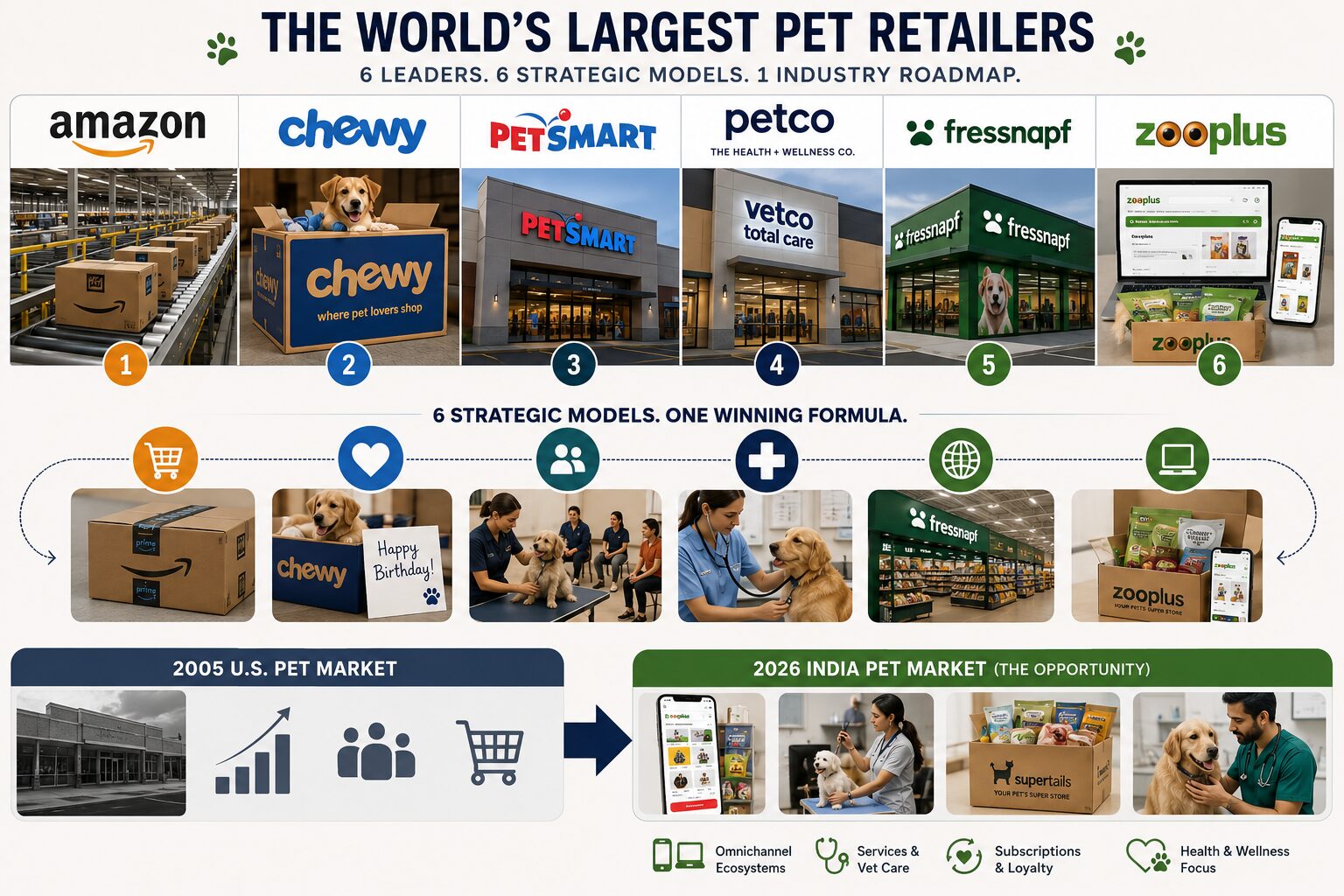
The six largest pet retailers in the world, by estimated annual revenue, are not just large businesses. They are proof of concept. Each one validates a different strategic thesis. Together, they tell a unified story about where the category is headed.
The Six: What They Built and Why It Matters
1. Amazon (Global) | USD 10B to 15B+ in pet


Amazon does not report pet revenue separately, which is why it is absent from most industry rankings. That absence is misleading. Pet product estimates place it at or near the top of any honest list, making it the category’s most consequential and least discussed competitor.
Amazon does not need to be a pet specialist to dominate pet purchasing. Its Prime membership, logistics infrastructure, and default search behaviour mean that millions of pet owners buy food, accessories, and supplements on Amazon without ever visiting a dedicated pet retailer. The competition is often not Chewy or PetSmart. It is inertia combined with convenience.
- Subscribe and Save is the structural equivalent of a subscription programme, and it predates most competitors
- Private label extension into pet food and accessories compresses margins for undifferentiated brands
- Advertising gatekeeping: the platform collects on the product sale and on the visibility required to achieve it
- No category obsession, no emotional connection: optimised for the transaction, not the relationship
Lesson: Convenience at scale is Amazon’s moat. It is also its ceiling. The customer belongs to Amazon, not to the brand. Any pet business that builds its entire digital presence on the marketplace is building on rented ground.
2. Chewy (USA) | USD 11B to 12B+


Chewy is the most instructive case study in the global pet industry, not because of its size but because of what it proved. Building a pet-only e-commerce business to compete against Amazon should not have worked. It worked because Chewy understood something Amazon structurally cannot do at scale: emotional connection at the category level.
The 24-hour customer service staffed by people who actually discuss pets, the handwritten birthday cards, and the condolence flowers for bereaved pet owners: none of this is scalable Amazon behaviour. It requires category obsession. Chewy’s Autoship subscription programme locks in recurring revenue, reduces churn, and creates predictable purchase cycles. Over 21 million active customers are evidence that retention, not acquisition, is the real growth lever.
- Subscriptions convert transactions into recurring revenue streams
- Emotional service builds loyalty that no performance marketing budget can replicate
- Customer lifetime value as the primary performance metric, not cost per acquisition
Lesson: In a world where Amazon owns convenience, the defensible position is depth of relationship. Chewy did not out-Amazon Amazon. It made Amazon irrelevant to its customers.
3. PetSmart (USA) | USD 9B to 10B+


PetSmart is not a pet store. It is a full-service pet ecosystem. Revenue spans retail product sales, grooming, training, boarding, veterinary partnerships, and in-store adoption programmes. Every additional service layer deepens the relationship, increases visit frequency, and creates a reason for the customer to return even when they are not buying a product.
- Owns multiple touchpoints across the entire pet ownership journey
- Services generate recurring footfall independent of product purchase cycles
- Adoption partnerships convert first-time visitors into long-term customers
- One of the largest physical retail footprints in North American pet
Lesson: When you own multiple stages of the customer journey, competitive advantage becomes structural rather than situational. It also makes you considerably harder to displace.
4. Petco (USA) | USD 6B+


Petco has executed one of the more deliberate brand pivots in recent retail history, repositioning from a general pet retailer to a pet health and wellness company. The shift is evident in its store formats, service mix (veterinary clinics, grooming, training), and marketing language. Products remain a revenue stream, but services now anchor the relationship.
- Wellness and preventive care repositioned as recurring revenue categories, not add-ons
- Veterinary integration brings a clinical layer to retail, increasing trust and visit depth
- Brand language repositioned around outcomes and health, not products and range
Lesson: Services create deeper, more durable customer relationships than products. They also reduce price sensitivity and reframe the customer relationship from transactional to an ongoing one.
5. Fressnapf/ Maxizoo (Germany) | EUR 4.3B+


Fressnapf began as a single pet store in Krefeld, Germany, in 1990. It now operates over 1,900 stores across more than 25 European countries, making it the largest specialist pet retail chain in Europe. The model proved that a focused, category-specialist retailer can scale geographically without diluting its identity. Its own-label product range builds margin and loyalty simultaneously.
- Category specialist approach maintained at continental scale
- Consistent positioning across culturally diverse European markets
- Private label strategy creates both margin advantage and brand stickiness
Lesson: Geographic expansion, when built on a clear category identity and operational discipline, is one of the most reliable growth levers in the pet industry.
6. zooplus (Germany) | EUR 4B+


zooplus is the largest dedicated online pet retailer in Europe, serving customers across more than 30 countries. It competes not through physical presence but through range depth, pricing transparency, and subscription mechanics. Acquired by EQT in 2022, it continues to demonstrate that an e-commerce specialist with genuine category focus can hold significant ground against both marketplace giants and omnichannel chains.
- Pure-play digital model competing at scale against brick-and-mortar chains
- Auto-reorder and subscription mechanics generate predictable, recurring revenue
- Pan-European reach built from a centralised logistics operation
Lesson: Category-focused e-commerce, executed with rigour, can scale without a single physical store. The key word is category focus: depth beats breadth in specialist retail.
The Full Picture: Revenue and Model at a Glance
| Rank | Retailer | Est. Revenue | Primary Model |
| 1 | Amazon | USD 10B to 15B+ | Marketplace and private label |
| 2 | Chewy | USD 11B to 12B+ | DTC digital and subscription |
| 3 | PetSmart | USD 9B to 10B+ | Omnichannel ecosystem |
| 4 | Petco | USD 6B+ | Health and wellness services |
| 5 | Fressnapf | EUR 4.3B+ | European specialist physical |
| 6 | zooplus | EUR 4B+ | European specialist digital |
Note: Amazon’s pet revenue is an estimate based on category analysis. Official figures are not disclosed.
The Pattern Across All Six
None of these businesses became multi-billion-dollar operations by selling pet food. The product was the entry point. What they built behind it is what produced the scale.
| Strategic Layer | What It Does |
| Subscriptions and autoship | Converts one-time buyers into recurring revenue |
| Services (grooming, vet, boarding, training) | Increases visit frequency and builds trust |
| Omnichannel integration | Removes friction and meets the customer in context |
| Own-label products | Builds margin and reduces price competition |
| Loyalty programmes | Converts repeat buyers into high-value long-term relationships |
| Data and personalisation | Makes every interaction more relevant over time |
| Emotional connection | Creates switching costs that price cannot overcome |
The through-line across all six: these businesses compete on customer lifetime value, not on unit economics at the point of sale.
What This Means for the Indian Pet Market
India’s pet industry is estimated at INR 7,000 to 8,000 crore and growing at 15 to 20 per cent annually, with urban pet ownership accelerating sharply post-2020. The category is still largely fragmented: local pet shops, general trade, underdeveloped digital infrastructure, and no dominant national player at scale. That is precisely the window the global playbook was built for.
Some signals are already visible in the Indian market:
- Heads Up For Tails (HUFT) has moved closer to the PetSmart and Petco models, expanding beyond products to include grooming, boarding, and veterinary services. Its omnichannel approach and premium brand positioning make it the most ecosystem-oriented player currently operating in India.


- Supertails has adopted a digital-first, category-specialist approach with embedded vet consultations, directly mirroring the wellness pivot that redefined Petco’s business model.
- Wiggles and Dogspot are building in their own ways, but neither has yet established the service depth or retention architecture of the global leaders.
- Quick commerce platforms (Blinkit, Zepto, Instamart) are capturing impulse and replenishment purchases in Tier 1 cities, but they offer no depth of relationship and no service layer. They accelerate transactions; they do not build customers.
- Amazon India and Flipkart already dominate pet product volumes for mid-market and commodity categories. The same dynamic applies as globally: reach without relationship. Brands that build primarily through these channels are building on rented ground.
- General trade still commands the majority of volume in Tier 2 and Tier 3 cities, creating significant white space for a specialist brand with the right trust model and distribution architecture.
The Indian market is roughly where the US market was in the early 2000s. The infrastructure is forming. Consumer habits are being established. The brands that build loyalty, service depth, and recurring revenue models now will hold structural advantages for the next decade. The ones that optimise for short-term marketplace GMV will find themselves squeezed between Amazon’s pricing power and whoever builds the relationship layer first.
The Strategic Takeaway for Pet Brand Builders
Six things the global top six confirm:
- Subscriptions are not a feature. They are a revenue architecture. Build for recurring, not transactional. Chewy and zooplus both prove it works at scale.
- Services are a moat. A customer who grooms with you, boards with you, and visits your vet is far less likely to switch for a price difference. PetSmart and Petco have built businesses around this principle.
- Amazon is a channel, not a strategy. Use it for reach. Do not mistake reaching for a customer relationship. The customer belongs to the platform.
- Own-label creates both margin and loyalty. Every major player has a private label strategy. It is not a cost play. It is a brand-and-margin play simultaneously.
- Omnichannel integration is a competitive advantage, not an operational complexity. The brands that meet customers across physical, digital, and service touchpoints are harder to displace than those that operate in a single channel.
- The next battleground is customer lifetime value, not product range. The largest pet retailers in the world are no longer competing primarily on what they sell. They are competing on how long they keep a customer and how deeply that customer is embedded in their ecosystem.
The brands that win the next decade of the pet industry will not be the ones with the widest product range or the lowest price point.
They will be the ones with the longest, deepest customer relationships.